
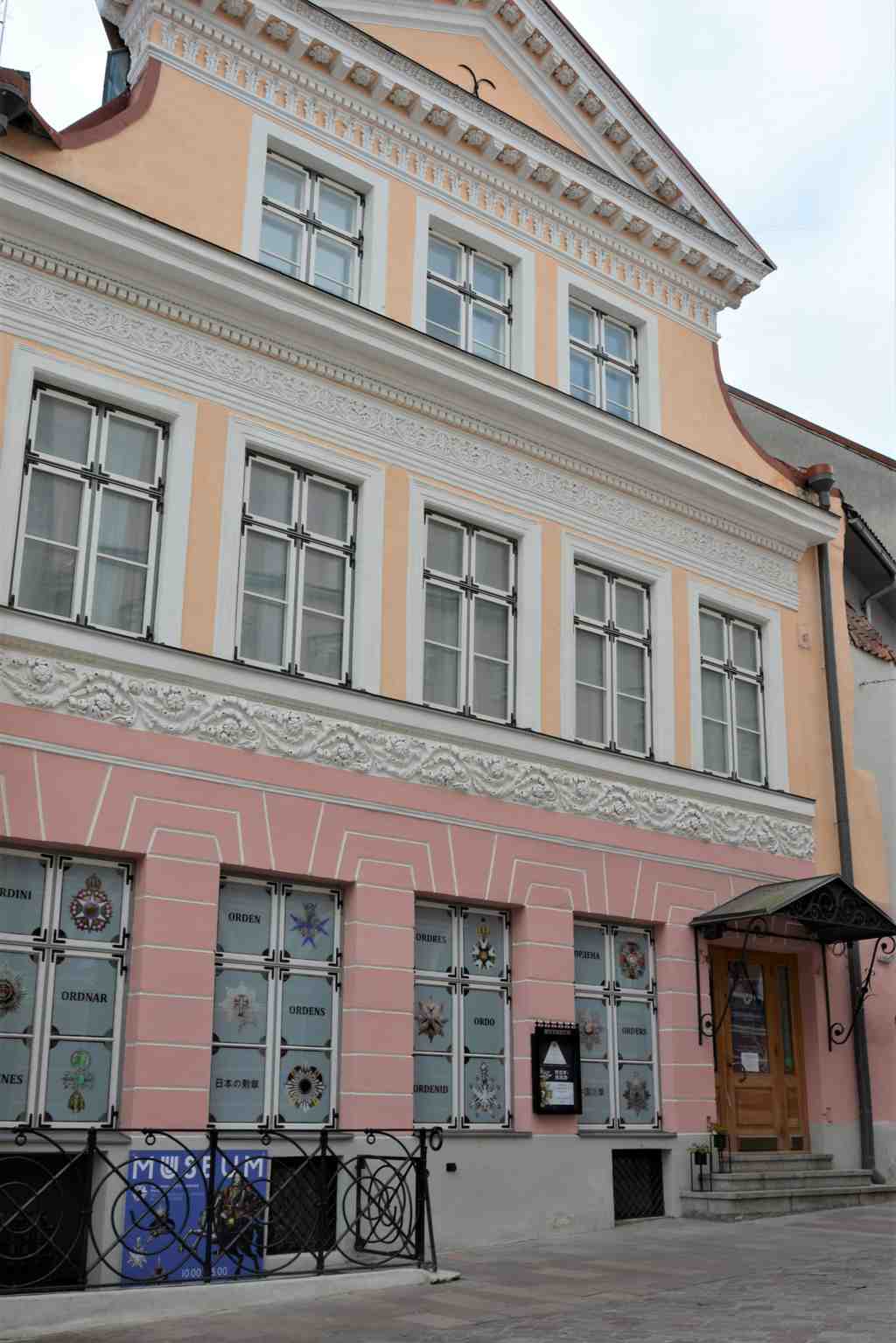
Look for the pale plaster-and-stone medieval house with its narrow upright façade, steep gable, and dark doorway set into a building that seems to have kept its posture for centuries.
This is the Tallinn Museum of Orders of Knighthood, a private museum opened in January of twenty seventeen, and it sits here on Kuninga Street for a reason deeper than convenience. The museum likes to remind you that this house rose in the very era when men of a military order governed the Old Town. So the setting is not a neutral box for display. These walls belong to the argument. You stand outside a medieval house and inside it wait the glittering signs of rank, favour, loyalty, ambition, and, sometimes, invention.
The collection holds around one thousand original mantles, chains, stars, badges, and cases linked to knightly orders and decorations from Europe, the Americas, Africa, and the Far East. Some pieces go back to the early eighteenth century. In twenty twenty-one, the main display was completely reworked, so visitors could see more clearly how single-grade orders differ from multi-grade merit orders, and how awards for battlefield courage, civil service, science, art, women, and the Red Cross evolved over time. That sounds tidy. The objects themselves are not. They carry bruised histories.
The museum’s favourite little detective story centres on the Order of the White Eagle. For years, people believed one badge here had belonged to King Stanisław August and had passed to Catherine the Second. Then the researcher Lyudmila Gavrilova looked more closely. She compared a photograph in the museum booklet with archive descriptions and felt the story did not quite fit. That instinct sent the object into a proper historical investigation. If you glance at your screen, you can see the piece itself: enamel, gold, silver, and diamonds, all trying to look certain of themselves. Archive work in Russia changed the case. On the reverse, specialists found the monogram of Augustus the Strong, and a document describing where the insignia was kept after the deaths of Peter the Great and his wife matched the Tallinn object almost word for word. Kremlin experts then spotted two diamond inserts added later, tiny clues that helped stitch its earlier life back together. After the revolution, the badge and an early star of the same order were sold off, and the star even kept traces of precious-metal testing, as if someone had tried to rub away its origin. That is what honour becomes once regimes collapse: not nothing, but evidence.
Other treasures here sparkle with equally oversized memory. Nicholas the Second gave a diamond-set Order of Saint Alexander Nevsky, with eight hundred and forty diamonds, to the future French president Paul Deschanel in Paris in eighteen ninety-six. Charlotte, Empress of Mexico, owned a diamond badge of the Austrian Order of the Starry Cross. Paul the First treasured a Maltese cross given to him in Saint Petersburg and wore it so constantly that it appears on portrait after portrait. On your phone, the Saint Alexander Nevsky star shows how close prestige comes to jewellery. Most tourists notice the shine. Locals notice the setting: a medieval house holding decorations that outlived kings, emperors, and their official stories. In Tallinn, symbols rarely die when power does; they simply change custodians. Here, collectors and researchers become the next guardians.
From here, we leave decorated honour and walk toward an older, sterner world of vows and discipline at the Dominican Monastery, about three minutes away. If you plan to come inside later, the museum is usually open from ten in the morning to five in the afternoon, and closed on Sundays.




