
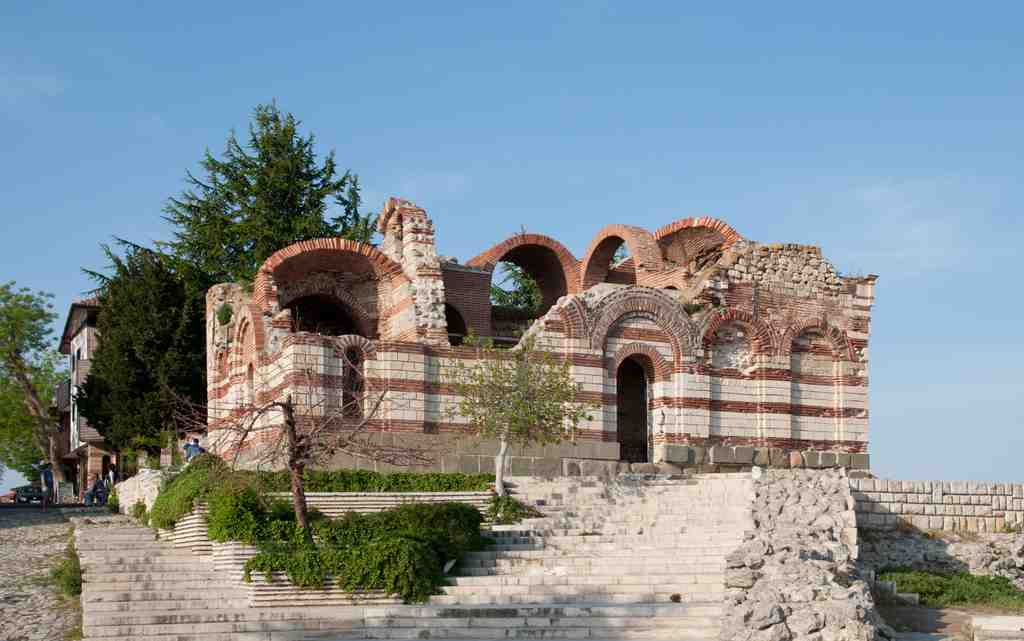
On your left stands a red-brick-and-stone church ruin, cross-shaped in outline, with striped walls cut into shallow arched recesses and dotted with pale stone cubes.
On this narrow peninsula, churches gather so closely that nearly every wall seems to remember an older act of devotion. And yet this one, raised in the fourteenth century, is famous for a painful paradox: it was never consecrated. The name Aliturgetos comes from Greek and means “not consecrated.” In Orthodox Christianity, consecration is the blessing that makes a church fully ready for worship... so this building has always stood in a strange in-between state, visibly sacred, officially unfinished.
Legend says one of the builders fell from the structure and died, and that death is often given as the reason the church was never consecrated, though some records suggest services may have happened here anyway. That uncertainty became part of its identity.
If you check the image on your screen, you can see the careful skin of the church: brick and stone arranged in geometric patterns. Its plan is cruciform, meaning cross-shaped, with three apses, the rounded altar ends, and a narthex, the entrance hall. Even its two side entrances, from north and south, are unusual.
Then the nineteen thirteen Chirpansko earthquake shattered its future. The shell you see today survived, but badly wounded. In the 2010s, preservation teams and international partners stabilized the ruin and protected its medieval details. UNESCO later became part of that long, uneven rescue.
So tell me... if the formal blessing never came, can centuries of memory make a place holy anyway? When you’re ready, the Church of Christ Pantocrator is about a three-minute walk away. This site is open all day, every day.




