
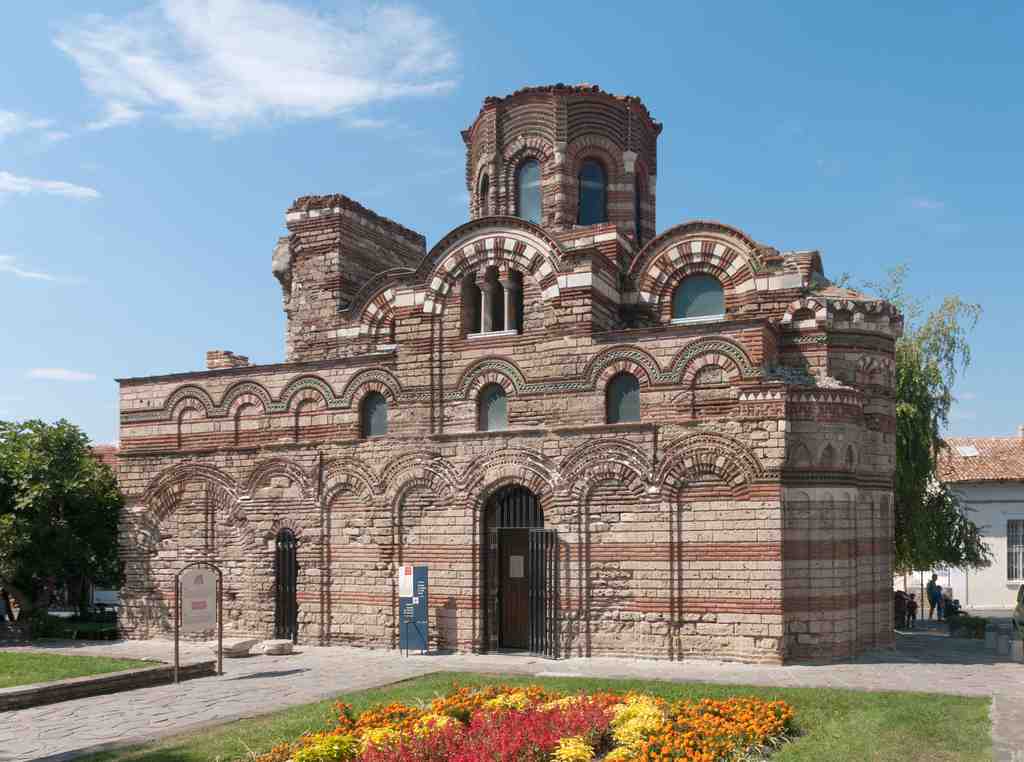
Look for a compact red-brick-and-stone church with a tall octagonal dome and richly patterned walls, marked by bands of arches and small turquoise ceramic circles.
This is the Church of Christ Pantocrator, one of the most finely preserved medieval churches in Nesebar... and one of the most argued over. Its very date slips a little through historians’ fingers. Scholar Robert Ousterhout placed it in the middle of the fourteenth century, while writer Jonathan Bousfield tied it to the reign of Tsar Ivan Alexander, between thirteen thirty-one and thirteen seventy-one. That contested chronology is more than an academic puzzle. It tells you what kind of city Mesembria, later Nesebar, had become: a place passed back and forth between Bulgaria and Byzantium, where power shifted often enough that even a church’s date remained debated.
And yet the building itself speaks with remarkable confidence. Notice the opus mixtum brick-and-stone patterning. That simply means the builders alternated rows of brick with carved stone, turning structure into ornament. The result is almost musical to the eye... red bands, pale bands, red again. If you glance at the image on your screen, you can see how the whole church wears that pattern like embroidery on cloth.
The church follows a late Byzantine cross-in-square plan, a design where a square body holds a cross-shaped interior beneath the dome. Above you, that dome has eight sides and once rested on four columns inside, now lost. There is also a bell tower rising over the entrance hall, or narthex, though part of it has fallen away. Beneath that small entrance hall, a medieval tomb lies hidden under the floor, as if one more life remains folded into the church’s memory.
The east end, with its apse, is the most lavishly dressed. Look closely and you may spot blind arches, which are arches built into the wall only for decoration, not as openings. Between them run four-petaled floral motifs, triangles, and those striking ceramic disks. On one wall, the brickwork even forms swastika shapes. In the medieval world, long before that symbol was poisoned in modern times, builders used it here as a sign of the sun. Ousterhout thought the stacked arches looked almost like an aqueduct, and once you hear that, it is hard not to see the comparison.
If you open the detail image, the reddish surface becomes even clearer, almost like skin stretched over centuries of care and repair. That matters, because this church is not just admired; it is actively protected. Since nineteen twenty-seven, the Bulgarian state has guarded it as a national antiquity. It also stands within Ancient Nesebar, part of the UNESCO World Heritage Site. Recent conservation plans led to emergency work funded in twenty twenty-three, because even a monument that looks intact still needs tending.
Today the church serves as an art gallery. In local heritage records, it even carries an overlapping name, Pantokrator Church, Saint Nicholas, a small reminder that sacred places here rarely belong to only one chapter.
So here is the quiet wonder of this stop: even the date remains unstable, yet the beauty does not. When you’re ready, we’ll continue about one minute to the Church of Saint John the Baptist. If you want to return later, the gallery here generally opens daily from nine in the morning until eight in the evening.




