
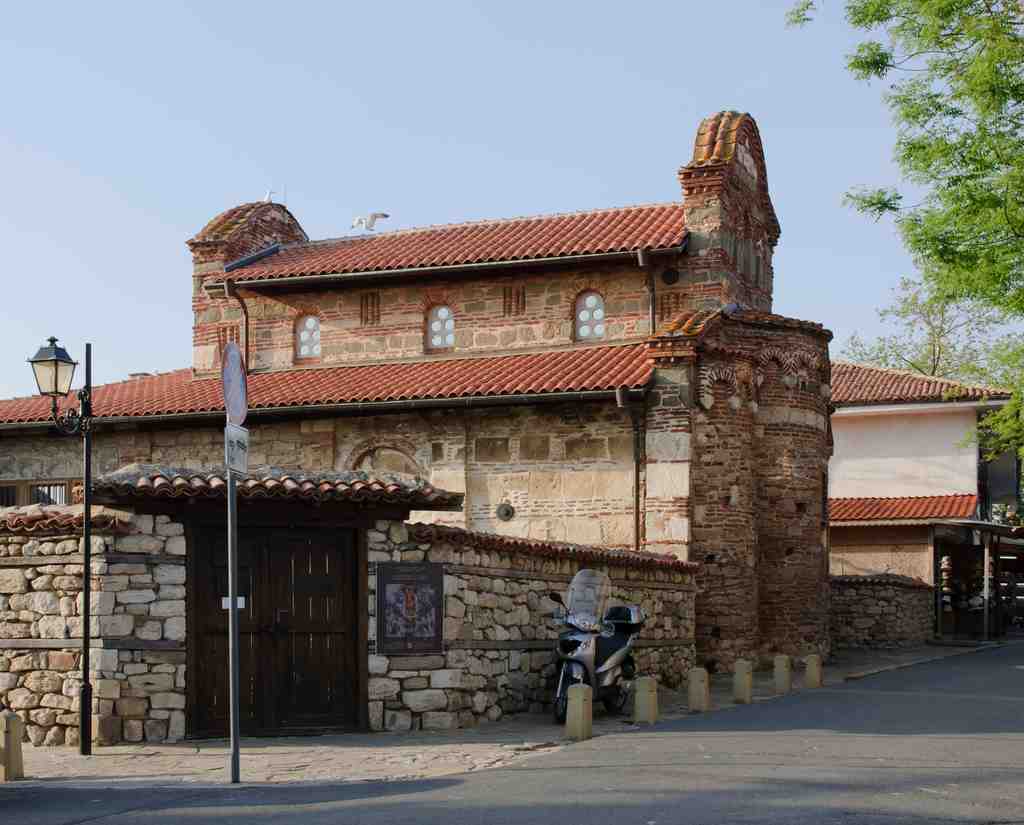
In front of you stands a compact brick-and-stone church with three rounded eastern apses, trefoil-shaped gables, and patterned masonry brightened by small ceramic plaques.
Welcome to the Church of Saint Stephen... though most visitors never suspect that this church began with another name, dedicated first to the Holy Mother. That quiet change tells you something important about Nesebar. In old Mesembria, today’s Nesebar old town, sacred places rarely stay fixed; they grow, shift, and keep carrying meaning as the town changes around them.
This church began in its eastern end, probably in the eleventh century. Later builders pushed it westward, removed an older wall, and added a narthex, the entrance space before the main hall. It served as the cathedral church of the local metropolitan center, and now it lives on as a museum within the UNESCO World Heritage site.
If you can, linger on the outside a moment. Notice how the stone and brick refuse a strict pattern, and how the middle apse rises higher than the two beside it. The exterior feels restrained... and that makes the painted interior even more astonishing. On your screen, you can peek inside and see how the walls bloom with images from nearly every surface.
Those paintings are not one single voice. An inscription above the south door dates a major repainting to fifteen ninety-nine, and scholars can trace three painters at work: two in the eastern main hall, and a third in the western part. Later still, the eighteenth century added scenes of the Last Judgment in the narthex, and the church kept its painted iconostasis, the icon screen before the altar, along with a carved throne and pulpit.
By the nineteen nineties, those murals were in real danger, a reminder that fragile color can fade if a church is left unattended.
So hold onto that date above the door, fifteen ninety-nine. Here, a wall can preserve memory as clearly as ink. Next, in about one minute, we’ll walk to the Church of Saint John Aliturgetos, where sacred identity meets interruption. If you want to return inside later, this museum is generally open daily from nine A-M to five P-M.




