
Sarajevo Audio Tour: A Journey Through Faith, History, and Heroism
A thousand years of struggle and survival echo from Sarajevo’s stone cathedrals to the soft flicker of the Eternal Flame. Each corner hides not just scars but secrets, as this city forever redefines what it means to endure and to remember. Set out on a self-guided audio adventure through these legendary streets. Peel back layers of faith, rebellion, and resilience—discovering the daring acts and curious encounters so many travelers overlook. Who risked everything at dawn as cannons stood watch over a cathedral’s grand opening? What hidden alliances and rivalries raged inside ancient towers while empires clashed outside? And why does a tiny flame in the city’s heart still draw mourners and dreamers with stories of loss, hope, and a near-singed eyebrow? Follow Sarajevo’s twisting paths, feel history pulse beneath your feet, and witness where past uprisings fuel present-day spirit. Ignite your own journey—step up and unravel the city’s most astonishing tales.
Tour preview
About this tour
- scheduleDuration 90–110 minsGo at your own pace
- straighten3.8 km walking routeFollow the guided path
- location_onLocationSarajevo, Bosnia & Herzegovina
- wifi_offWorks offlineDownload once, use anywhere
- all_inclusiveLifetime accessReplay anytime, forever
- location_onStarts at Roman Catholic Archdiocese of Vrhbosna
Stops on this tour
lock_open 3 free previews · 12 unlock with purchase
To spot the Cathedral of the Nativity of the Theotokos, just look up for the largest Orthodox church in Sarajevo-its pale pink walls, striking five domes, and a tall gilded…Read moreShow less
To spot the Cathedral of the Nativity of the Theotokos, just look up for the largest Orthodox church in Sarajevo-its pale pink walls, striking five domes, and a tall gilded baroque belfry with a golden cross shining above the green hedges will guide your eye. Welcome! You’re now standing before one of Sarajevo’s grandest sights, where history towers overhead and the past whispers from every stone. This majestic cathedral, the largest Serbian Orthodox church in the city, was built between 1863 and 1868-back when Sarajevo was bustling under Ottoman rule. Picture a city skyline dotted mostly by slim minarets, and imagine the chatter spreading as Orthodox Christians began raising their own monumental building right here. All around you, the sound of chisels and hammers filled the air as master builders from the renowned Damjanovi-Renzovski family designed a church unlike anything Sarajevo had ever seen: three sections in a cross shape, painted walls imitating elegant marble, and no fewer than five domes-one massive in the center, four smaller at the corners-all perched above solid wooden beams. What makes this cathedral even more dramatic is its backstory. The Orthodox community, led by the spirited Manojlo Jeftanović, raised most of the 36,000 dukats for construction, but the truly unusual part is who else chipped in: the Ottoman Sultan Abdülaziz and Serbia’s Prince Mihailo Obrenović each donated 500 dukats! Even Tsar Alexander II of Russia sent his best craftsmen to carve the magnificent iconostasis. For a moment it must have seemed like peace and good neighborliness would win the day. But as soon as the tower rose high, locals took notice. Some conservative Muslims in Sarajevo became uneasy seeing a church spire rising high over the city, taller than many minarets. A little comedy here-the new church was called the “New Orthodox Church” just to avoid confusion with the “old” one a few blocks away, but it had already made a big impression! In 1871, excitement and tension reached a boil. A hot May day was set for the cathedrals' dedication, but rumors spread like wildfire. About forty agitated townsfolk, followers of the fiery imam Hadži Lojo, planned to block the ceremony. The Ottoman governor didn’t wait-he sent police, who quickly arrested some and sent others running for the hills. The dedication had to be postponed. The next summer, determined the celebration would go on, the authorities sent over a thousand soldiers and even rolled a cannon above the city! Imagine the nerves in the air as troops guarded the grounds, all for the church’s grand debut. But, at last, in the sunshine of July 20, 1872, the dedication went off in spectacular fashion. Local Serbs, Ottoman officials, even a young Austro-Hungarian ambassador-future mover and shaker Béni Kállay-looked on as the new cathedral stood proud, a symbol of Sarajevo’s layered identities. Since then, the church has weathered wars and political storms but remains a dazzling centerpiece. In 2006, it finally received the honor it deserved, becoming a recognized National Monument. So, as you gaze up at those domes and golden crosses, just imagine the cheers, the worries, and the cannon on the hill-a place where faith and history still echo through the streets.
Open dedicated page →To spot the Eternal Flame, look ahead for a small, round, stone structure with a burning flame in the center, nestled under a tall archway in the cream and yellow…Read moreShow less
To spot the Eternal Flame, look ahead for a small, round, stone structure with a burning flame in the center, nestled under a tall archway in the cream and yellow building. Welcome to the Eternal Flame! You might notice the gentle, steady just in front of you. This isn’t just your average flame-this fire has been burning day and night since 1946, right here in the heart of Sarajevo. Imagine the city after World War II: streets full of whispers, people peeking out from behind damaged buildings, still unsure if peace could last. Then, on April 6th, a year after Sarajevo finally broke free from four long, nerve-wracking years of Nazi and fascist occupation, the people came together and lit this fire. But don’t get too close-or the flame might give your eyebrows a singe as a Sarajevo souvenir! Architect Juraj Neidhardt designed this spot, choosing the very center of the city, right where three bustling streets come together. Can you feel the energy of the city moving all around you? Every April 6th, the square fills with footsteps and the buzz of voices as people gather to lay flowers and honor both the heroes of World War II and those lost in the more recent siege of Sarajevo. It’s a place of memory, hope, and the promise that-no matter what-the light of Sarajevo won’t go out.
Open dedicated page →
Show 12 more stopsShow fewer stopsexpand_moreexpand_less
Look to your left for a striking beige building with four corner towers topped by black domes, standing tall and proud next to a bright green apartment block-yep, that's the…Read moreShow less
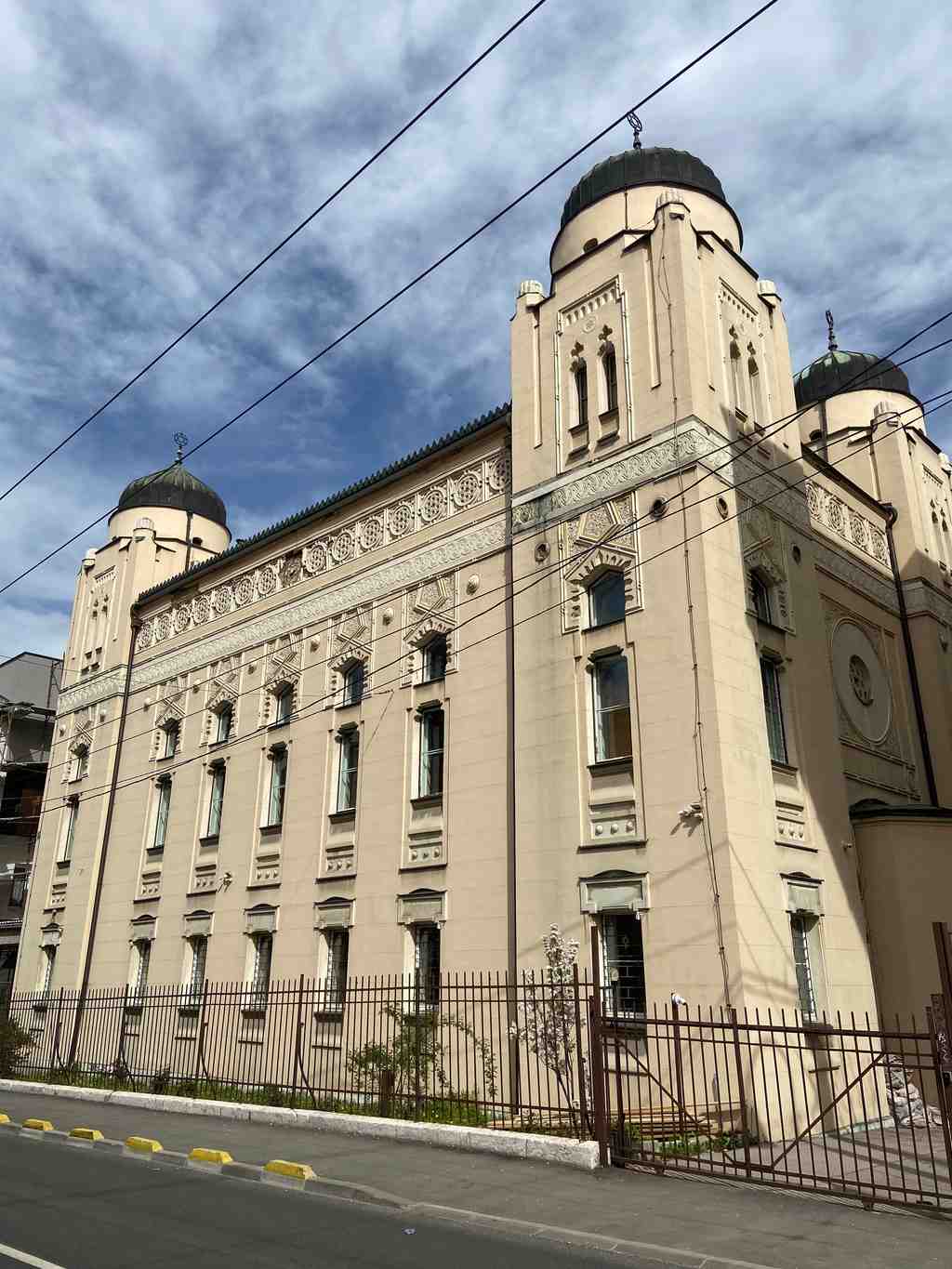
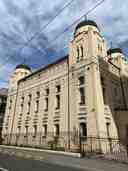
Look to your left for a striking beige building with four corner towers topped by black domes, standing tall and proud next to a bright green apartment block-yep, that's the Sarajevo Synagogue! Now, let’s step a little closer and uncover the story wrapped up in these Moorish arches and golden rosettes. Imagine you’re standing by the bustling Miljacka River around 1541, where the very first Jewish settlers of Sarajevo arrived after a long and winding journey from Salonika. They were artisans, merchants, doctors, pharmacists-ordinary people with extraordinary resilience, setting off on a new adventure in a city that would become their home. By 1577, thanks to the kindness of Pasha Siavush, they were granted a quarter of their own, El Cortijo, where laughter and the delicious scent of spices filled the air. Not long after, their hearts turned to faith and they built their first synagogue in 1580. Sadly, that synagogue was twice destroyed by fire-once in 1679, then again in 1778-but each time, the community rolled up their sleeves and rebuilt, showing what it means to never give up hope. The current synagogue you see today came much later, in 1902, after a new wave of Ashkenazi Jews arrived from lands ruled by the Austro-Hungarian Empire. They brought with them fresh dreams-and a need for their own synagogue. Picture a group of folks poring over architectural plans, arguing in a mix of German, Ladino, and Bosnian about how the new building should look. The original sketches by Wilhelm Stiassny, a superstar synagogue designer from Vienna, proposed swirling Moorish arches and soaring ceilings. But the government tinkered with his vision, so Czech architect Karel Pařík took the lead and, with a few quick flicks of his pencil, gave us the unique creation you see today. The inside was especially stunning, decked out with relief ornaments and a ten-pointed star on the ceiling. If you step close to the entrance you’ll spot a stone menorah, celebrating 400 years of Jewish life in Bosnia and Herzegovina. But history wasn’t always so majestic. In World War II, the larger Sephardic synagogue of Sarajevo-Il Kal Grande-was destroyed by the Nazis, lost forever. Miraculously, this Ashkenazi synagogue survived, although it was used by the Germans as a stable. Imagine the clatter of horse hooves echoing through the halls where prayers once soared. Many of the decorations downstairs were wiped away, and the Torah ark was damaged, but somehow the community pulled together again. After the Holocaust and the Yugoslav wars, only a fraction of Sarajevo’s Jewish population remained-a few hundred where once there were thousands-but still, their traditions lived on. In 1964, for the 400th anniversary of Jews in Bosnia and Herzegovina, the main prayer room moved up to what used to be the women’s galleries, a symbolic rise above centuries of struggles and new beginnings. Today, the ground floor buzzes with celebrations-bar mitzvahs, weddings, festivals-a reminder that Sarajevo’s Jewish history is still very much alive. The synagogue has been lovingly renovated in the 2000s, so thanks to a dash of history, a sprinkle of Moorish beauty, and a mountain of determination, it continues to stand-welcoming, resilient, and always ready for the next chapter. Keep your eyes (and ears) open on your stroll through Sarajevo; you never know what other stories are waiting just around the corner!
Open dedicated page →To spot this landmark, look for a small plaque set into the building wall next to the busy street by the river-just beside the famous Latin Bridge-where the assassination took…Read moreShow less
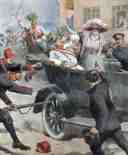
To spot this landmark, look for a small plaque set into the building wall next to the busy street by the river-just beside the famous Latin Bridge-where the assassination took place; the site is often marked by the occasional guided group and faces the traffic flowing by. Alright, get ready for one of Sarajevo’s most dramatic stories-right where you’re standing, history took a sharp and noisy turn! Imagine this: It’s the morning of June 28th, 1914-a hot summer day, and the air is buzzing with excitement and maybe just a bit of tension. Franz Ferdinand, the heir to the Austro-Hungarian throne, and his beloved wife Sophie, are parading through Sarajevo in a shiny open car, waving and smiling to crowds. You can almost hear the clatter of horses and the chatter of nervous officials. Sarajevo was bustling with energy, but under it all was a city on edge. Bosnia had been formally taken over by Austria-Hungary just a few years earlier, and not everyone was thrilled about that. A secret band of young revolutionaries, hopeful for a new Yugoslav state, saw their moment. Among them was Gavrilo Princip-a skinny, serious student, burning with patriotic fire. He and his friends had made a secret pact to strike a blow for freedom, their plan put in motion with help from the murky world of nationalist conspiracies and shadowy safe-houses stretching from Belgrade all the way to this city. That morning, the roads were packed with only about sixty police officers, no soldiers lining the streets-an effort to avoid offending the local citizens. Security? Let’s just say you could almost hear history’s alarm clock ringing. The imperial motorcade glided along the Appel Quay, Sarajevo’s riverside boulevard, and passed not one, not two, but several would-be assassins, each getting cold feet. One, armed with a bomb, stood in front of the Mostar Café-and then simply froze. Another, Vaso Čubrilović, missed his chance. Crowd, nerves, and perhaps the enormity of the moment got to most of them. But Nedeljko Čabrinović threw his bomb! It bounced off the folded roof of Franz Ferdinand’s car and exploded under the next vehicle-deafening bang, a cloud of smoke, shouts, and panic-wounding bystanders instead of the royal couple. The chaos didn’t stop the Archduke. Covered in dust but still determined, Franz Ferdinand and Sophie made it to the town hall where, shaken, the Archduke famously interrupted the mayor’s welcome speech: “Mr. Mayor, I come here on a visit, and I am greeted with bombs!” Not exactly the warm welcome he'd hoped for. After a quick regroup and a new plan-visit the wounded at the hospital!-the cars started off again. Now, let’s set the scene for a slice of fate straight out of a thriller: The driver, confused by last-minute changes and poor communication, suddenly takes a wrong turn onto a side street near the Latin Bridge. The car stalls-right next to a small deli. And who should be standing there, almost by accident, but Gavrilo Princip? Luck, fate, destiny, whatever you want to call it, lined everything up. Princip, barely believing his chance, stepped forward, raised his pistol, and fired two shots at close range. One bullet hit the Archduke, the other his wife. In seconds, the car-once filled with hope and pageantry-became the silent witness to a tragedy that would ignite the First World War. The last thing Franz Ferdinand said was to his dying wife: “Sophie, Sophie! Don’t die! Live for our children.” What followed was even stranger-the funeral in Vienna was a cold, political affair, with the couple’s children snubbed and most of Europe’s royals pointedly uninvited. The officer corps was told not to salute, and Sophie’s coffin was set lower than her husband’s, just to remind everyone of her “inferior” status. And if you ever hear the rumor about Princip stopping for a sandwich next door before the shooting, don’t believe it! That’s just a myth-no historical evidence he paused for a snack at the crucial hour. Standing here, remember: This quiet corner once echoed with the chaos and confusion that changed the world forever. It’s history’s ultimate “wrong place, wrong time”-a small site with consequences that thundered across empires. For further insights on the background, preliminaries or the assassination, feel free to navigate to the chat section below and inquire.
Open dedicated page →To spot the Gazi Husrev-beg Mosque, look for a white building with a tall, slender minaret capped by a black spire and several grey domes rising above the rooftops right in front…Read moreShow less
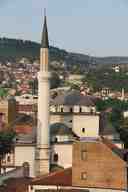
To spot the Gazi Husrev-beg Mosque, look for a white building with a tall, slender minaret capped by a black spire and several grey domes rising above the rooftops right in front of you. Welcome to the awe-inspiring Gazi Husrev-beg Mosque, the crown jewel of Sarajevo’s old town! Picture this: It’s the 1530s, and the air in Baščaršija is filled with the sound of chisels striking stone and the lively chatter of workers from across the Ottoman Empire. Right here, on these stones, the story of Sarajevo starts to shimmer. Towering above the city’s heart, this mosque isn’t just a place of worship. It’s a living museum, a community hub, and-believe it or not-the first mosque in the entire world to have electric lights. Imagine the shock when the minaret started glowing back in 1898. “What’s next?” the locals probably joked, “flying carpets with headlights?” Let’s step back into the 16th century. The mighty Ottoman governor Gazi Husrev-beg wants to give something extraordinary to Sarajevo-not just a mosque, but a whole endowment. So, he brings in skilled artisans, some straight from the rich cities of the Ottoman world, and even persuades Ragusan masons from Dubrovnik to pitch in. There’s a rumor that Mimar Sinan, the most famous Ottoman architect, might have inspected the plans, but most scholars agree the true mastermind was Acem Ali Tabrizi, a Persian-born genius. But if you think architectural mysteries are just for old buildings, think again-even today, nobody’s quite certain who really called the shots. Take a look at the structure before you. See how the main dome rises above the others, commanding attention with quiet authority. The dome is like a judge’s gavel, declaring, “This is the center of the city.” The walls are high and sturdy, while the front portico welcomes you with elegant arches perched atop thick columns, each capped with intricate muqarnas carvings-little stone stalactites that look almost good enough to eat. And if you peer up at the minaret, try to imagine the call to prayer echoing through the narrow streets, mingling with the lively sounds of market traders, musicians, and schoolchildren. But the mosque isn’t just a pretty face. It anchors a whole ecosystem-schools, a bustling marketplace, a hammam for weary travelers, a water fountain for all who thirst. Generations of Sarajevans learned to read and write here; merchants weighed spices in the bezistan next door; friends caught up under the shade of its domes. That’s not by accident. Here’s a little gem from Gazi Husrev-beg himself: “Good deeds drive away evil, and the most worthy act of charity is one which lasts forever. Of all charitable deeds, the most beautiful is one that continually renews itself.” You can feel that spirit humming in the stone around you, can’t you? Yet Sarajevo has seen its share of storm clouds, and this mosque stood right in the line of fire. During the war in the 1990s, when the city was under siege, Gazi Husrev-beg Mosque became a symbol and a target. Shells rained down, shattering domes and breaking hearts. But like a phoenix, the mosque rose again. With help from friends around the world-especially Saudi Arabia-the community swept away the dust, peeled back faded Austro-Hungarian decorations, and called on local artist Hazim Numanagić to breathe new life into the walls with fresh, colorful calligraphy in 2001. If you look closely, echoes of the old style linger in the portal’s design, a whisper of the past amid a song of renewal. So as you stand here, imagine the layers of time pressing gently together. Imagine the crackle of the city’s first electric lights, the excited crowds at the marketplace, the defiant prayers during wartime, the laughter of children learning to write. The Gazi Husrev-beg Mosque is more than a building-it’s the beating heart of Sarajevo, still shining and sheltering all who come near.
Open dedicated page →To spot the Church of the Holy Archangels Michael and Gabriel, just look for a sturdy stone building with a modest bell tower sticking up above a low wall, and keep your eyes…Read moreShow less
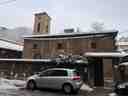
To spot the Church of the Holy Archangels Michael and Gabriel, just look for a sturdy stone building with a modest bell tower sticking up above a low wall, and keep your eyes peeled for the small arched windows and a splash of color in the painted icon above the entrance. Now that you’re here, let’s take a step back-way back, actually. Imagine you’re in Sarajevo in the 1500s. The streets are buzzing, the scents of spice and fresh bread drift by, but nestled right here is something truly special-a little stone church quietly holding its own secrets. This spot has seen more history than a time-traveling pigeon! The first time the church is mentioned in records is in 1539, but many believe it was built on the bones of an even older place of worship, maybe all the way back to the 5th or 6th century. If these stones could talk, they’d probably brag about their ancient roots and maybe complain a bit about Ottoman architects stomping around! Throughout the centuries, the church saw fires, wars, and plenty of dramatic moments-let's be honest, you don’t get to 500 years old without a few scorch marks and epic makeovers. As you stand here, take in the thick stone walls and that single bell tower peeking into the sky. Inside, the church glows with a dazzling iconostasis and frescoes that make you feel like you’ve wandered into a hidden treasure trove. But wait, there’s more! In 1889, the Old Orthodox Church became home to a museum. Don’t let its quiet exterior fool you-inside, you’ll find over 700 artifacts, from breathtaking icons to ancient ecclesiastical robes, shimmering chalices, old manuscripts, even antique weapons! It’s like a game of “what’s behind this door,” but with centuries of sacred loot. This church is much more than just a building. For Sarajevo’s Orthodox community, it’s a soul and meeting point, and for the city, it’s a living reminder of how cultures overlap, layer by layer, like a really good cake-sweet, rich, and full of surprises. So, as you stand here, you’re not just a visitor; you’re part of the ever-unfolding story. Wondering about the architecture, museum or the cultural significance? Feel free to discuss it further in the chat section below.
Open dedicated page →Straight ahead, you'll spot a huge, eye-catching building with orange and yellow striped walls, topped with fancy Moorish-style arches and a lacy white crown along the roof-just…Read moreShow less
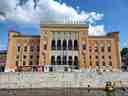
Straight ahead, you'll spot a huge, eye-catching building with orange and yellow striped walls, topped with fancy Moorish-style arches and a lacy white crown along the roof-just look for the largest and grandest building on the riverbank! Now, take a deep breath, stand tall, and imagine you’re about to walk into a palace-but not just any palace. This is Sarajevo’s Vijećnica, the City Hall! Back in 1891, a Czech architect named Karel Pařík dreamed up this masterpiece, but it turned out his work was a bit like trying to bake a cake with too many chefs. After a few architectural disagreements-let’s just say that wasn’t his cup of Bosnian coffee-he walked away, leaving others to finish the recipe. Alexander Wittek took the lead, but after falling ill and dying in 1894, it was Ćiril Iveković who finally placed the cherry on top. Construction started in 1892, and two years and 984,000 crowns later (talk about an expensive housewarming party), the grand building was unveiled in 1896. Picture it: elite Austro-Hungarian officials striding through its arches, the city’s heart beating with excitement. This building wasn’t just big, it was the *biggest* and most impressive showpiece around-a striking marvel, with patterns and turrets inspired by the faraway stories of Moorish Spain and North Africa. If the walls could talk, they’d tell you about secret council meetings, sparkling banquets, and, yes, some real drama. One infamous guest was Archduke Franz Ferdinand, who visited here with his wife in June 1914. After a fancy reception, they left in style in their motorcade-and only minutes later, history changed forever when they were assassinated nearby, right by the Latin Bridge. That event sent the world spinning into World War I, making Vijećnica a silent witness to one of the 20th century’s biggest “plot twists.” The City Hall kept reinventing itself. In 1949, it was handed over to the National and University Library of Bosnia and Herzegovina, turning from a house of politics to a treasure trove of stories, manuscripts, and rare books. But the city’s greatest library faced its darkest hours in August 1992. During the Siege of Sarajevo, the building was shelled and set ablaze. Try to picture ancient books and unique manuscripts-sometimes centuries old-turning to ashes in the smoky air, as brave citizens and librarians risked everything to save what they could under sniper fire. It was a disaster that sent shockwaves through the city’s soul, with over a million volumes lost and memories scorched forever. But, as always, Sarajevo’s spirit wouldn’t stay down. Like a phoenix (with a nice hat), Vijećnica started to rise from its own ashes. Repairs and rich restorations began in the late ‘90s, with help from Austria, the European Commission, and even Barcelona. Imagine workers, artists, and craftspeople painstakingly reconstructing each stenciled wall, gilded column, and arch-sometimes reviving old features with ingenious new molds, sometimes recreating what simply could not be saved. By July 2014, after years of delays (and a bureaucracy battle that could fill a whole library), the City Hall’s doors finally opened wide once again, just in time for Sarajevo to commemorate 100 years since that fateful shot that rocked the world. Today, Vijećnica is alive as ever-hosting concerts, fancy government events, and even inspiring animated films. In a city of survivors, this building stands like a coat of many stories: Moorish daydream, historic stage, victim, survivor, and, always, a vibrant heart of Sarajevo. So next time you cross that bridge, or pass its doors after a riverside stroll, remember: these stones have watched history unfold, both glorious and tragic, and they’re still standing, ready for the next story to come.
Open dedicated page →To spot the Baščaršija Mosque, look for a stone building with a large dome and several smaller green domes, crowned by a tall, slender minaret rising above the trees and shops…Read moreShow less
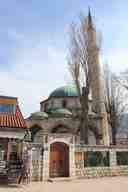
To spot the Baščaršija Mosque, look for a stone building with a large dome and several smaller green domes, crowned by a tall, slender minaret rising above the trees and shops right in the heart of the old bazaar. As you’re standing here, just imagine yourself walking into Baščaršija almost five centuries ago-the hustle and bustle of traders calling out, merchants arguing over the price of carpets and coffee, and at the very center of it all, this beautiful mosque, quietly watching the city change. Baščaršija Mosque, also known as the Mosque of Hadži Durak, was built way back in 1528, when Sarajevo was just finding its feet as a lively market town. Hadži Durak, a local man with a big heart (and probably an even bigger beard), gifted his fortune to build this very mosque, shaping the spiritual and economic life of the community. Now, if these stones could talk, they’d have quite the story-like the time in 1697 when the mosque’s wooden dome was swallowed up by a terrible fire, probably caused by one too many candles and not enough fire extinguishers. But Sarajevo is nothing if not resilient, and out of the ashes rose the solid stone dome you can see today. And don’t forget Mehmed-pasha Musinović, who gave the place a fresh lick of paint in 1762, proving that even in the Ottoman era, everyone loved a good home makeover. Inside, this mosque is famous for being bathed in daylight and for acoustics so crystal clear, even the softest prayers seem to fill every corner. Over centuries, generous merchants and shopkeepers donated their riches to keep sermons going and the doors open for visitors and neighbors. In 2006, Baščaršija Mosque officially became a national monument. So as you look up at its elegant minaret, think about all the generations who’ve found peace here in the center of Sarajevo’s whirlwind. This mosque isn’t just a building; it’s a story of survival, generosity, and the heart of an entire city. And no matter what chaos whirls around, it stands tall-like a true local who isn’t bothered by a bit of noise.
Open dedicated page →
Frequently asked questions
How do I start the tour?
After purchase, download the AudaTours app and enter your redemption code. The tour will be ready to start immediately - just tap play and follow the GPS-guided route.
Do I need internet during the tour?
No! Download the tour before you start and enjoy it fully offline. Only the chat feature requires internet. We recommend downloading on WiFi to save mobile data.
Is this a guided group tour?
No - this is a self-guided audio tour. You explore independently at your own pace, with audio narration playing through your phone. No tour guide, no group, no schedule.
How long does the tour take?
Most tours take 60–90 minutes to complete, but you control the pace entirely. Pause, skip stops, or take breaks whenever you want.
What if I can't finish the tour today?
No problem! Tours have lifetime access. Pause and resume whenever you like - tomorrow, next week, or next year. Your progress is saved.
What languages are available?
All tours are available in 50+ languages. Select your preferred language when redeeming your code. Note: language cannot be changed after tour generation.
Where do I access the tour after purchase?
Download the free AudaTours app from the App Store or Google Play. Enter your redemption code (sent via email) and the tour will appear in your library, ready to download and start.
If you don't enjoy the tour, we'll refund your purchase. Contact us at [email protected]
Checkout securely with 




