
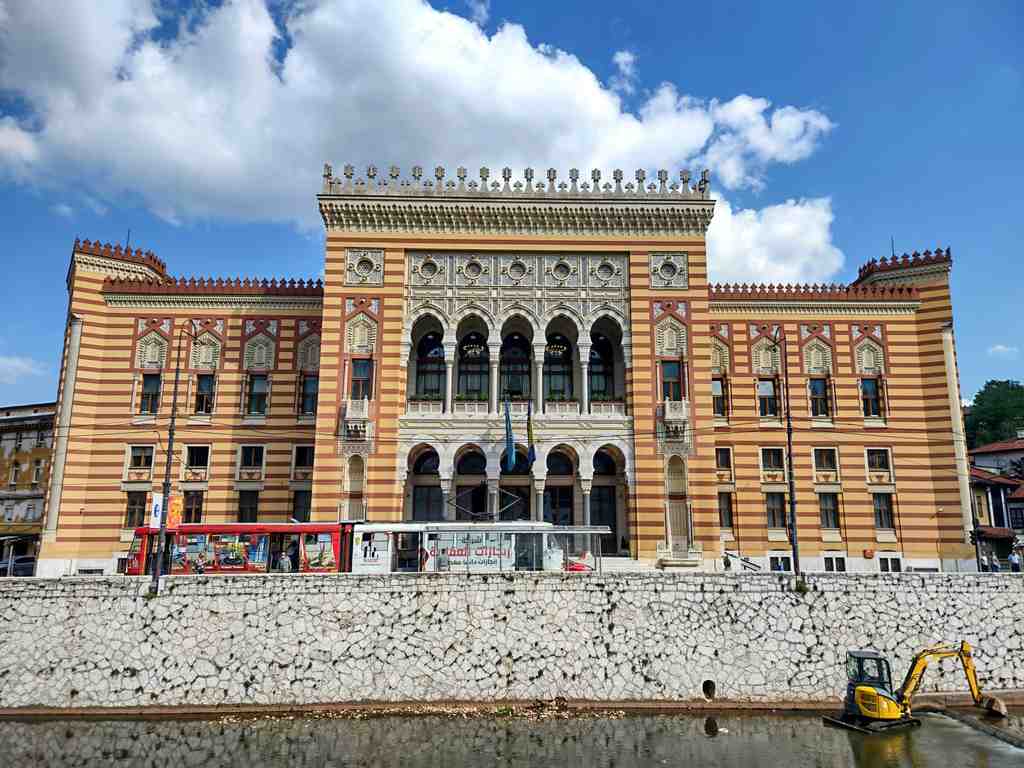
Straight ahead, you'll spot a huge, eye-catching building with orange and yellow striped walls, topped with fancy Moorish-style arches and a lacy white crown along the roof-just look for the largest and grandest building on the riverbank!
Now, take a deep breath, stand tall, and imagine you’re about to walk into a palace-but not just any palace. This is Sarajevo’s Vijećnica, the City Hall! Back in 1891, a Czech architect named Karel Pařík dreamed up this masterpiece, but it turned out his work was a bit like trying to bake a cake with too many chefs. After a few architectural disagreements-let’s just say that wasn’t his cup of Bosnian coffee-he walked away, leaving others to finish the recipe. Alexander Wittek took the lead, but after falling ill and dying in 1894, it was Ćiril Iveković who finally placed the cherry on top. Construction started in 1892, and two years and 984,000 crowns later (talk about an expensive housewarming party), the grand building was unveiled in 1896.
Picture it: elite Austro-Hungarian officials striding through its arches, the city’s heart beating with excitement. This building wasn’t just big, it was the *biggest* and most impressive showpiece around-a striking marvel, with patterns and turrets inspired by the faraway stories of Moorish Spain and North Africa. If the walls could talk, they’d tell you about secret council meetings, sparkling banquets, and, yes, some real drama. One infamous guest was Archduke Franz Ferdinand, who visited here with his wife in June 1914. After a fancy reception, they left in style in their motorcade-and only minutes later, history changed forever when they were assassinated nearby, right by the Latin Bridge. That event sent the world spinning into World War I, making Vijećnica a silent witness to one of the 20th century’s biggest “plot twists.”
The City Hall kept reinventing itself. In 1949, it was handed over to the National and University Library of Bosnia and Herzegovina, turning from a house of politics to a treasure trove of stories, manuscripts, and rare books. But the city’s greatest library faced its darkest hours in August 1992. During the Siege of Sarajevo, the building was shelled and set ablaze. Try to picture ancient books and unique manuscripts-sometimes centuries old-turning to ashes in the smoky air, as brave citizens and librarians risked everything to save what they could under sniper fire. It was a disaster that sent shockwaves through the city’s soul, with over a million volumes lost and memories scorched forever.
But, as always, Sarajevo’s spirit wouldn’t stay down. Like a phoenix (with a nice hat), Vijećnica started to rise from its own ashes. Repairs and rich restorations began in the late ‘90s, with help from Austria, the European Commission, and even Barcelona. Imagine workers, artists, and craftspeople painstakingly reconstructing each stenciled wall, gilded column, and arch-sometimes reviving old features with ingenious new molds, sometimes recreating what simply could not be saved. By July 2014, after years of delays (and a bureaucracy battle that could fill a whole library), the City Hall’s doors finally opened wide once again, just in time for Sarajevo to commemorate 100 years since that fateful shot that rocked the world.
Today, Vijećnica is alive as ever-hosting concerts, fancy government events, and even inspiring animated films. In a city of survivors, this building stands like a coat of many stories: Moorish daydream, historic stage, victim, survivor, and, always, a vibrant heart of Sarajevo. So next time you cross that bridge, or pass its doors after a riverside stroll, remember: these stones have watched history unfold, both glorious and tragic, and they’re still standing, ready for the next story to come.




