
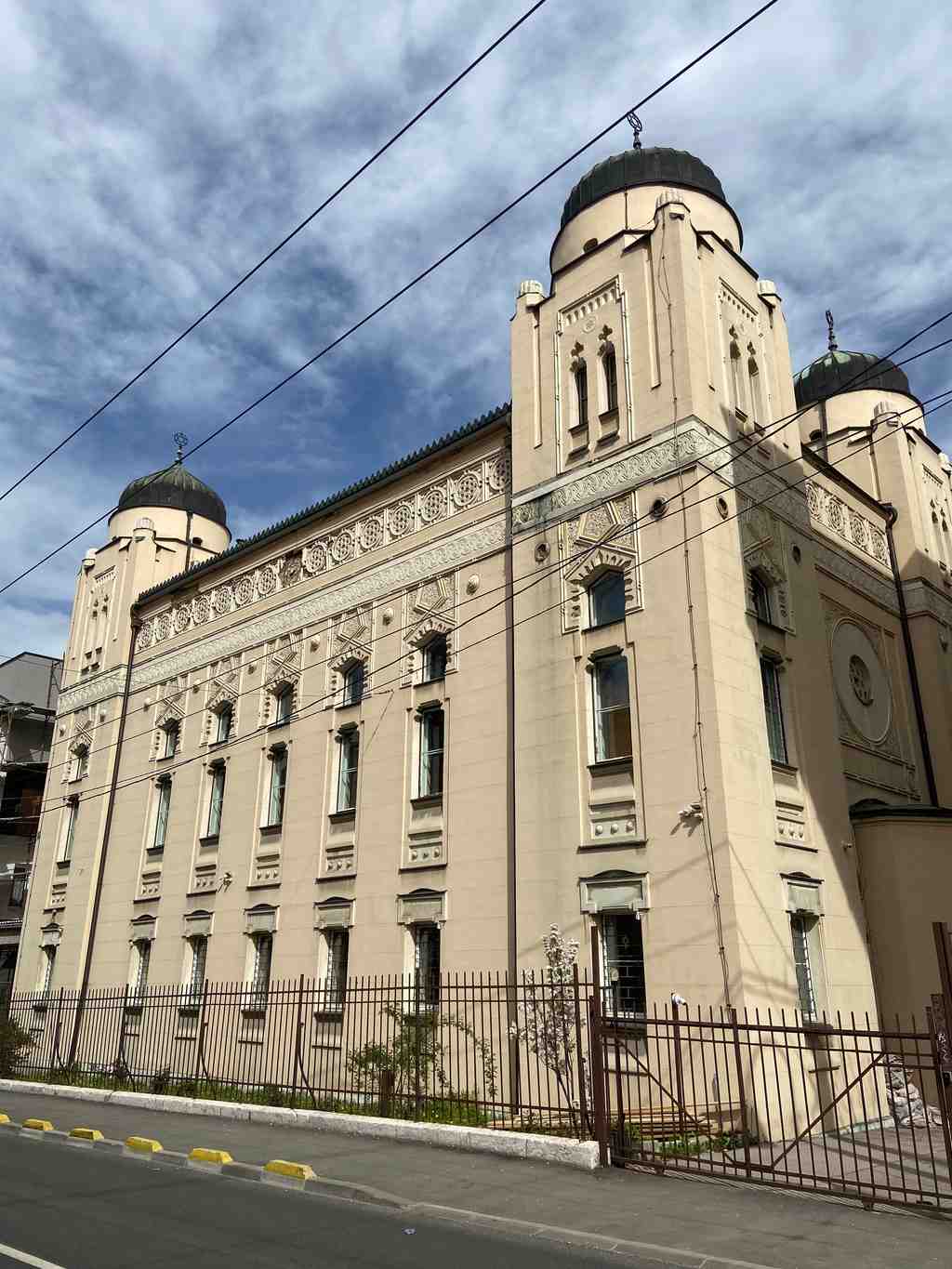
Look to your left for a striking beige building with four corner towers topped by black domes, standing tall and proud next to a bright green apartment block-yep, that's the Sarajevo Synagogue!
Now, let’s step a little closer and uncover the story wrapped up in these Moorish arches and golden rosettes. Imagine you’re standing by the bustling Miljacka River around 1541, where the very first Jewish settlers of Sarajevo arrived after a long and winding journey from Salonika. They were artisans, merchants, doctors, pharmacists-ordinary people with extraordinary resilience, setting off on a new adventure in a city that would become their home.
By 1577, thanks to the kindness of Pasha Siavush, they were granted a quarter of their own, El Cortijo, where laughter and the delicious scent of spices filled the air. Not long after, their hearts turned to faith and they built their first synagogue in 1580. Sadly, that synagogue was twice destroyed by fire-once in 1679, then again in 1778-but each time, the community rolled up their sleeves and rebuilt, showing what it means to never give up hope.
The current synagogue you see today came much later, in 1902, after a new wave of Ashkenazi Jews arrived from lands ruled by the Austro-Hungarian Empire. They brought with them fresh dreams-and a need for their own synagogue. Picture a group of folks poring over architectural plans, arguing in a mix of German, Ladino, and Bosnian about how the new building should look. The original sketches by Wilhelm Stiassny, a superstar synagogue designer from Vienna, proposed swirling Moorish arches and soaring ceilings. But the government tinkered with his vision, so Czech architect Karel Pařík took the lead and, with a few quick flicks of his pencil, gave us the unique creation you see today. The inside was especially stunning, decked out with relief ornaments and a ten-pointed star on the ceiling. If you step close to the entrance you’ll spot a stone menorah, celebrating 400 years of Jewish life in Bosnia and Herzegovina.
But history wasn’t always so majestic. In World War II, the larger Sephardic synagogue of Sarajevo-Il Kal Grande-was destroyed by the Nazis, lost forever. Miraculously, this Ashkenazi synagogue survived, although it was used by the Germans as a stable. Imagine the clatter of horse hooves echoing through the halls where prayers once soared. Many of the decorations downstairs were wiped away, and the Torah ark was damaged, but somehow the community pulled together again. After the Holocaust and the Yugoslav wars, only a fraction of Sarajevo’s Jewish population remained-a few hundred where once there were thousands-but still, their traditions lived on.
In 1964, for the 400th anniversary of Jews in Bosnia and Herzegovina, the main prayer room moved up to what used to be the women’s galleries, a symbolic rise above centuries of struggles and new beginnings. Today, the ground floor buzzes with celebrations-bar mitzvahs, weddings, festivals-a reminder that Sarajevo’s Jewish history is still very much alive.
The synagogue has been lovingly renovated in the 2000s, so thanks to a dash of history, a sprinkle of Moorish beauty, and a mountain of determination, it continues to stand-welcoming, resilient, and always ready for the next chapter. Keep your eyes (and ears) open on your stroll through Sarajevo; you never know what other stories are waiting just around the corner!




