
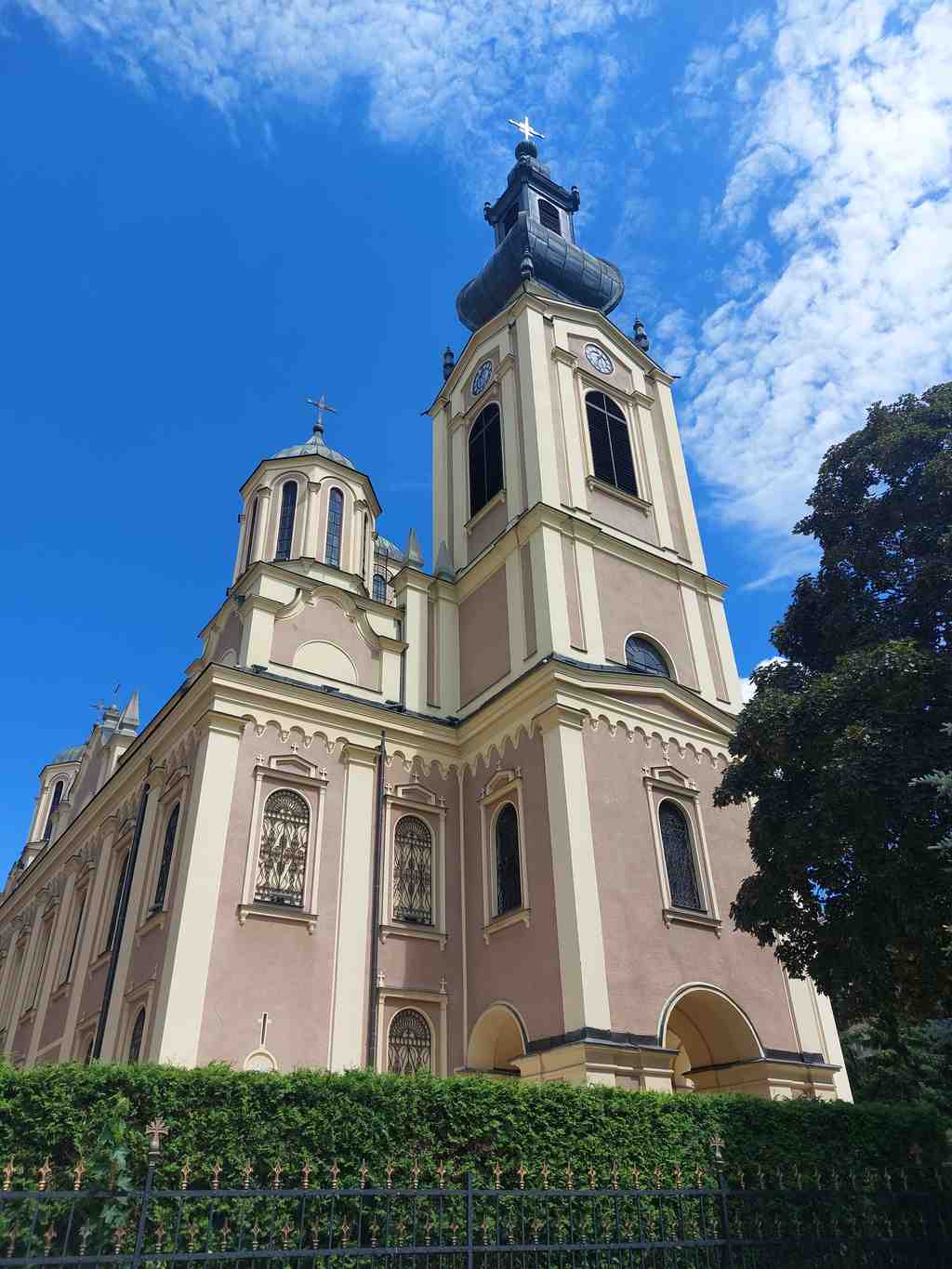
To spot the Cathedral of the Nativity of the Theotokos, just look up for the largest Orthodox church in Sarajevo-its pale pink walls, striking five domes, and a tall gilded baroque belfry with a golden cross shining above the green hedges will guide your eye.
Welcome! You’re now standing before one of Sarajevo’s grandest sights, where history towers overhead and the past whispers from every stone. This majestic cathedral, the largest Serbian Orthodox church in the city, was built between 1863 and 1868-back when Sarajevo was bustling under Ottoman rule. Picture a city skyline dotted mostly by slim minarets, and imagine the chatter spreading as Orthodox Christians began raising their own monumental building right here. All around you, the sound of chisels and hammers filled the air as master builders from the renowned Damjanovi-Renzovski family designed a church unlike anything Sarajevo had ever seen: three sections in a cross shape, painted walls imitating elegant marble, and no fewer than five domes-one massive in the center, four smaller at the corners-all perched above solid wooden beams.
What makes this cathedral even more dramatic is its backstory. The Orthodox community, led by the spirited Manojlo Jeftanović, raised most of the 36,000 dukats for construction, but the truly unusual part is who else chipped in: the Ottoman Sultan Abdülaziz and Serbia’s Prince Mihailo Obrenović each donated 500 dukats! Even Tsar Alexander II of Russia sent his best craftsmen to carve the magnificent iconostasis. For a moment it must have seemed like peace and good neighborliness would win the day.
But as soon as the tower rose high, locals took notice. Some conservative Muslims in Sarajevo became uneasy seeing a church spire rising high over the city, taller than many minarets. A little comedy here-the new church was called the “New Orthodox Church” just to avoid confusion with the “old” one a few blocks away, but it had already made a big impression!
In 1871, excitement and tension reached a boil. A hot May day was set for the cathedrals' dedication, but rumors spread like wildfire. About forty agitated townsfolk, followers of the fiery imam Hadži Lojo, planned to block the ceremony. The Ottoman governor didn’t wait-he sent police, who quickly arrested some and sent others running for the hills. The dedication had to be postponed. The next summer, determined the celebration would go on, the authorities sent over a thousand soldiers and even rolled a cannon above the city! Imagine the nerves in the air as troops guarded the grounds, all for the church’s grand debut.
But, at last, in the sunshine of July 20, 1872, the dedication went off in spectacular fashion. Local Serbs, Ottoman officials, even a young Austro-Hungarian ambassador-future mover and shaker Béni Kállay-looked on as the new cathedral stood proud, a symbol of Sarajevo’s layered identities. Since then, the church has weathered wars and political storms but remains a dazzling centerpiece. In 2006, it finally received the honor it deserved, becoming a recognized National Monument. So, as you gaze up at those domes and golden crosses, just imagine the cheers, the worries, and the cannon on the hill-a place where faith and history still echo through the streets.




