
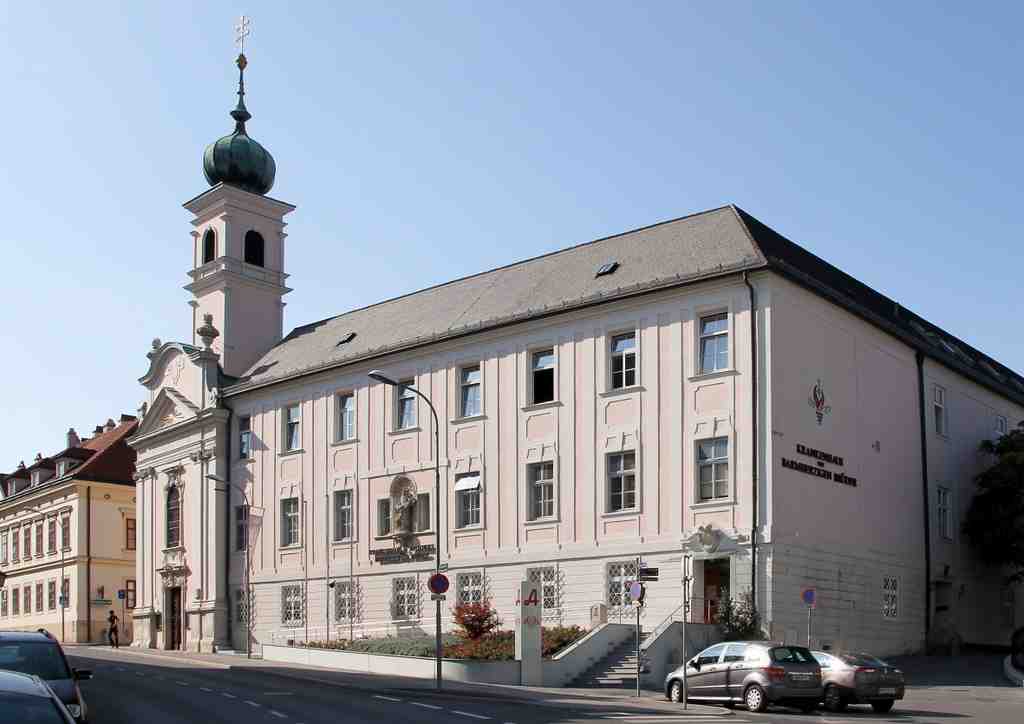
On your right, look for the pale, three-story hospital block with a central gable, the Esterházy coat of arms, and a niche holding a statue of Saint John of God.
This place tells a quieter kind of power story... not who ruled, but who got cared for when life went sideways. Around the year fifteen hundred, Eisenstadt already had a poorhouse where brothers of the Order of Saint George nursed the sick and wounded. After the Esterházy family made the city their residence in sixteen twenty-two, they kept a civic hospital here in town. So the habit in Eisenstadt was old: authority, yes, but with a bed, a remedy, and someone at your side.
The turning point came with Prince Paul Anton the Second Esterházy. In seventeen fifty-nine, and formally in seventeen sixty with Empress Maria Theresa’s approval, he handed this complex to the Brothers of Mercy: hospital, church, and pharmacy together. Very efficient, really. One donation, several forms of salvation.
If you peek at the app image, you can catch that long historic frontage as part of a living medical campus, not a museum fossil.
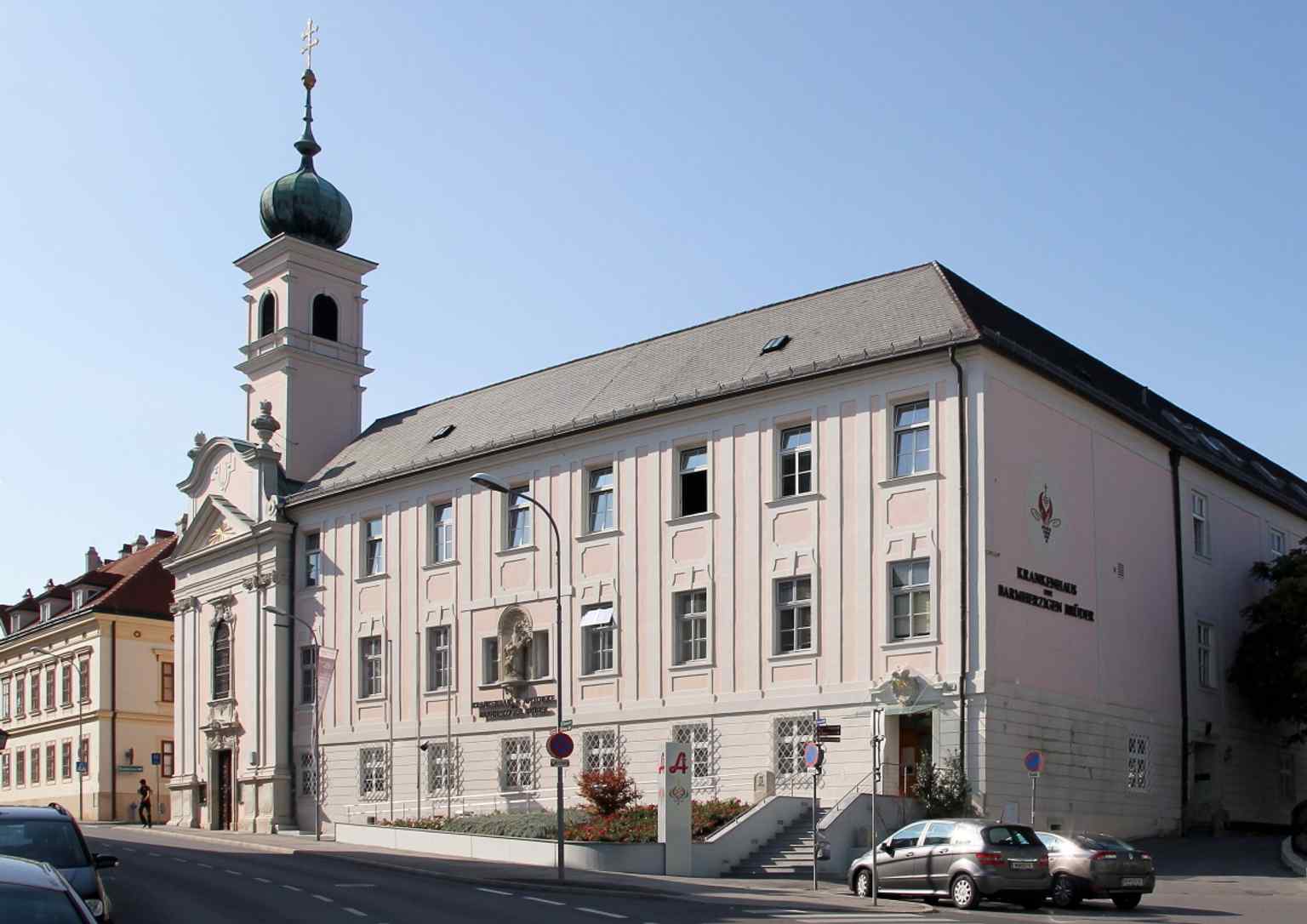
The church attached to the old hospital was already standing by seventeen thirty-nine. Inside, it holds a tiny baroque organ with just eight stops, meaning eight sets of pipes to shape the sound. And that modest instrument matters because Joseph Haydn likely wrote his Missa brevis Sancti Joannis de Deo for it, and tradition says he played here himself. So even in a hospital chapel, Eisenstadt found room for music... because healing the spirit has always been part of the treatment plan.
This house also absorbed the region’s harder history. Until the mid nineteenth century, the Brothers here belonged to the Hungarian order province, and the site stayed tied to Hungary until nineteen twenty-two. Then in nineteen thirty-eight, the Nazi state expropriated the hospital. That same year, after church schools were shut, the first Sister of the Divine Redeemer arrived to nurse here. What began as a stopgap became a long partnership with generations of sisters, ending only when the order finally withdrew.
After the Second World War, this was the only medical provider for northern and central Burgenland. New departments followed: internal medicine in nineteen forty-seven, then ear, nose and throat care, gynecology, pediatrics, trauma surgery, anesthesia, and intensive care. In recent years the hospital added a palliative ward, a stroke unit for urgent brain-attack treatment, a central laboratory, and even a Da Vinci surgical robot in twenty twenty-five. Baroque charity, meet high-tech medicine.
There is one more lovely Eisenstadt detail: the Brothers also kept a wine cellar here for more than two hundred and fifty years. Because of course in this town, even a hospital comes with a connection to music, faith, and wine.
From here, we head toward a different sort of recovery: public distraction, flickering screens, and a city learning to entertain itself. Haydn Cinema is about a four-minute walk from here.
And fittingly for a hospital, this place never really closes; it is open twenty-four hours a day.





