
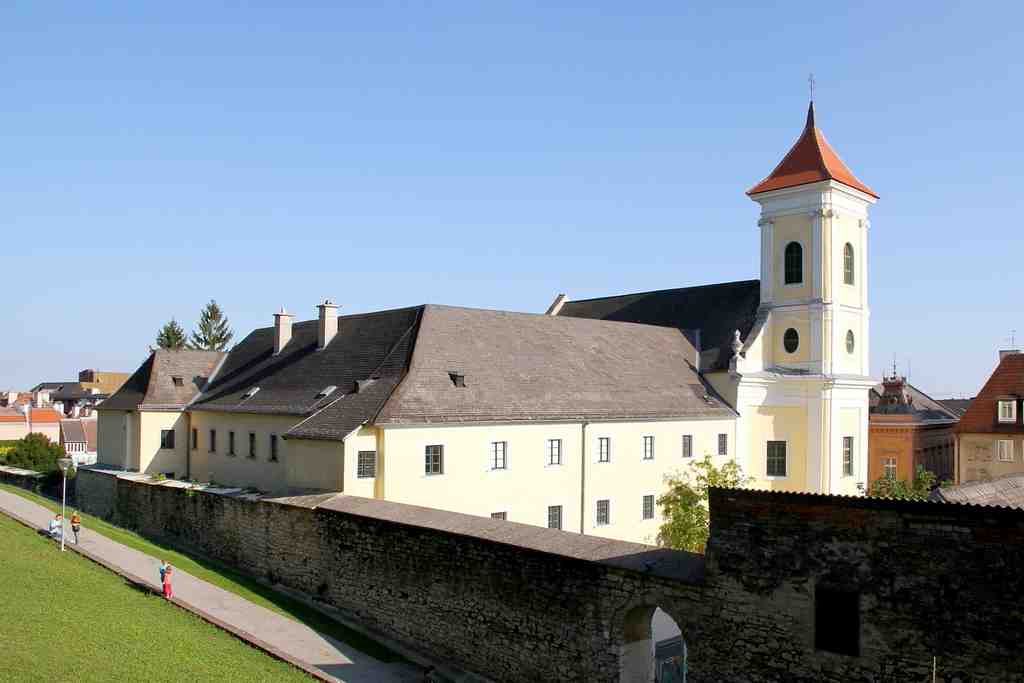
On your right, look for the pale church façade with its tall baroque tower, simple gabled roofline, and the attached monastery wing pressed close along one side.
At first glance, this place seems almost plain... which is exactly how it sneaks up on you. The Franciscan church and monastery of Saint Michael hold one of Eisenstadt’s longest, most tangled memories.
This ground had a religious life long before the present buildings. In thirteen eighty-six, Archbishop Johann Kanizsai established a monastery and church here, back when Eisenstadt had only just become a walled town. Later, a Minorite house and the church of Saint John the Evangelist stood on this spot, until the Ottoman attack of fifteen twenty-nine destroyed them. After that, the place lay empty for decades, a scar right in the town.
Then Count Nikolaus Esterházy stepped in. In sixteen twenty-five, he founded a Franciscan monastery here, and between sixteen twenty-five and sixteen twenty-nine the friars and their patrons raised the church you see now, folding some older Gothic building parts into the new work. They consecrated it in sixteen thirty.
This is also where the Esterházy family enters religious space in a very intimate way. They were the great ruling house of Eisenstadt, and they did not keep power neatly inside a palace. In seventeen oh five, Prince Paul the First Esterházy chose this complex as the family burial place, and the friars took on the care of that crypt along with their pastoral work. Most visitors never realize that the princely dead are here at all, because inside the church you do not see grand tombstones advertising the fact; the family crypt sits in the monastery wing and opens only from the cloister. Power, here, learned to whisper.
Eisenstadt also kept meeting the same harsh editor over and over again: fire. In seventeen sixty-eight, one of the city’s recurring fires badly damaged this church and monastery. It did not stop there. The same blaze also spread into the surrounding neighborhood, so this cloister belongs to the city’s domestic story too, whether either building asked for the connection or not. Another fire in seventeen seventy-six struck again, and Prince Nikolaus the First financed repairs.
Even after disaster, the place kept shaping culture. In seventeen seventy, Stephan Dorfmeister painted the refectory, the friars’ dining hall, with scenes including the Last Supper. By seventeen ninety-three, the organist here was the Franciscan Gaudentius Dettelbach, a remarkable scholar who spoke German, Latin, Hungarian, and Slovak, and compiled a large handwritten collection of church music for the order. So this monastery did not just pray and bury princes; it helped decide what sacred music would sound like.
Inside, the church still preserves early baroque altars from around sixteen thirty, crafted by Italian artists who usually worked for the court. And the story keeps moving: since nineteen eighty, part of the monastery has housed the diocesan museum. In twenty eighteen, after the last two Franciscan friars left, the diocese took over the complex.
Monastery walls rarely boast, but they often keep more of a city’s biography than any grand façade. From here, Haydn House is about a one-minute walk away... and now you know the two places already share a burn mark in history. If you want to return later, the site generally keeps daily hours from nine to six.




