
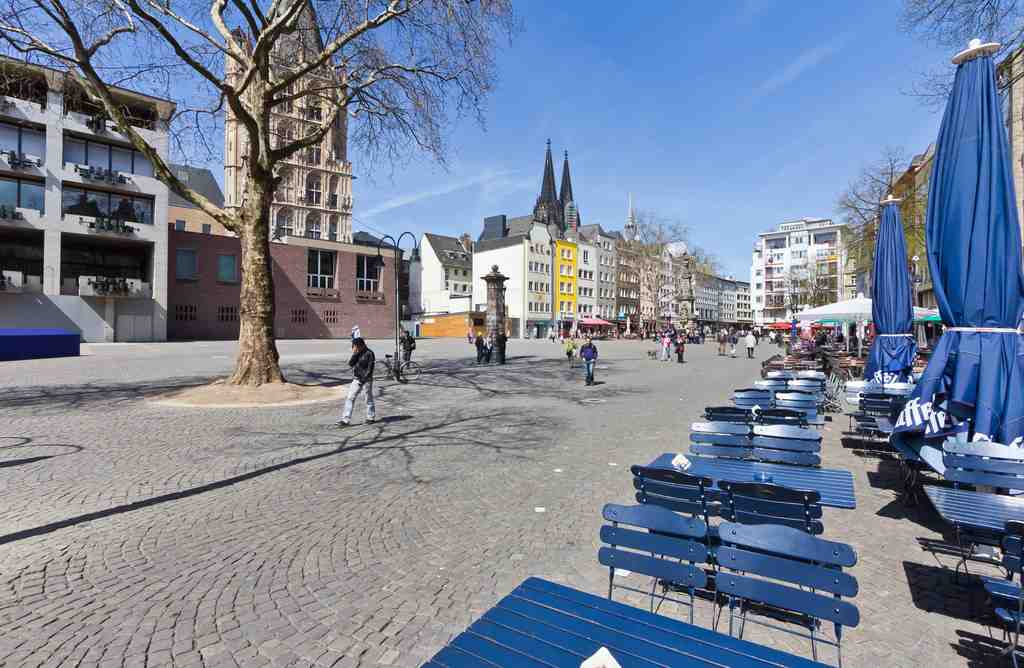
You are looking at a wide, stone-paved plaza framed by narrow gabled buildings, with an intricately carved stone fountain monument standing near the center and the towering octagonal stone spire of the town hall rising to your left.
This is the Alter Markt, the oldest continuously recorded square in Cologne, documented since the year nine twenty-two. But the real story of this ground goes much deeper, literally. If you dug down thirteen meters below where you are standing, you would not find solid earth, but the bottom of an ancient Roman harbor. The Romans built a massive port right here in the first century. During the construction of a new subway line in two thousand and seven, workers actually unearthed a massive Roman transport barge buried deep in the mud. By the third century, the river had filled with sand and silt, pushing the water eastward and creating the solid ground you see today.
During the Middle Ages, the city's wealthy merchant families claimed this new land. The Alter Markt became the stage for grand, theatrical jousting tournaments. The city patricians hosted knights and kings right on this spot. To protect the riders from the hard ground, organizers would cover the plaza in thick layers of manure. This detail became famously embarrassing in October of fourteen eighty-six, when the young King Maximilian the First was knocked from his horse and landed face-first in the muck.
The beautiful stepped gables lining the square today give you a sense of that merchant wealth, but they carry a heavy legacy. Heavy bombing in May of nineteen forty-two and June of nineteen forty-three leveled nearly every historic house here. You can take a quick look at your screen to see a photo showing how the eastern side of the square looked in nineteen oh nine, compared to its rebuilt architecture today.
As residents rebuilt, they made sure to preserve the unique local sense of humor. If you look closely near the roofline of the plain building at number twenty-four on the east side, you will find a small, strange sculpture called the Kallendresser. The term refers to someone relieving themselves into a rain gutter. The legend behind it claims two neighbors had a bitter feud. One man insisted on playing his tuba loudly at the open window every day. The neighbor living directly above him finally snapped, hung out of his own window, and perfectly aimed his waste right into the bell of the loud tuba, silencing the musician. The city thought the story was so funny that they immortalized the act in stone.
This square has survived buried Roman ships, royal embarrassments, and total destruction, yet it always returns to life. Take all the time you need here. When you have taken it all in, we will make our way toward the Heumarkt.




