
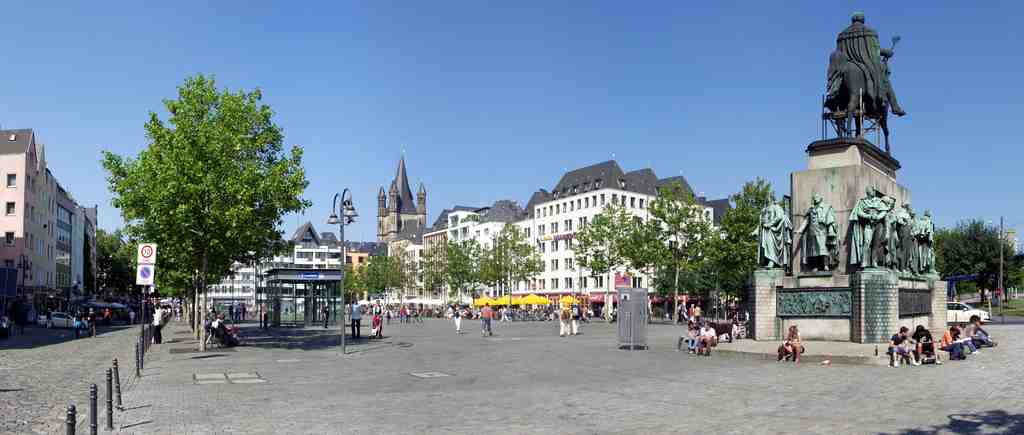
Look to your left for a vast stone paved square anchored by a towering bronze equestrian statue perched on a massive, tiered stone pedestal. You are standing on Heumarkt, the historic hay market, but beneath the cobblestones lies a very different landscape.
In the first century, you would have needed a boat to reach this exact spot. Back then, this area was a kilometer long island sitting entirely within a deep arm of the Rhine river. The Romans heavily fortified it, building a massive stone harbor where up to two hundred transport ships could dock at once, bringing in the heavy stone needed to build their ancient city. As the centuries passed, sand built up, the river arm dried out, and the ground softened. By the year nine fifty-seven, Archbishop Brun ordered the muddy land cleared and filled to create a central market.
And a central market it became. For hundreds of years, Heumarkt and the nearby Alter Markt were actually one massive, unified space. Farmers carted in enormous piles of hay, giving this square its enduring name, alongside vegetables, cheese, and livestock.
But Heumarkt was also the stage for the city's darkest public spectacles. The city council erected a pillory and a gallows right here to punish anyone who defied their authority. In fifteen thirteen, a fierce guild rebellion led to a series of gruesome public executions on this very stone. When the executioner swung his blade at a councilman named Diederich Spitz, he struck with such violent force that the man's severed head went rolling straight into the terrified crowd. To appease the mob, the executioners then publicly beheaded several other high ranking officials, including the former mayor Johann von Berchem.
Thankfully, the dramatic focal point of the square today is much less grisly, though it has its own chaotic story. Look closely at the towering monument to Prussian King Friedrich Wilhelm the Third. During an air raid in nineteen forty-three, a massive blast threw the bronze horse and its royal rider right off the pedestal. In nineteen fifty-nine, city officials decided to melt down the damaged fragments. They destroyed almost everything, except for the king's head and the horse's rear end, which the locals affectionately nicknamed the Fott vum Pääd in the local dialect. The rest of the statue you see today was painstakingly reconstructed from scratch in nineteen ninety.
You can check out the before and after image in your app to see how this historic square and its iconic equestrian statue endured and evolved around the devastation of World War Two.
Today, Heumarkt pulses with life again, bridging the ancient Roman waters and the modern energy of the city. Feel the layered history beneath these stones. When you are ready, let us continue to our next destination.




