AudaTours logoAudaTours

Aachen Audio Tour: Echos von Kaisern, Banken und barocker Pracht

Audioguide13 Stopps

Vor tausend Jahren knieten Kaiser unter hoch aufragenden Gewölben, während geheime Räte in kerzenbeleuchteten Korridoren flüsterten. Aachens Steine bergen das Echo von Krönungen und Verschwörungen, wenn man weiß, wo man lauschen muss. Mit dieser selbstgeführten Audiotour folgen Sie verwinkelten Gassen von der goldenen Pracht des Aachener Doms zu den geflüsterten Geschichten im Palast von Aachen und dem Couven Museum. Erfahren Sie Dramen und Details, an denen die meisten Besucher vorbeieilen. Welche verborgene Agenda explodierte einst in eine Rebellion direkt unter den Palastbögen? Welches Relikt im Dom entfachte einen Kampf zwischen Glaube und Ehrgeiz? Und warum birgt ein scheinbar gewöhnliches Teeglas im Couven Museum den Schlüssel zu einem der faszinierendsten Skandale Aachens? Bewegen Sie sich durch Licht und Schatten, während mit jedem Schritt Geschichten ans Licht kommen. Am Ende der Reise werden Sie Aachen mit neuen Augen sehen – vielschichtig, dramatisch, unvergesslich. Die Geheimnisse der Stadt warten. Drücken Sie auf Play und lüften Sie sie.

Tourvorschau

map

Über diese Tour

  • schedule
    Dauer 40–60 minsEigenes Tempo
  • straighten
    1.6 km FußwegDem geführten Pfad folgen
  • location_on
  • wifi_off
    Funktioniert offlineEinmal herunterladen, überall nutzen
  • all_inclusive
    Lebenslanger ZugriffJederzeit wiederholen, für immer
  • location_on
    Startet bei AachenMünchener

Stopps auf dieser Tour

  1. Look for the modern, angular structure built with sweeping panels of reflective glass and a distinctive open pathway cutting straight through its ground floor. For centuries,…Mehr lesenWeniger anzeigen
    AachenMünchener
    AachenMünchenerPhoto: Unknown author, Wikimedia Commons, Public domain. Cropped & resized.

    Look for the modern, angular structure built with sweeping panels of reflective glass and a distinctive open pathway cutting straight through its ground floor.

    For centuries, this city's story was dictated by emperors and kings, grand thrones, and royal decrees. But eventually, a new kind of force took root... the power of civic ambition. Local businessmen began stepping out from the long shadow of royalty to forge their own destiny, shaping the local community from the ground up rather than from a palace down. At the heart of this shift was a visionary named David Hansemann, a man who realized that financial institutions could do far more than turn a profit, seeing them instead as essential tools to provide true social security for everyone.

    Hansemann was a successful wool merchant and the son of a pastor. In 1825, he founded a fire insurance company right here in Aachen. He was a brilliant, cool-headed calculator, yet he carried a revolutionary conscience. He actually wrote it into the company's rulebook that half of all annual profits must be donated to charity. He set up an association dedicated to diligence, channeling vast amounts of corporate money into building local schools, kindergartens, and public housing. To invest in this vision, people would buy shares. An early stock certificate from 1930 cost one thousand Reichsmarks, which would be the equivalent of about five thousand dollars today.

    Over the decades, his company grew into the massive AachenMünchener group. But the path held dark chapters too. In 1938, during the oppressive era of the National Socialists, the regime systematically crushed Catholic organizations. The company absorbed a liquidated Catholic insurer, an opportunistic expansion that was part of the forced economic alignment common during those harsh years.

    Later in the century, the brand became a household name across the country. They hired the renowned actor Mario Adorf for a series of lavish television commercials, declaring with grave seriousness that you do not play with money. The irony was quite thick, as the broader European financial world was about to do exactly that.

    In 1998, the company's independence ended in a massive corporate game of chess. An Italian insurance giant named Generali attempted a hostile takeover, trying to force a buyout of a reluctant French company. A German firm, Allianz, rode to the rescue as a financial white knight to buy the French company instead. But to avoid monopoly laws and appease the Italians, Allianz traded away their shares in AachenMünchener. The proud, historic civic institution became a simple consolation prize in a multi-billion dollar European poker game.

    Yet, before the brand name officially vanished, they left behind this striking architectural gift, completed in 2010 by the local firm kadawittfeldarchitektur. Instead of a fortress, they designed an inviting, transparent glass hub that features a pocket park and a public pathway connecting the train station to the inner city.

    If you want to take a closer look, the complex is generally open from 9 AM to 8 PM Monday through Saturday, though it is closed on Sundays.

    As we consider how early insurance laid the groundwork for public welfare, we can see how those same ideals sparked the rise of cooperative banking just a short stroll from here. Let us keep walking, it is about a four minute journey over to our next destination, the Aachener Bank.

    Eigene Seite öffnen →
  2. Here in front of you stands the Aachener Bank. While so much of local history is shaped by emperors and grand palaces, the story of this building rests firmly in the hands of the…Mehr lesenWeniger anzeigen

    Here in front of you stands the Aachener Bank. While so much of local history is shaped by emperors and grand palaces, the story of this building rests firmly in the hands of the people. This is the heart of what we call the cooperative spirit. In a cooperative model, ordinary citizens buy a membership and pool their hard earned resources together, sharing ownership of the bank. Instead of distant wealthy shareholders, the local people vote on decisions, and the profits are poured right back into the community to support neighborhood charities, social projects, and local sports.

    They even sponsor the beloved local bicycle race that bounces over the old cobblestones around the Cathedral and City Hall. It is a beautiful example of civic power in action, everyday people holding their own alongside grand institutions.

    The roots of this place go back to December 3, 1899. Imagine stepping back to that day, not into a glittering hall, but into a humble Catholic journeyman's house on Pontstraße. A journeyman's house was a simple lodging for traveling craftsmen who had finished their apprenticeships. There, nine master craftsmen gathered with a simple idea: help for self help. They did have one prominent figure among them, a consul named Adam Johann Jakob Bragard, whose presence gave their small venture some immediate societal weight.

    Through trust, they weathered the economic crash of 1929. By 1942, their balance sheet had grown to four million Reichsmark, which would be around eighteen million dollars today. But their finest hour came just after the Second World War. People needed to rebuild their shattered lives but had no collateral, meaning they had no valuable property or assets to guarantee a loan. The bank lent them the money anyway, relying entirely on the deep trust they had built with their members.

    As the city grew, so did the bank. A merger in 1960 pushed their assets to thirty five million Deutsche Marks, roughly eighty five million dollars in today's money. Over the years, they expanded outward, even crossing the border into Belgium to open a branch in Eupen in 1990.

    That Belgian branch actually provided a rare splash of drama years later. In 2016, long after the branch had closed, a former employee alleged that the bank had kept secret accounts for money laundering. The bank firmly denied it. Extensive internal investigations found absolutely no evidence of wrongdoing, and the bank was completely cleared, but it was certainly a wild chapter for such a quiet institution.

    Today, that grounded spirit remains. For their one hundred and twenty fifth anniversary in 2024, instead of throwing an expensive gala, the bank executives traded their suits for work clothes. They spent their workdays physically renovating a local children's home playground. Even as they recently merged to become part of a massive cooperative network, they made sure to keep their beloved Aachener Bank name right here at home.

    If you need to step inside, they are open most weekdays from nine to five or six, closing early on Fridays and remaining closed on weekends. Now, let us take a short, one minute walk toward Theater Aachen, where you will see exactly how this kind of civic wealth takes the stage.

    Eigene Seite öffnen →
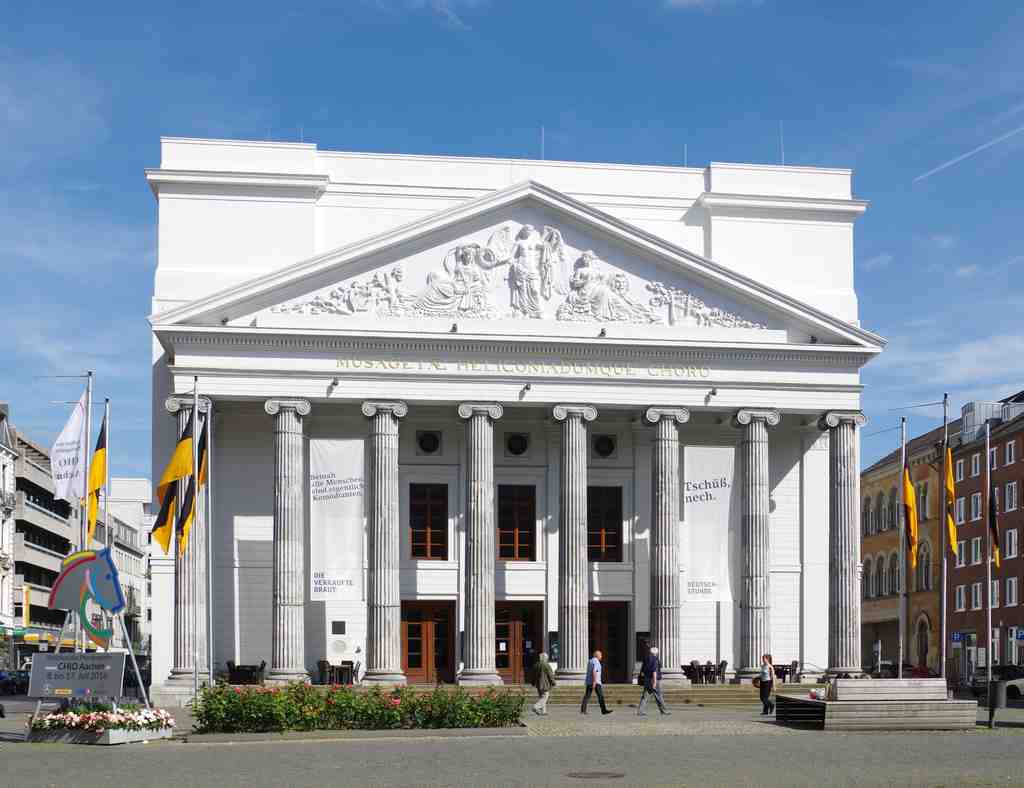
  3. Look to your right, where you will spot a grand, brilliant white classical building featuring a wide, beautifully carved triangular roofline resting atop eight towering fluted…Mehr lesenWeniger anzeigen
    Theater Aachen
    Theater AachenPhoto: Berthold Werner, Wikimedia Commons, CC BY-SA 3.0. Cropped & resized.

    Look to your right, where you will spot a grand, brilliant white classical building featuring a wide, beautifully carved triangular roofline resting atop eight towering fluted stone columns.

    This is Theater Aachen. Today, it stands as a magnificent temple to the arts, but its roots are surprisingly humble. Before this grand structure existed, Aachen's first public theater was housed in a simple converted cloth hall, a practical space originally used by weavers and merchants. But as the early nineteenth century dawned, the city experienced a massive boom in spa tourism. Wealthy elites and European high society flocked here to soak in the healing thermal waters. These affluent visitors expected glamour and prestige to match the imperial reputation of the city, and a modest old cloth hall simply would not do. The pressure mounted from both the ruling administrations and the proud citizens to build something truly spectacular.

    To answer this call, the city enlisted the genius of Karl Friedrich Schinkel and Johann Peter Cremer. These master architects worked together to design the classicist cultural venues that forever elevated Aachen's landscape. Cremer originally planned for six columns, but Schinkel expanded the design to eight, creating the breathtaking, full-width entrance we see now. You can really appreciate their vision if you look at the exterior photo on your screen. Notice those eight majestic pillars... they are Ionic columns, a classical Greek architectural style recognized by the elegant, scroll-like loops at the top, and they are carved entirely from local Aachen bluestone.

    For over a century, the theater thrived as a beacon of high culture, but tragedy struck in July 1943. A devastating bombing raid reduced the magnificent building to ruins, leaving only the front columns and the triangular pediment, the decorative gable just above the pillars, standing. Yet, this is where the true heart of Aachen's people revealed itself. The imperial powers that once demanded grand monuments were gone, replaced by ordinary residents desperate for connection and art.

    In the years immediately following the war, the people were quite literally starving, yet their hunger for theater was just as fierce. Local artists performed in makeshift spaces like the city library or drafty school gymnasiums. The citizens stood in long lines just to watch a play, and since money was scarce, they paid their admission with whatever they had... a few coal briquettes or a handful of potatoes. That sheer civic willpower eventually drove the reconstruction of this beloved house of art. You can see how the grand neoclassical facade of Theater Aachen has endured through the decades, from its pre-war elegance to its modern-day presence in the bustling city, by checking out the before and after comparison in your app.

    The people of Aachen proved that a city's cultural soul belongs to its citizens. But monumental dreams also require monumental funding. Let us continue just one minute down the street to our next stop, the Bankhaus Kapuzinergraben, to discover the financial powerhouses that helped fund the city's grandest ambitions.

    Eigene Seite öffnen →
10 weitere Stationen anzeigenWeniger Stationen anzeigenexpand_moreexpand_less
  1. Before you stands a grand, sand colored stone building characterized by its deeply textured lower blocks, a striking curved gable rising on the upper right, and a monumental…Mehr lesenWeniger anzeigen
    Bankhaus Kapuzinergraben
    Bankhaus KapuzinergrabenPhoto: User:Grunpfnul, Wikimedia Commons, CC BY-SA 4.0. Cropped & resized.

    Before you stands a grand, sand colored stone building characterized by its deeply textured lower blocks, a striking curved gable rising on the upper right, and a monumental arched doorway anchoring the left side.

    This is the Bankhaus Kapuzinergraben, completed in nineteen ten. It stands as a profound physical monument to the ambitious merchants who built the modern might of this city. For centuries, emperors and kings left their grand mark on Aachen, but by the nineteenth century, a new kind of power was rising. It was the power of civic enterprise, forged by local merchants.

    The story of this immense wealth begins with a man named Leopold Scheibler. He was not born into royalty. He was a master of transport, running a booming business that moved vast quantities of wool and cloth across the region. In eighteen sixty eight, Scheibler cleverly expanded his freight company into a private banking venture. His heavy transport wagons and careful ledgers laid the exact financial foundation for the bank that eventually built this very edifice.

    Look closely at that massive doorway on the left side of the facade. Above the arch, you will see two Atlantes, which are massive sculpted male figures used in place of standard stone columns to support the structure above them. They are not holding up the heavens like the mythological Atlas. Instead, they hold the tools of local industry.

    The figure on the left grasps a heavy ledger and a money bag, while the one on the right stands near a millstone and holds a sickle. These are direct, heartfelt tributes to the bank's founding families, honoring the honest, heavy labor of milling and transport that paved their path to prosperity. The architect blended Neo Baroque, a revival of highly ornate, theatrical seventeenth century design, with flowing, modern elements to project absolute financial stability.

    But the building has seen its share of deep scars. Following the Second World War, its roof was simplified, and in the nineteen sixties, the bank's magnificent, cavernous main hall was entirely demolished to make way for ordinary offices, erasing a grand piece of local history.

    If you glance at your screen, you can see a photo from twenty nineteen during a massive redevelopment phase. The historic bank was preserved and woven into a modern complex of offices and hotel spaces. This project forever changed the street, leading to the demolition of the neighboring Elysée cinema, a cherished local theater where generations of Aacheners spent their youth and fell in love with the magic of film.

    The Bankhaus Kapuzinergraben in 2019, showing the adjacent construction site for Motel One, part of a major redevelopment that integrated the historic bank into a new complex of offices, apartments, and hotel space.
    The Bankhaus Kapuzinergraben in 2019, showing the adjacent construction site for Motel One, part of a major redevelopment that integrated the historic bank into a new complex of offices, apartments, and hotel space.Photo: Jonathan Haas, Wikimedia Commons, CC BY 4.0. Cropped & resized.

    Today, this complex stays open late, welcoming guests from seven in the morning until one or two in the morning, depending on the day.

    These wealthy merchants shaped the bustling streets you stand on right now. But long before the ledger books and the transport wagons arrived, there was a deeper, natural draw that made this land legendary in the first place. Let us walk about two minutes away to Elisenbrunnen, to uncover the steaming, mineral rich waters that forged the city's very first fortunes.

    Eigene Seite öffnen →
  2. Here we are at the magnificent Elisenbrunnen. Take a moment to take in the sheer scale of this building, with its grand pavilions and sweeping colonnades. Aachen is defined by…Mehr lesenWeniger anzeigen

    Here we are at the magnificent Elisenbrunnen. Take a moment to take in the sheer scale of this building, with its grand pavilions and sweeping colonnades.

    Aachen is defined by its thermal waters. Deep beneath the ground we are walking on, hot, sulfurous springs bubble through the earth. For thousands of years, long before the Romans built their vast bathing complexes here, these deeply healing waters have drawn people seeking cures and comfort from all over the world. The water piped into this very building from the nearby Kaiserquelle, or Emperor's Spring, arrives at a steaming 52 degrees Celsius, which is about 125 degrees Fahrenheit.

    Back in the 1820s, the city leaders wanted a grand drinking hall to showcase these famous waters. They chose this exact spot to make a bold statement. Believe it or not, before this elegant structure existed, this area was an open, foul smelling sewer ditch. The city council transformed a dreaded eyesore into the most sophisticated promenade in town, proving that the local citizens could build something just as magnificent as any emperor's palace. To do this, they turned again to the renowned architects Johann Peter Cremer and Karl Friedrich Schinkel. If you glance at your screen, you can see a lovely detail of the crisp Doric columns, those classic, unadorned pillars that define this neoclassical masterpiece.

    A close-up of the Doric columns and pilasters surrounding the Elisenbrunnen's central rotunda, a hallmark of its Neoclassical architecture.
    A close-up of the Doric columns and pilasters surrounding the Elisenbrunnen's central rotunda, a hallmark of its Neoclassical architecture.Photo: Jean Housen, Wikimedia Commons, CC BY-SA 4.0. Cropped & resized.

    The building was named after the Prussian Crown Princess Elisabeth, affectionately called Elise. In 1832, a pristine Carrara marble bust of the Princess was proudly placed right inside the central rotunda.

    Step close and look into that open rotunda. Can you imagine the heavy, pungent scent of sulfur that fills the air here?

    It is the unmistakable smell of rotten eggs. And as it turns out, those potent, sulfurous vapors are highly aggressive. The city had built this glorious civic monument to honor royalty, but nature had the last laugh. The harsh thermal fumes literally began eating away at the Princess. Her beautiful marble face was dissolving. Eventually, the original royal bust had to be evacuated to a local museum to save it, and the one you see today is just a much tougher copy.

    During the Second World War, the Elisenbrunnen was nearly completely destroyed by bombs. When it came time to rebuild, local architects proposed sleek, modern replacements. But Ludwig Mies van der Rohe, the world famous pioneer of glass and steel modernism who was born right here in Aachen, stepped in. He passionately argued that the beloved classicist design of Schinkel and Cremer had to be brought back exactly as it was. You can tap your screen to see a neat comparison showing the elegant facade in 1915, and how faithfully it was reborn after the war. It was a beautiful moment of the city honoring its own roots.

    By the way, you can wander through these colonnades any time you like, as the space is open twenty four hours a day, every day of the week. Let us leave these grand pavilions behind now and explore the older, more intimate historic streets nearby. It is just a short two minute stroll over to our next stop, Klüppel.

    Eigene Seite öffnen →
  3. Look for the striking rough-hewn stone facade, anchored by a wide central arched doorway and topped with a steeply pitched roof featuring a prominent dormer window. Let me tell…Mehr lesenWeniger anzeigen
    Klüppel
    KlüppelPhoto: Unknown author, Wikimedia Commons, Public domain. Cropped & resized.

    Look for the striking rough-hewn stone facade, anchored by a wide central arched doorway and topped with a steeply pitched roof featuring a prominent dormer window. Let me tell you the story of the Klüppel, a fascinating double house that once defined this very corner.

    Its origins are wrapped up in some rather cunning family networking. Back in the late fourteen hundreds, a city financial official-often called a rentmaster-named Johann von Guilich owned the main house here. Through a quiet web of family ties, his relative seized the neighboring building over unpaid rent and simply handed it over to Johann. Just like that, the Great and Small Klüppel were united under one family, secretly connected by an underground cellar.

    But these quiet cellars soon served a far more daring purpose. During the late sixteenth century, the city's religious landscape was fraught with conflict, forcing reformed Protestant communities to seek temporary safe havens away from the ruling Catholic authorities. The Klüppel became exactly that-a hidden sanctuary where ordinary residents gathered in secret to practice their faith.

    As the Protestant community grew stronger, they began to push back against the old imperial order. A brave mayor named Peter von Zevel saw an opportunity for a major civic triumph. He boldly transformed the Great Klüppel into the official, central prayer house for the entire reformed community. For a brief, shining moment, the citizens of Aachen claimed their own spiritual independence right here, defying the immense weight of the empire's traditional powers.

    Sadly, this victory was short-lived. The Catholic authorities struck back hard, securing an imperial ban-a devastating legal decree from the emperor that essentially declared the reformers as outlaws. Mayor von Zevel lost everything and was forced into exile, and the city quickly confiscated the Klüppel. The citizens had boldly flexed their power, but the heavy hand of the empire crushed their newfound freedom.

    Over the following centuries, the building lived many fascinating lives. It served as a city weigh house, a noisy coffee roastery, and eventually a wildly popular restaurant boasting the city's very first gas lighting. Diplomats and wealthy travelers flocked to it, dazzled by the bright modern lights. However, despite fierce protests from the local public who wanted to protect their heritage, the historic stone walls were torn down in the nineteen thirties simply to make way for modern traffic flow.

    If you need to visit the venue here today, they are open Monday through Friday from nine in the morning until one in the afternoon, and remain closed on weekends.

    The spirit of Aachen is always shifting, shaped as much by local defiance as by deep imperial roots. Now, let us turn our attention back toward the legacy of the thermal waters at the site of the old baths, as we make the two-minute walk over to Kaiserbad.

    Eigene Seite öffnen →
  4. To help you spot our next stop in the provided image, look for the grand four-story stone facade featuring repeating rows of arched windows and a prominent central balcony…Mehr lesenWeniger anzeigen
    Kaiserbad
    KaiserbadPhoto: Unknown author, Wikimedia Commons, Public domain. Cropped & resized.

    To help you spot our next stop in the provided image, look for the grand four-story stone facade featuring repeating rows of arched windows and a prominent central balcony supported by sturdy classical columns. Standing here, you are right above the very heart of the city's ancient water network. Long before any grand hotels existed... this site was ruled by the Roman military. The soldiers discovered the Kaiserquelle, an incredibly hot natural spring bubbling up at fifty-two degrees Celsius, and they built the first monumental bathhouses around it, known as the Büchelthermen. The sheer might of an empire was poured into these deep foundations, laying down a powerful bathing culture that would define the city for centuries to come. If you glance at your screen, you can see a glimpse of those deep origins... the ancient Roman spring enclosure, which today is preserved and visible under a modern glass floor.

    The interior of the Kaiserquelle's chamber, showing the original spring enclosure, which the 1990s 'Quellhaus' design made visible through a glass floor to honor the site's 2000-year history.
    The interior of the Kaiserquelle's chamber, showing the original spring enclosure, which the 1990s 'Quellhaus' design made visible through a glass floor to honor the site's 2000-year history.Photo: © Geolina, Wikimedia Commons, CC BY-SA 4.0. Cropped & resized.

    But as the Roman empire faded and the centuries rolled into the Middle Ages, the local citizens claimed these baths for themselves, and the dark, steaming ruins birthed an entirely different kind of story. Have you ever heard of the Bahkauv? Locals translated it as the brook calf. According to legend, this terrifying creature... a massive calf with sharp teeth and a scaly tail... lurked during the day in the warm, shadowy wastewater canals of the thermal baths. But at night, the monster would creep out into the alleys. It waited for drunken men stumbling home from the taverns, leaping onto their shoulders and forcing them to carry it. The beast would grow unbearably heavy if the poor victim started to pray, but it would instantly become lighter if the man began to swear.

    Historians suspect this myth was just a clever, face-saving excuse invented by local husbands who had gambled away all their money and needed a fantastical reason for arriving home utterly exhausted with empty pockets. It brilliantly shows how the working people of the town wove their own vibrant, mischievous identity right over the strict imperial Roman foundations. You can actually see how the city later honored this local legend by checking the before and after image on your device, showing the whimsical bronze Bahkauv fountain that was added in front of the grand hotel between 1880 and 1920.

    From those murky medieval myths, the Kaiserbad eventually transformed into a beacon of refined bourgeois living in the eighteenth century, drawing elegant aristocrats and even the famous adventurer Giacomo Casanova to its luxurious private tubs. Today, the modern complex on this site offers moderate prices and stays open until eleven at night, and even until one in the morning on weekends, if you want to soak in the waters yourself. But for now, let us leave the grand bathing halls behind and take a brief one-minute walk to the Couven Museum, to see exactly how that elegant eighteenth-century society lived behind closed doors.

    Eigene Seite öffnen →
  5. Look to your right for a handsome, block-shaped building featuring painted red walls framed by grey stone accents, and a striking set of tall, bright blue double doors. Take a…Mehr lesenWeniger anzeigen
    Couven Museum
    Couven MuseumPhoto: Sascha Faber, Wikimedia Commons, CC BY-SA 4.0. Cropped & resized.

    Look to your right for a handsome, block-shaped building featuring painted red walls framed by grey stone accents, and a striking set of tall, bright blue double doors. Take a look at the first image on your screen to see the full elegance of this building, known as Haus Monheim, where the Couven Museum reopened in 1958 after its original home was destroyed in the Second World War.

    The Couven Museum, housed in the historic Haus Monheim, reopened here in 1958 after its original building was destroyed during World War II.
    The Couven Museum, housed in the historic Haus Monheim, reopened here in 1958 after its original building was destroyed during World War II.Photo: Berthold Werner, Wikimedia Commons, CC BY-SA 3.0. Cropped & resized.

    This museum is a beautiful window into the refined domestic world of Aachen's wealthy middle class. As Aachen grew into a prosperous spa town, its prosperous residents built exquisite homes, asserting their own power and influence alongside the city's ancient royal heritage.

    You can see a fascinating detail in the second photo on your app. Notice the initials on the door frame. They belong to Andreas Monheim, whose family ran a historical pharmacy, an apothecary, right here on the ground floor. This pharmacy holds an unexpected, delicious secret. In the nineteenth century, apothecaries used cocoa butter strictly to make medicinal ointments and bitter health pastilles. But the ambitious Leonard Monheim realized this medicine could be so much more. In 1857, he hired an Italian expert and used his pharmacy equipment to produce the very first machine-made bar chocolate in Germany. This bold move birthed the famous chocolate brand Trumpf, building a massive fortune that forever changed the city's economic landscape.

    This entrance door features the initials of Andreas Monheim, whose family pharmacy, the Adler-Apotheke, located here, was the birthplace of Germany's first machine-made bar chocolate, leading to the famous 'Trumpf' brand.
    This entrance door features the initials of Andreas Monheim, whose family pharmacy, the Adler-Apotheke, located here, was the birthplace of Germany's first machine-made bar chocolate, leading to the famous 'Trumpf' brand.Photo: Marquardt14, Wikimedia Commons, CC BY-SA 4.0. Cropped & resized.

    However, the drive of Aachen's citizens often collided with its rigid, old traditions. Inside the museum hangs a portrait of the Clermont family. They were brilliant, innovative cloth manufacturers. But because they were Lutheran Protestants, the powerful, strictly Catholic guilds, which were the ancient associations that controlled all local trade, systematically boycotted them. The guilds completely blocked the Clermonts from participating in the local government or freely running their business. Frustrated by this stubborn intolerance, the family packed up and moved just across the border to the Netherlands. There, free from Aachen's archaic rules, they built a towering textile empire, leaving the old imperial city to deeply regret the loss of their wealth and vision.

    The fact that we can still witness these stories today is a miracle of quiet defiance. During the Second World War, the museum's director, Felix Kuetgens, was forbidden by authorities from evacuating the city's priceless historical interiors. They feared that packing away art would signal that the leaders doubted a quick victory. Kuetgens secretly smuggled out what little he could. When the original museum building burned to the ground during a bombing raid, he literally dug through the still-smoking rubble, scraping together charred doors and salvaged fireplaces to eventually build the beautiful rooms you see before you today.

    We have just explored how the people of Aachen gathered their private wealth and challenged old boundaries, but their public assertion of faith is just as compelling. Let us walk about one minute from here to St. Foillan to explore exactly that. If you wish to step inside the Couven Museum to see the elegant rooms for yourself, it is open Tuesday through Sunday from ten in the morning until five in the evening.

    Eigene Seite öffnen →
  6. Look to your left to find Saint Foillan, a commanding gray stone church distinguished by its tall pointed gothic windows and a soaring, intricately carved spire crowning its…Mehr lesenWeniger anzeigen
    St. Foillan
    St. FoillanPhoto: Thomas Hummel, Wikimedia Commons, CC BY-SA 4.0. Cropped & resized.

    Look to your left to find Saint Foillan, a commanding gray stone church distinguished by its tall pointed gothic windows and a soaring, intricately carved spire crowning its southern side.

    For centuries, the magnificent Cathedral next door was the exclusive domain of emperors and the elite clergy, leaving the everyday citizens of the city with nowhere to worship. These were the common burghers, the hardworking merchants and craftsmen whose hands actually built and sustained this city, and they demanded a spiritual home of their own. Refusing to be sidelined by the royal court, they pooled their resources and built Saint Foillan right here around the year 1180, claiming their own sacred space just a stone's throw from the imperial center.

    You can feel the quiet defiance in the very placement of this building. There is just a narrow alleyway separating it from the Cathedral. That tiny gap was more than just physical distance. It was a profound social boundary dividing the glittering power of the empire from the heartbeat of the bustling medieval city. When the Cathedral was expanded in 1414, the proud citizens of Aachen matched that ambition. They completely rebuilt Saint Foillan into a much larger church. They even placed the new tower untypically on the south side, rather than the traditional west, simply to avoid overcrowding the Cathedral while still standing tall in its shadow.

    If you take a look at the historical timeline on your screen, you can see how this church's story weaves through the centuries. It witnessed astonishing moments of history. In 1507, the infamous preacher Johann Tetzel sold his indulgences right here in Saint Foillan. These were controversial pardons for sins that people bought with cash, a practice that would spark Martin Luther's outrage and ignite the Protestant Reformation just ten years later. And in 1520, the legendary artist Albrecht Dürer stood right about where you are to sketch this very church while visiting for a royal coronation.

    An information board on the church exterior displays key historical dates, including its founding around 1180 as a parish church for Aachen's citizens, distinct from the nearby Dom.
    An information board on the church exterior displays key historical dates, including its founding around 1180 as a parish church for Aachen's citizens, distinct from the nearby Dom.Photo: Sascha Faber, Wikimedia Commons, CC BY-SA 4.0. Cropped & resized.

    But this church is not just a monument to medieval civic pride. It bears the physical scars of modern tragedy. During a devastating bombing raid just after Easter in 1944, Saint Foillan was almost entirely destroyed. When it was rebuilt in the nineteen fifties, the architect made a powerful choice. On the outer walls, restorers deliberately left the bullet holes and shrapnel scars visible in the stone. They are the wounds of the past, preserved as a silent memorial to the fierce street fighting during the Battle of Aachen. Inside, the architect beautifully blended the surviving medieval ruins with a daring modern ceiling made of folded concrete, uniting a broken past with a hopeful future.

    The people of Aachen have always known how to build and rebuild their own power, carving out their rightful place beside the thrones of kings. Let us continue our journey to another cornerstone of civic life, an institution forged specifically to serve the everyday people, as we make the short walk to Sparkasse Aachen.

    Eigene Seite öffnen →
  7. To your left stands the Sparkasse Aachen, a prominent rectangular building defined by its stark grey stone grid of recessed windows and a bold red square logo mounted high on the…Mehr lesenWeniger anzeigen
    Sparkasse Aachen
    Sparkasse AachenPhoto: Norbert Schnitzler, Wikimedia Commons, CC BY-SA 3.0. Cropped & resized.

    To your left stands the Sparkasse Aachen, a prominent rectangular building defined by its stark grey stone grid of recessed windows and a bold red square logo mounted high on the upper facade.

    For centuries, wealth in cities like this was tightly controlled by rulers and a select group of nobles. But in the early nineteenth century, a new idea took root, the belief that the working public deserved a way to build their own financial security. The city fathers of Aachen opened the first public savings bank in eighteen twenty nine. It was a radical step toward civic empowerment.

    But this noble project quickly ran into a formidable rival. A brilliant entrepreneur and social pioneer named David Hansemann had started his own private savings bank. Hansemann believed deeply in a cooperative spirit. He used the profits from his fire insurance company to fund social causes, earning the immense trust of the local people.

    The city's public bank went about as you might expect when facing such a beloved competitor. It was completely crushed. By eighteen fifty, the city's bank held a meager five hundred Taler in deposits. A Taler was the large silver coin used in Germany at the time, so five hundred was perhaps the equivalent of a few thousand dollars today. Meanwhile, Hansemann's private association had amassed an astonishing eight hundred and fifty five thousand Taler. Unable to compete, the city fathers had to surrender, and they liquidated their public bank in eighteen fifty one.

    It took decades for the public savings bank to successfully relaunch. But when it did, it became deeply woven into the fabric of the city. It survived the crushing hyperinflation of the nineteen twenties. During the terrifying final months of the Second World War in nineteen forty four, bank clerks carried out an astonishing overnight rescue mission. They smuggled cash, heavy ledgers, and even typewriters out of the city to protect the people's savings from the advancing front lines.

    The bank has witnessed modern extremes as well. In nineteen ninety nine, a building now part of the Sparkasse became the center of a tense fifty hour hostage crisis. An armed bank robber barricaded himself inside with hostages, demanding a ransom. The terrifying standoff ended with a police rescue. In a moment of incredible bravery, a surviving hostage physically held the safety lever of the attacker's live hand grenade in place after he fell, saving everyone left in the room until special forces could secure it.

    Today, the Sparkasse stands strong, helping everyday citizens invest in their futures. If you need their services, they are open weekdays from nine to five, with an early closure on Fridays, and they remain closed on the weekends.

    We have spent time exploring how everyday people built their power in this city. Now, it is time to face the ultimate symbol of ancient imperial might. Aachen Cathedral is just a short, two minute walk away.

    Eigene Seite öffnen →
  8. Look to your left, and you will see an extraordinary stone complex anchored by a massive octagonal dome, a towering dark spire, and a soaring rear section made almost entirely of…Mehr lesenWeniger anzeigen
    Aachen Cathedral
    Aachen CathedralPhoto: CEphoto, Uwe Aranas, Wikimedia Commons, CC BY-SA 3.0. Cropped & resized.

    Look to your left, and you will see an extraordinary stone complex anchored by a massive octagonal dome, a towering dark spire, and a soaring rear section made almost entirely of tall, delicate glass windows.

    This magnificent structure began around the year 796 as the royal chapel of Emperor Charlemagne, casting a monumental shadow of imperial power that would shape the destiny of Europe for centuries. It is truly a marvel of history preserved in stone. The very core of the building, that central, rounded structure, is the Carolingian Romanesque octagon. This was Charlemagne's personal sanctuary, modeled after the great Byzantine churches to the south. When the emperor passed away in the year 814, he was laid to rest right inside.

    Over time, the chapel became a powerful magnet for weary travelers. Following Charlemagne's canonization, thousands of pilgrims flocked here to honor his memory and to see the holy relics kept within the cathedral treasury. The crowds grew so enormous that the original chapel simply could not hold them all. So, in the fourteenth century, the city added the breathtaking Gothic choir hall to the back of the building. With its towering windows spanning over a thousand square meters, it was essentially conceived as a giant glass reliquary, a luminous architectural container meant to display and protect the emperor's remains. Comparing the cathedral's south facade over a century apart reveals the enduring presence of its medieval architecture alongside the subtle passage of time.

    This cathedral was the absolute epicenter of royal authority. Between the years 936 and 1531, thirty one German kings and twelve queens were crowned inside its walls. The coronations were massive, highly choreographed spectacles. The new rulers would be led to the high altar, then ascend to the upper gallery to take their seat upon Charlemagne's simple marble throne. Yet, these royal events often brought utter chaos to the city. During the coronation of Emperor Charles the Fifth in 1520, the royal train included over two thousand horsemen, leading to bitter squabbles among the nobles right at the cathedral doors over who had the right to enter first.

    It makes you wonder... standing before this ancient structure, how does it feel to know that emperors were crowned in unimaginable luxury exactly where you stand, while the common people could only watch from the outside?

    That tension between the supreme power of the emperors and the everyday lives of the citizens is woven into the very fabric of Aachen. The cathedral is a profound statement of imperial might, but the people eventually built their own monument to stand against it and claim their own voice. Take a moment to look across the square. We are going to walk toward the civic answer to this royal powerhouse, the Aachen City Hall, which is just a three minute walk away. And just so you know, the cathedral welcomes visitors daily from eleven in the morning until the early evening, opening a bit later on Sundays.

    Eigene Seite öffnen →
  9. Look to your left, and you will see a massive, rough-hewn stone building crowned by two soaring, slate-tiled spires and an intricate Gothic facade adorned with statues of…Mehr lesenWeniger anzeigen
    Aachen City Hall
    Aachen City HallPhoto: Berthold Werner, Wikimedia Commons, CC BY-SA 3.0. Cropped & resized.

    Look to your left, and you will see a massive, rough-hewn stone building crowned by two soaring, slate-tiled spires and an intricate Gothic facade adorned with statues of long-gone kings. Welcome to Aachen City Hall.

    We just walked from the Cathedral, the spiritual heart of the old empire. But this building tells a very different story. It is a story of how the everyday citizens of Aachen claimed their own voice.

    Beneath this very spot once stood the great king's palace hall, the Aula Regia. But by the fourteenth century, that grand imperial hall was falling into ruin. Instead of just repairing it for the emperor, the people of Aachen did something wonderfully bold. They took the physical remnants of Charlemagne's ancient palace, including Roman stones that had been recycled into its walls, and used them as the literal foundation for their own magnificent City Hall. They built their future right on top of the bones of the past.

    It was a brilliant compromise of power. The city's mayor and council claimed the entire ground floor to manage the bustling, everyday life of the city. But they reserved the grand upper floor as a spectacular banquet hall for imperial coronations. For centuries, newly crowned kings would dine under the very roof that the citizens had built. It was a perfect balance. The empire got its royal pageantry, but the city held the keys.

    This building has endured so much to protect that civic independence. In eighteen eighty-three, a huge fire sparked by a nearby chemical store jumped right to the City Hall's roof. Brave locals rushed inside, dodging falling beams and thick smoke, desperate to rescue the city's precious historical archives from the burning stone tower. They succeeded, saving the very documents that proved their rights as a free city.

    Even the walls themselves bear the scars of modern struggles. In nineteen twenty-three, armed separatists stormed the building to forcefully declare a new republic. The citizens fiercely resisted the occupation, and if you look closely at the stunning romantic frescoes, which are large wall paintings done on wet plaster, you can still find bullet holes in the grand hall from the fierce gun battles that finally drove the invaders out. Then came the devastation of the Second World War, which left the building in ruins, but once again, the people painstakingly rebuilt their civic heart.

    If you would like to explore those beautifully restored halls, the building is open daily from ten in the morning until five thirty in the afternoon.

    This spirit of everyday people standing up for their place in the world did not stop in the past. Modern citizens have continued that long tradition of challenging authority to create a more inclusive community. Let us walk just one minute further to our final stop, the Ecumenical Working Group on Homosexuals and the Church.

    Eigene Seite öffnen →
  10. You will know you have found our final stop when you spot the clean, flat marker displaying large, bold pink letters H and K flanking a smaller grey letter U, set above crisp…Mehr lesenWeniger anzeigen
    Ecumenical Working Group on Homosexuals and the Church
    Ecumenical Working Group on Homosexuals and the ChurchPhoto: Ökumenische Arbeitsgruppe Homosexuelle und Kirche (HuK) e. V., Wikimedia Commons, Public domain. Cropped & resized.

    You will know you have found our final stop when you spot the clean, flat marker displaying large, bold pink letters H and K flanking a smaller grey letter U, set above crisp black text.

    It is a simple emblem for a movement that required immense courage. This is the Ecumenical Working Group on Homosexuals and the Church, known as HuK. Being ecumenical, their goal was to bridge the divide across different Christian denominations. To understand their journey, we have to look back to a time of both hope and deep secrecy. On a June day in nineteen seventy seven, thirteen men gathered quietly in a room. They were not plotting a typical revolution. They were everyday citizens... devout men who simply wanted to exist fully within the faith they loved. But the institution they loved did not love them back.

    Three years earlier, a parish helper named Klaus Kindel had come out, and he was immediately fired. The founders of HuK decided they could no longer accept these quiet dismissals. They wanted to step out of the shadows and confront a religious hierarchy that had dictated the rules of morality for centuries.

    It was a steep uphill climb. When HuK tried to formally register as a legal association in nineteen eighty three, the state court actually asked the local churches for permission. The churches objected, and the court denied the registration. It was a stark reminder of how towering authority still held sway over civic life, blurring the lines between state law and religious doctrine. Then there was the heartbreaking case of Pastor Klaus Brinker. After publicly acknowledging his homosexuality in nineteen eighty one, he was fired by the church via a cold, certified letter, told his life was in constant contradiction to their message. He fought for his right to serve for two decades as an underground pastor. It was not until his funeral in two thousand and three that a high ranking bishop finally offered a public apology for the harm the church had caused him.

    And the group had its own painful shadows to confront. For a time, their desire for broader liberation blinded them to the presence of predatory individuals within their early ranks, specifically concerning a prominent member who supported networks of abuse. It was a tragic failing the group later had to forcefully dismantle and publicly reckon with. Progress is rarely a clean, straight line. It is fraught, messy, and deeply human. Yet, they persisted, eventually winning awards for their fight for human dignity and fundamentally shifting how the church engages with the queer community.

    As we conclude our walk together, think about the towering cathedrals and ancient halls we have passed. Aachen is so often defined by its grand imperial past and the weight of centuries old decrees. But the real heartbeat of this place... the energy that truly shapes its identity... comes from the friction and harmony between that monumental history and the courage of ordinary people claiming their space. The city's true legacy is not frozen in the stone of emperors, but lives on in its people's ongoing push for progress. Thank you for walking with me.

    Eigene Seite öffnen →

Häufig gestellte Fragen

Wie starte ich die Tour?

Laden Sie nach dem Kauf die AudaTours-App herunter und geben Sie Ihren Einlösecode ein. Die Tour ist sofort startbereit – tippen Sie einfach auf „Play“ und folgen Sie der GPS-geführten Route.

Benötige ich während der Tour Internet?

Nein! Laden Sie die Tour vor dem Start herunter und genießen Sie sie vollständig offline. Nur die Chat-Funktion benötigt Internet. Wir empfehlen den Download über WLAN, um mobiles Datenvolumen zu sparen.

Handelt es sich um eine geführte Gruppentour?

Nein – dies ist ein selbstgeführter Audioguide. Sie erkunden unabhängig in Ihrem eigenen Tempo, wobei die Audioerzählung über Ihr Telefon abgespielt wird. Kein Reiseleiter, keine Gruppe, kein Zeitplan.

Wie lange dauert die Tour?

Die meisten Touren dauern 60–90 Minuten, aber Sie kontrollieren das Tempo vollständig. Pausieren Sie, überspringen Sie Stopps oder machen Sie Pausen, wann immer Sie wollen.

Was, wenn ich die Tour heute nicht beenden kann?

Kein Problem! Touren haben lebenslangen Zugriff. Pausieren Sie und setzen Sie sie fort, wann immer Sie möchten – morgen, nächste Woche oder nächstes Jahr. Ihr Fortschritt wird gespeichert.

Welche Sprachen sind verfügbar?

Alle Touren sind in über 50 Sprachen verfügbar. Wählen Sie Ihre bevorzugte Sprache beim Einlösen Ihres Codes. Hinweis: Die Sprache kann nach der Tour-Generierung nicht mehr geändert werden.

Wo greife ich nach dem Kauf auf die Tour zu?

Laden Sie die kostenlose AudaTours-App aus dem App Store oder von Google Play herunter. Geben Sie Ihren Einlösecode (per E-Mail gesendet) ein, und die Tour erscheint in Ihrer Bibliothek, bereit zum Download und Start.

verified_user
Zufriedenheit garantiert

Wenn Ihnen die Tour nicht gefällt, erstatten wir Ihnen den Kaufpreis. Kontaktieren Sie uns unter [email protected]

Sicher bezahlen mit

Apple PayGoogle PayVisaMastercardPayPal

AudaTours: Audioguides

Unterhaltsame, budgetfreundliche, selbstgeführte Stadtrundgänge

App ausprobieren arrow_forward

Beliebt bei Reisenden weltweit

format_quote Diese Tour war eine großartige Möglichkeit, die Stadt zu sehen. Die Geschichten waren interessant, ohne zu konstruiert zu wirken, und ich liebte es, in meinem eigenen Tempo erkunden zu können.
Jess
Jess
starstarstarstarstar
Tbilisi-Tour arrow_forward
format_quote Das war eine solide Art, Brighton kennenzulernen, ohne sich wie ein Tourist zu fühlen. Die Erzählung hatte Tiefe und Kontext, übertrieb es aber nicht.
Christoph
Christoph
starstarstarstarstar
Brighton-Tour arrow_forward
format_quote Habe diese Tour mit einem Croissant in der einen Hand und null Erwartungen gestartet. Die App schwingt einfach mit einem mit, kein Druck, nur man selbst, Kopfhörer und ein paar coole Geschichten.
John
John
starstarstarstarstar
Marseille-Tour arrow_forward

Unbegrenzte Audioguides

Schalten Sie Zugriff auf JEDE Tour weltweit frei

0 Touren·0 Städte·0 Länder
all_inclusive Unlimited erkunden

