
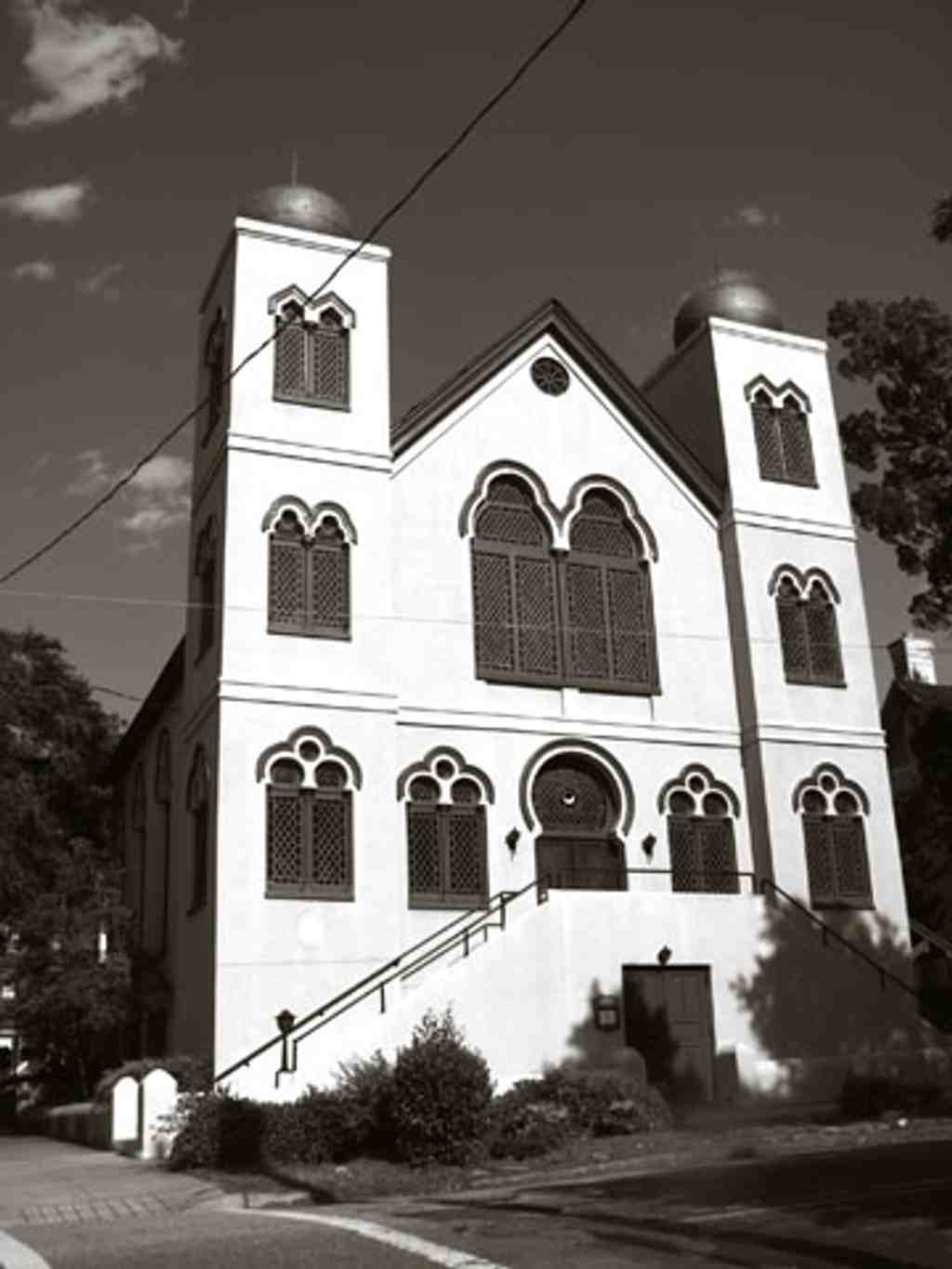
Look to your right and you will spot a striking white stucco building defined by its twin square towers topped with golden onion domes and uniquely curved horseshoe arches over the windows. Behind this stunning facade lies a remarkable story of how a small group managed to thrive and build bridges in the nineteenth-century South. In a society often rigid with its boundaries, the Jewish community here chose integration and connection over isolation, using their culture to forge bonds across Wilmington. Starting in 1872, German Jewish immigrants formed this Reform congregation, embracing modernized practices designed to mesh with contemporary civic life. To lead them, they brought in Rabbi Samuel Mendelsohn, a Russian-born scholar who tirelessly fostered unity by frequently stepping out of his synagogue to preach at local Christian churches, including a Black Baptist congregation.
Built in 1876, the Temple of Israel is the oldest synagogue in North Carolina. Its gorgeous design by architect Samuel Sloan is a mix of Greek Revival and Moorish Revival. Moorish Revival is a romantic architectural style from the late eighteen hundreds that borrowed decorative elements from the Islamic empires of Spain and North Africa, which is exactly where those beautiful horseshoe arches come from.
The women of the community, led by Rosalie Jacobi through the Ladies Concordia Society, funded much of the interior by hosting dances and feasts for both Jews and non-Jews. They even purchased a massive pipe organ, a choice that firmly signaled their progressive, Reform approach to Jewish worship.
Rabbi Mendelsohn served this congregation for an astonishing forty six years. He did not just preach unity, he lived it. In 1886, when Wilmington's Front Street Methodist Church burned to the ground, Mendelsohn and his congregation did not hesitate. They opened their doors, inviting the displaced Methodists to hold Sunday services right here in the Jewish synagogue for two whole years while their own church was reconstructed.
This gorgeous national treasure has survived its own share of disasters since then. When Hurricane Florence caused severe water damage in 2019, the community rallied yet again, launching a massive five hundred thousand dollar campaign to meticulously restore the historic structure. It stands now as a gleaming testament to enduring faith and mutual support.
But that uplifting spirit of unity stands in sharp contrast to the deep fractures we will explore next. Let us take a short two-minute walk over to the site of the George Davis Monument, where we will confront a very different chapter of Wilmington's history, one rooted in the bitter divisions of the Civil War.




