
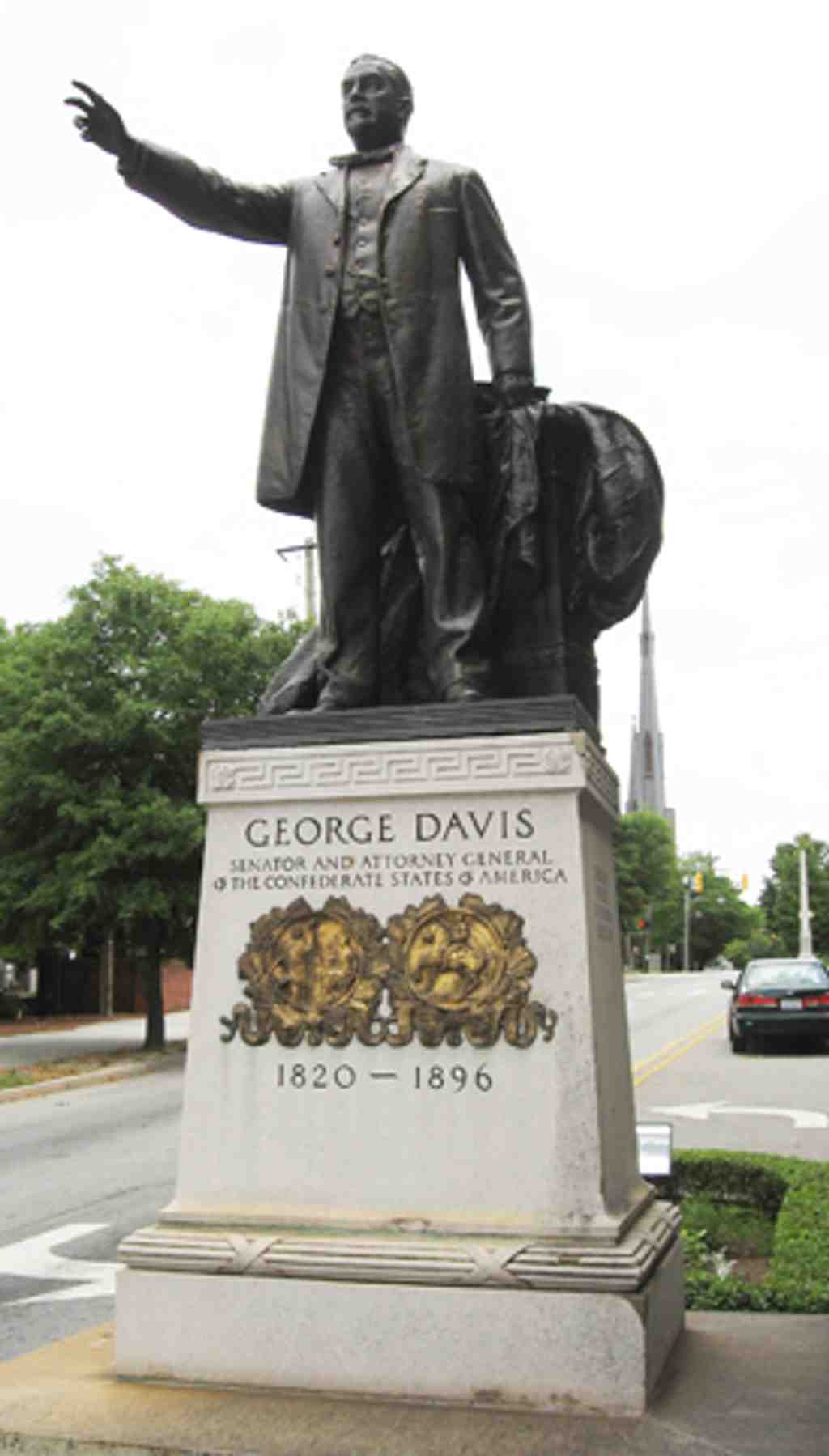
On your right, you will spot the George Davis Monument, an eight foot tall bronze statue of a man with his right arm outstretched, standing atop a massive white stone pedestal adorned with two gilded circular seals.
At least, this is exactly what you would have seen here for over a century. George Davis was a wealthy railroad attorney who became the Attorney General for the Confederacy. But this proud, polished memorial completely erased the reality of how his Confederate career actually ended. After the fall of Richmond in April 1865, Davis made a desperate, chaotic run for it. Fleeing the city, he abandoned his motherless children with extended family and traveled south to Florida, attempting a wild solo escape to the Bahamas in an old, battered boat. It did not work. United States forces captured him in Key West that October and threw him into a military prison in Brooklyn.
While locked up, Davis petitioned for amnesty. He totally downplayed his role in starting the rebellion. Eventually, he was pardoned, returned to Wilmington, and went right back to getting rich as a railroad lawyer.
Fast forward to 1901. A group called the United Daughters of the Confederacy, an organization dedicated to creating a heroic, fictionalized memory of the South's rebellion, decided Davis needed a grand tribute. They spent years fundraising. Ultimately, wealthy railroad investors and a former Civil War blockade runner chipped in to finish the job. The total cost was just over five thousand dollars, which is about one hundred and sixty five thousand dollars in today's money. The result was a seventeen hundred pound bronze giant unveiled in 1911.
The monument declared Davis a pure-hearted Christian gentleman and a patriot. Yet the true foundation of his politics was undeniable. In a major speech right here in Wilmington in 1861, Davis explicitly argued that North Carolina had to secede for one specific reason, to preserve the economic institution of human slavery. For decades, his bronze likeness stared west down Market Street, glaring directly toward the riverfront where enslaved people had been bought and sold. It is a perfect example of how this city so often wraps its darkest, most turbulent history in an incredibly polished, beautiful civic veneer.
That hidden tension finally snapped in June 2020. A routine audit of police dash camera footage uncovered violently racist conversations between three veteran Wilmington police officers. One officer was even caught on tape saying he could not wait to start slaughtering Black people in a civil war. The police chief fired them immediately. Fearing this horrifying scandal and the massive public outrage would spark violent clashes at Confederate monuments, the city used a public safety legal loophole. Under the cover of darkness, in the middle of the night, crews dismantled the George Davis statue. It was just gone. The city later agreed to permanently keep the monument off public land, letting the United Daughters of the Confederacy eventually take it back.
From a story about a desperate, failed escape and a city struggling with its shadows, we are now going to move toward the ultimate place of escapism. Keep walking, because just a four minute stroll from here is our next stop, Thalian Hall.




