
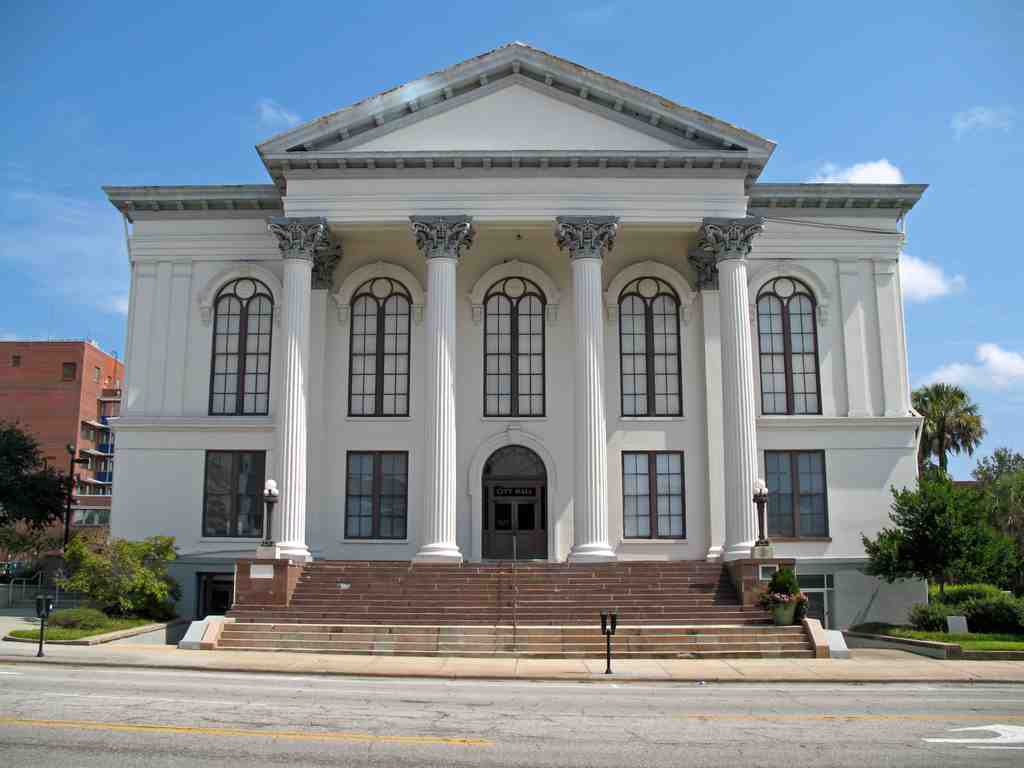
Look right for a gleaming white stucco building dominated by four towering Corinthian pillars, identifiable by their leafy carved tops, and a wide set of brick stairs leading to an arched entrance. Behind this grand exterior lies a rare piece of nineteenth century stage magic called a Thunder Roll. Stagehands would vigorously roll grapefruit sized iron cannonballs down shallow wooden troughs hidden high in the attic, mimicking the menacing rumble of an approaching storm for the audience below.
It is absolutely incredible to think about. Designed in 1858 by John Montague Trimble, Thalian Hall is a brilliant masterclass in contradictions. An exquisitely elegant exterior sits squarely in front of a world of raw, functional mechanics, concealing an incredibly dark, volatile past. This is actually Trimble's only surviving theater still in use today. When it opened, the lobby showcased a drop curtain painted by William Russell Smith, which amazingly still hangs there as the oldest surviving curtain of its kind in the United States.
This stage has truly seen it all. Buffalo Bill Cody famously brought live horses right onto the floor, and crowds watched in awe as Thomas Edison demonstrated an early film projector. But the drama was certainly not confined to the stage. Just a few years after the Civil War, the theater was managed by John T. Ford, the notorious owner of the Washington D.C. theater where President Abraham Lincoln was assassinated.
More chillingly, in November 1898, this very building hosted a political rally where white supremacist Alfred Moore Waddell delivered a violently incendiary speech. Seeking to overthrow Wilmington's legitimately elected biracial Fusionist government, a progressive coalition of Black and white politicians, Waddell told an armed crowd to choke the local river with carcasses if necessary. Days later, that white mob murdered up to three hundred Black citizens and forced the city council to resign at gunpoint, ushering in the state's era of segregation.
Given that heavy, dark legacy, it is no surprise people claim the building is haunted. Theatergoers frequently report seeing a ghostly man and woman occupying two specific red seats in the upper balcony, quietly watching the performances unfold.
From these dramatic nineteenth century theatrical spectacles, we are going to walk about thirteen minutes to see a completely different kind of modern collegiate rivalry at the Joe and Barbara Schwartz Center.




