
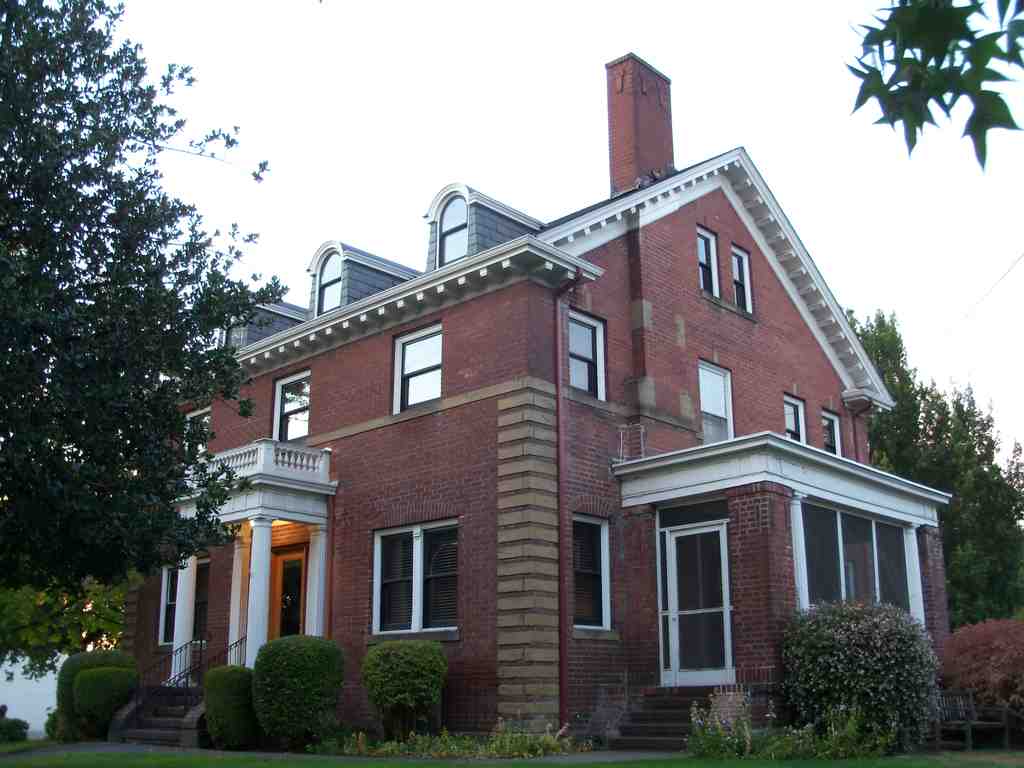
On your right, you will spot a pair of striking historic brick mansions, the older one showcasing decorative brick patterns and ornate stained glass, while a smaller blue carriage house sits right between them. You are looking at the Hidden Houses, the absolute epicenter of Vancouver's grassroots grit.
This is the ultimate story of building a community from the ground up, quite literally. Lowell M. Hidden was born into deep poverty in Vermont and was bound out at just six years old. Being bound out meant he was handed over as an indentured servant to a farmer in exchange for an education. Well, the farmer broke his promise, so at thirteen, Lowell ran away. He eventually fled west to escape the Civil War, arriving right here in Vancouver in 1864 hoping to harvest crops. Instead, he found the Columbia River had completely flooded the fields.
Unfazed, he pivoted. He cut hay, built a city dock, started a fence business, and soon leased a hotel with his wife, Mary. Then came the twist of fate. A formidable nun named Mother Joseph approached him with an impossible request. She wanted to build a massive academy and needed one million bricks. Lowell had never been a brickmaker, but he boldly agreed, opening his brickyard in 1871. He sold those first bricks for eight dollars per thousand, roughly two hundred dollars today.
That accidental business venture turned into an empire. Over his lifetime, his company produced an estimated sixty million iconic red bricks, shaping the very face of the city against overwhelming odds. If you look closely at older buildings downtown, you might spot bricks with the name HIDDEN stamped directly into the frog, the small indentation on the flat side meant to hold mortar.
He built his own family home right here in 1884 in the Queen Anne style, an architectural design known for its elaborate details like those fancy, stepped out brick chimney caps you can see on the roof. His son built the equally grand Colonial Revival house next door in 1913, though despite their immense wealth, the family remained incredibly frugal, even keeping a chicken coop out back to supply their own eggs. Between the homes, the blue carriage house features a garden planted by his son to honor the women of the family.
As you walk by Lowell's house, you might even hear a ghostly melody. For decades, restaurant workers in the building have reported phantom footsteps, self unlocking doors, and the beautiful singing of a woman, believed to be the spirit of Lowell's daughter, Julie, who loved entertaining guests.
From a runaway child to the literal architect of a city, Lowell left a towering legacy. One magnificent structure built from his sixty million bricks is a nearby church that sparked a decades long power struggle. Let us take a three minute walk to see the Proto-Cathedral of St. James the Greater.




