
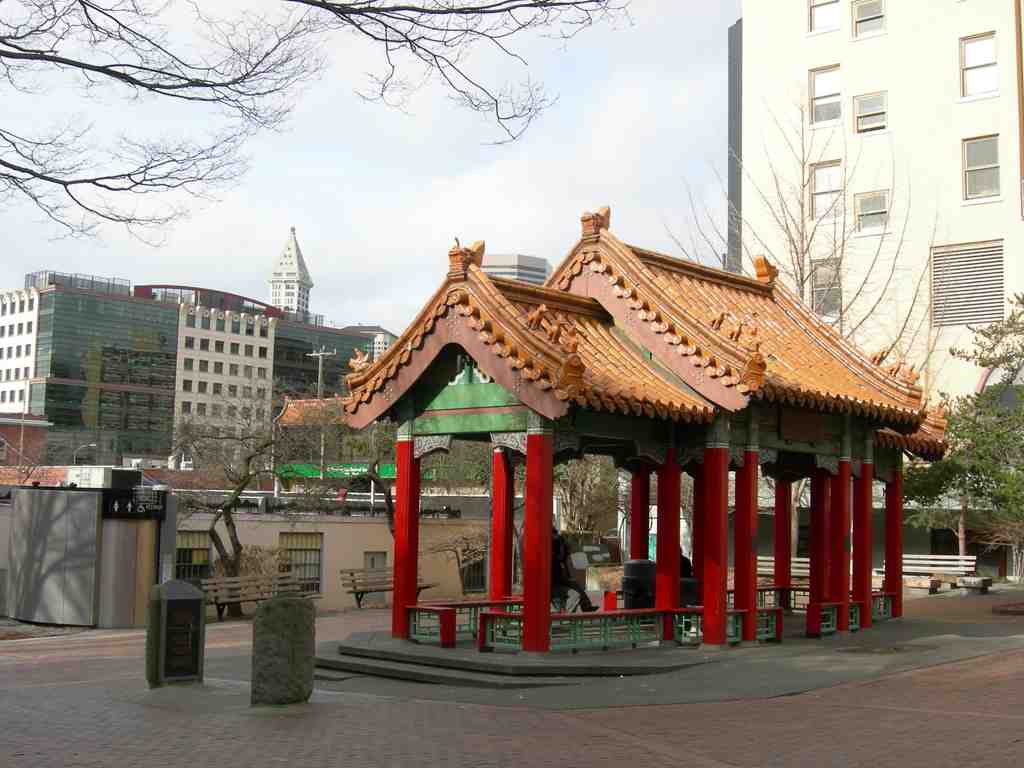
You’re looking for a vibrant pavilion with red pillars and an ornately tiled golden roof-just ahead in the open brick plaza, framed by city buildings and a hint of skyline, that’s Hing Hay Park!
Welcome to Hing Hay Park, truly a jewel box tucked into the heartbeat of Seattle’s Chinatown-International District! As you stand here, right on the north side of South King Street between 6th and Maynard avenues, take a deep breath and listen: this little corner is full of stories, celebrations, and, if you’re lucky, maybe even the sound of a dice game or two in the pavilion.
Back in the 1960s, Seattle was brimming with grand plans-one of which came to life when the community, with a boost from the Forward Thrust bond initiative, decided that this was the perfect spot for a park. Before that, can you imagine this area filled with the offices of the Specie Bank of Seattle, built in 1911? But by the ‘70s, those buildings were long condemned and ripe for a new beginning.
The original park opened in 1973, taking up just a quarter of this block, right at the corner where Maynard meets King. And it wasn’t just any old park-the landscape was designed by S.K. Sakuma and his firm, blending local spirit with elements straight from an old-world Chinese village square. The star of the show? You guessed it: this ornate pavilion in the center, crafted with care, every detail echoing authentic East Asian architecture.
But get this-these beautiful bricks and that elegant pavilion didn’t just appear by magic or city funds. Picture Ruby Chow, a trailblazing King County Council member at the time, pitching the idea to the Mayor of Taipei, who was in Seattle on a visit. She explained they had the land, but the city had no money to keep things fancy-she needed something sturdy, beautiful, and easy to maintain. The mayor didn’t hesitate: he reached into his own pocket and sent funding, bricks, even a team of skilled workers all the way from Taipei. By 1975, the pavilion you see was standing proud, a gift from across the Pacific.
Take a look around and notice the clever touches-those chess tables and benches that always seem to draw in eager players, and a curious little bulletin board with its own tiny tiled roof in the southeast corner. Here’s a neat bit of mystery: its placement follows feng shui principles, set at an angle instead of neatly parallel with the street. They say it’s to allow the flow of qi-the good energy-between the park and the businesses across King Street. Don’t want to block the good vibes, right?
Now, if you walk a little, you’ll spot a massive mural splashed across the neighboring Bush-Asia Center’s wall. A dragon-bold and coiling-watches over railroad workers, scenes from old Seattle, and the iconic King Street Station clock tower. It was painted in 1977 by John Woo, and it serves as a colorful reminder of the immigrant journeys and hard work that built this district.
Hing Hay Park isn’t just for show-feel the echoes of Memorial Day each spring, when American Legion Cathay Post No. 186 gathers at the cenotaph here, honoring ten Chinese American veterans lost in World War II. On quieter days, you might stumble upon tai chi classes, locals gliding quietly in the morning mist, or catch a burst of free music filling the air in summer.
And then came the expansion! In 2007, the city picked up the old post office lot next door, and by 2017, nearly doubled the park’s size. The “wow” feature? That impressive red gateway on the southwest corner, looking like something straight out of a storybook-it looms 20 feet high and 70 feet long, all in gleaming perforated metal, a new beacon for the district.
Today, everything-from the stone furniture to the terraced rice-paddy-inspired landscaping-invites gatherings and festivals, with Dragon Fest turning Hing Hay into Chinatown’s own celebration epicenter. And if someone starts humming the Blue Scholars’ “Talk Story,” well, you’re not imagining things-the park even gets a shoutout in their music!
So while this spot might not rival Seattle’s old skyscrapers for height, Hing Hay Park stands tall when it comes to heart. It’s a stage for history, culture, and community-a place where an ordinary stroll turns suddenly magical, with a story hiding behind every bench, pillar, and painted dragon scale.




