
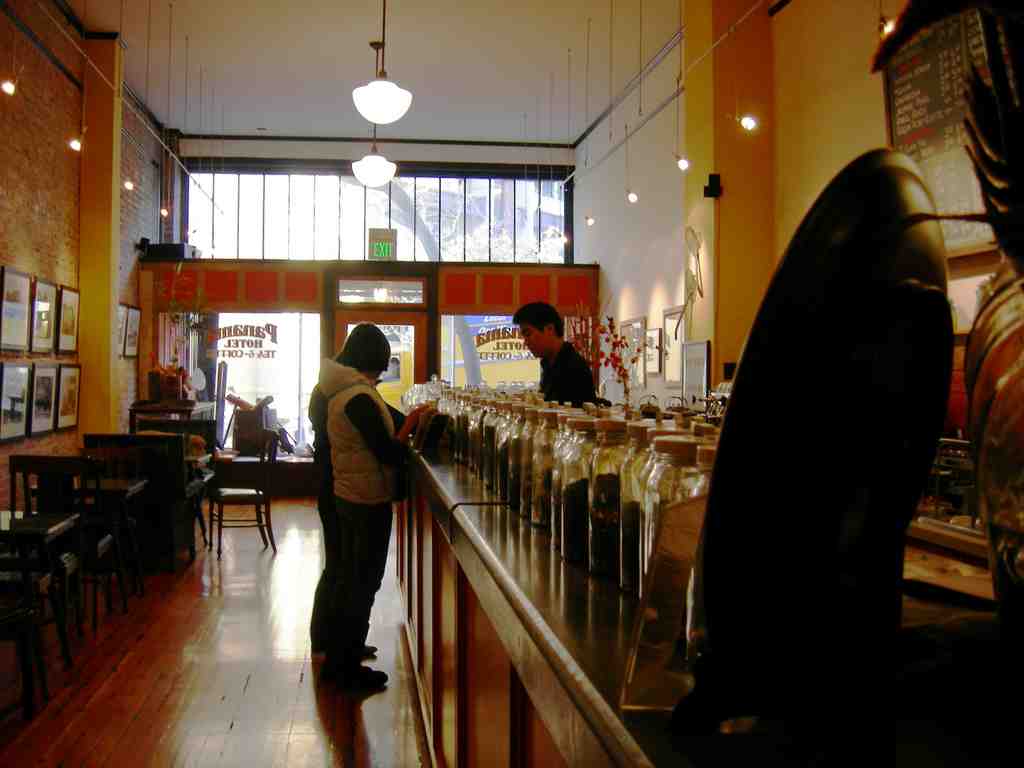
To spot the Panama Hotel, look for a charming brick building with large windows and a sign announcing “Panama Hotel Tea & Coffee” above its ground-floor café-stand right by the entrance where the welcoming glow spills onto the sidewalk.
Take a deep breath-can you smell the aroma of fresh tea and coffee wafting out from the Panama Hotel’s cozy cafe? Now, let’s travel back in time, because the air here is thick with secrets, old stories, and a little bit of steam! The Panama Hotel was built in 1910, and it was designed by Sabro Ozasa, Seattle’s very first Japanese-American architect. Imagine the city over a hundred years ago: horse hooves on snowy streets, lanterns glowing in every window, and people bustling into Japantown for a warm, communal bath at the sento downstairs.
This hotel was truly the heart of the Japanese community. It wasn’t just a place to sleep-it was a hub with restaurants, shops, and the famous Hashidate-Yu bathhouse, the last remaining Japanese public bathhouse, or sento, in the entire United States! Picture hardy workers and travelers, women and children, all coming together to relax and gossip in the soothing steam-because in early 1900s Japantown, most folks didn’t have bathtubs at home. These bathhouses were the original social networks-without weird algorithms or cat videos.
But not all the stories here are light and warm as a cup of tea. In 1942, when Executive Order 9066 forced Japanese residents into internment camps, families had to leave everything behind. Many handed their most precious belongings to the Panama Hotel for safekeeping, tucking away trunks, kimonos, and memories in the basement, hoping they’d return soon. Sadly, for many, that day never came, and their suitcases are still waiting in the dark downstairs. Today, you can actually peek through a glass panel in the floor to see those untouched belongings, like a time capsule of hope and heartbreak.
After the war, the Panama Hotel stood as a quiet guardian of these lost treasures, while Seattle’s Japantown shifted and changed. In 1985, Jan Johnson took over and lovingly restored the building, honoring its original spirit. The hotel has become a symbol-a witness to resilience, community, and the bittersweet stories of Japantown.
There’s a bit of literary magic here, too! Ever hear of the novel “Hotel on the Corner of Bitter and Sweet” by Jamie Ford? This very place inspired those pages, bringing its rich history to readers everywhere.
Don’t be surprised if you see film crews someday-the upcoming documentary, “The Panama Hotel Legacy,” will shine a spotlight on these endless layers of memory and history. And in 2006, the hotel was named a National Historic Landmark; by 2015, it became one of only 60 places in the U.S. recognized as a National Treasure by the National Trust for Historic Preservation. To top it off, in 2020, the Japanese government awarded the Panama Hotel for promoting friendship between Japan and America.
So as you stand outside or perhaps inside the warmly lit café, savor a sip and look around-the Panama Hotel isn’t just a building; it’s a living story, woven from the laughter, secrets, and silences of everyone who’s ever crossed its threshold. And let’s be honest-these walls have probably heard so many stories, they could use a bath of their own!
Interested in knowing more about the seattle's "japantown" (nihonmachi), japanese bathhouses (sento) or the film




