
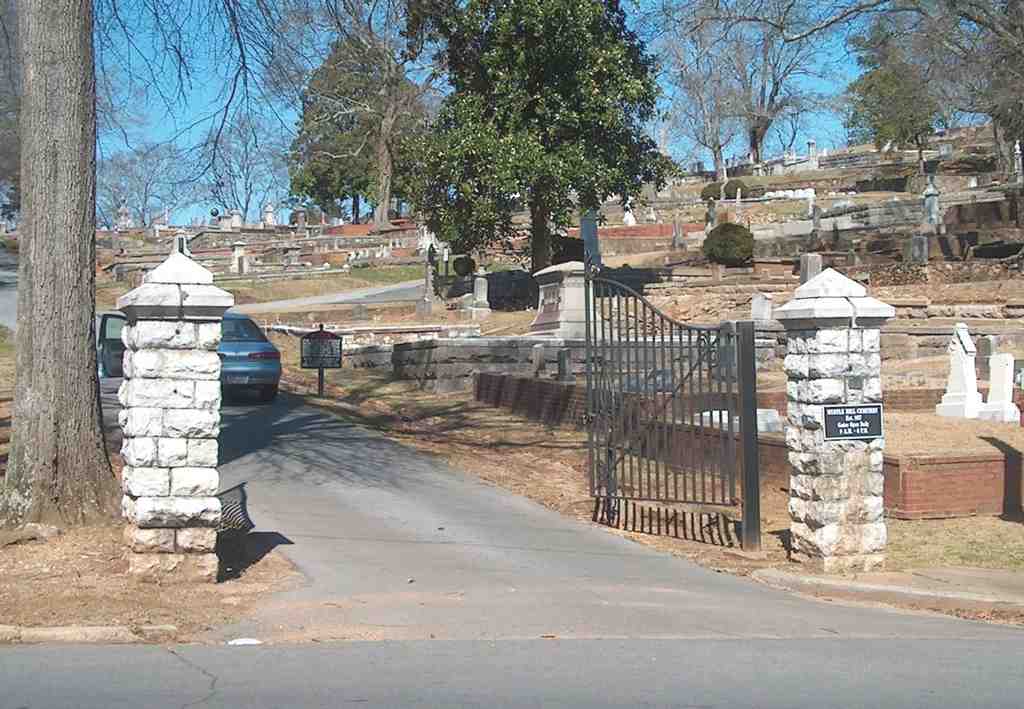
Look for the iron gate between two chunky white stone pillars, opening onto a paved lane that climbs up through terraced rows of headstones on the hillside.
Alright, welcome to Myrtle Hill Cemetery... a place that manages to be peaceful, scenic, and quietly packed with history all at once. Standing here at the entrance, you’re looking up at a hill laid out in steps-six terraces, spread over about 32 acres-almost like the town decided to build a “wedding cake” out of marble and granite. Not everyone gets a view like this forever, but apparently a lot of folks applied.
There’s a practical reason it’s on a hill. Rome sits at the meeting point of three rivers-the Etowah and Oostanaula join to form the Coosa-and those rivers have always had a habit of spreading out when they feel like it. So early Romans picked higher ground for burial space: safer, drier, and less likely to float away. Myrtle Hill, Lumpkin Hill, Mount Aventine… the city’s hills weren’t just pretty; they were insurance policies.
The name “Myrtle Hill” comes from a plant called trailing myrtle-Vinca minor-that used to grow wild here. It even had the cheery nickname “Flower of Death,” which, points for honesty, I guess.
But before this became a cemetery, this hill had a rougher reputation. In 1793, it was part of a violent clash now remembered as the Battle of Hightower. General John Sevier brought about 800 men into the area-without official permission-chasing Cherokee warriors after attacks near Knoxville. Sevier wrote about trying to outsmart defenders: he made a move to cross the river downstream to draw them out, then doubled back and crossed here instead. The fight ended when a Cherokee leader known as Kingfisher was killed, and Sevier’s men burned the nearby village. Later, people reportedly found bones and relics tucked into the hill’s crevices. History doesn’t always stay neatly in the past… sometimes it turns up under your feet.
Fast forward to the 1800s. After gold was discovered in Georgia in 1829 and after the Cherokee were forced out during the years of removal, Rome was founded in 1834. The city’s first cemetery, Oak Hill, opened in 1837-but by mid-century it was filling up. So in 1850, locals chose this hill near the rivers, and a civil engineer named Cunningham Pennington designed the layout to work with the steep terrain: looping roads, tiered levels, and that layered look you see now. Myrtle Hill officially opened in 1857, and one of the first burials was a man named John Billups.
Then the Civil War arrived, because of course it did. In 1863, Rome spent $3,000-about $75,000 today-building earthen forts to defend the city. One of them, Fort Stovall, sat up near this crest. You won’t see it now; terracing and time erased the surface evidence. But the hill’s height made it a prime lookout, and it likely buzzed with activity during the brief standoff when Union forces approached in May 1864.
Today, more than 20,000 people rest here-founders, politicians, doctors, soldiers, even a U.S. First Lady: Ellen Axson Wilson, who grew up in Rome and later returned here after her death in 1914. And up at “Crown Point,” the Confederate soldier monument still watches over it all, carrying its own complicated history-including vandalism in 2017 that left it scarred.
When you’re set, the Tomb of the Known Soldier is a 5-minute walk heading west.




