
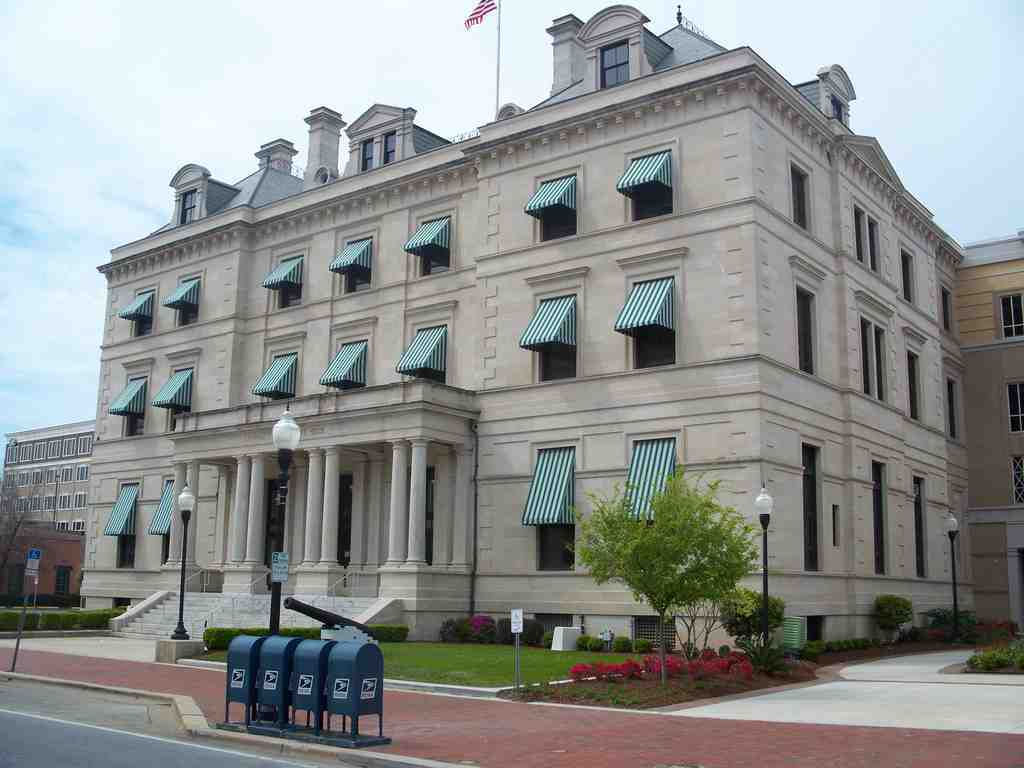
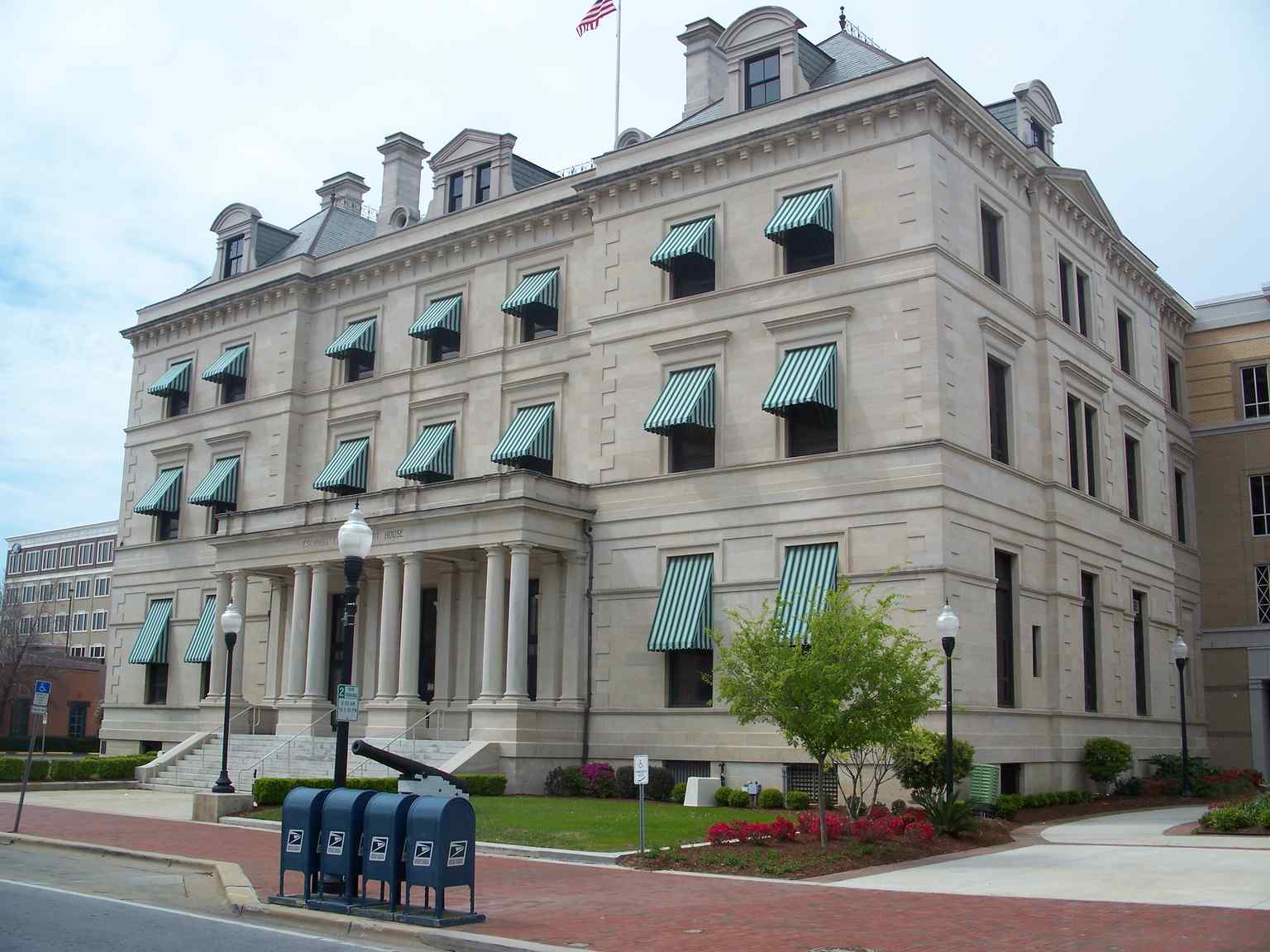
To your left sits a monumental four-story limestone building with a flat roof, easily recognizable by its colonnaded portico, which is a grand porch supported by classical columns, and those striking green and white striped awnings shading the windows. This is the United States Customs House and Post Office. It stands as a beautiful testament to how this city constantly tears down and rebuilds its identity, but civic expansion usually comes with a real human cost. Back in the early 1850s, long before this stone structure existed, a local merchant named William Kaiser ran a bustling department store right on this very spot. The federal government realized this land was perfectly close to the city wharfs and decided they wanted it for a new federal hub. Kaiser refused to back down. He actually took the United States government to court to save his livelihood! Sadly, he lost everything because he could not prove he held the legal title against the government. His store was promptly razed to the dirt. In its place, the government built a wooden custom house in 1854 for $60,000, which is over two million dollars today. The locals absolutely hated it. They thought it was overpriced and incredibly ugly. So, when that unpopular wooden building completely burned to the ground in an 1880 fire, local newspapers bluntly noted that few mourned its loss. The push to build the Victorian Renaissance Revival beauty you see now, an architectural style famous for its imposing scale and classical symmetry, brought fresh drama. After the original architect resigned amid a massive fraud scandal, M. E. Bell took over. He secured a $200,000 budget, about six and a half million dollars today, but hit a literal snag. During excavation, his masonry team struck a massive underground water flow. The entire foundation was at risk of sinking into the mud! In a stroke of desperate genius, Bell ordered hundreds of giant cotton bales to be dropped directly into the flooded trench to absorb the moisture. It worked flawlessly. To this day, those 19th-century cotton bales remain buried right beneath this colossal stone structure. This landmark perfectly captures the practical magic of our town. In 1937, when Escambia County desperately needed more space, they simply swapped buildings with the federal government, who needed land for a new courthouse elsewhere. It was a huge logistical headache, leaving county officials operating out of temporary offices nearby, but it was a brilliantly pragmatic approach to managing urban progress. It makes you wonder what other deep roots are buried beneath our feet here. Let us keep unearthing them as we leave the plaza behind us and take a quick two-minute walk toward our next stop, the Palafox Historic District.


