
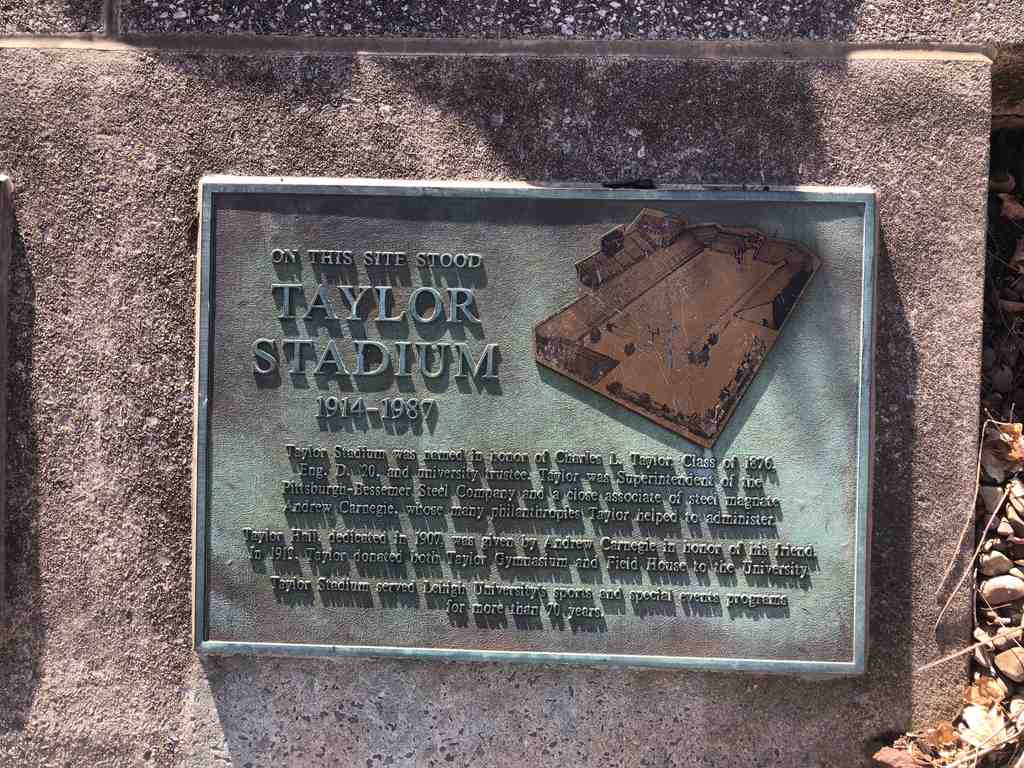
Look for the blue-and-gold Pennsylvania historical marker on a metal post beside modern brick campus buildings; it marks the ground where Taylor Stadium once rose in sweeping concrete tiers.
This was where Lehigh turned school spirit into public theater. Before the stadium, this ground was just a practice field. Then Charles L. Taylor, class of eighteen seventy-six, pushed to give the university a real home for athletics, and alumni opened their wallets. The biggest gift came from steel titan Charles M. Schwab and his wife Emma. When Taylor opened the stadium in nineteen fourteen, Lehigh got something rare: one of the earliest concrete stadiums in the United States.
And Lehigh did not treat it like a mere sports facility. Taylor formally presented it to the university on the seventeenth of October, nineteen fourteen, in a campus-wide celebration called Taylor Day. That name tells you everything. This place was engineered for emotion as much as athletics... a gift, a stage, and a declaration that the Engineers knew how to make an entrance.
Football led the show, but not alone. Baseball, soccer, lacrosse, and track all used the stadium. Later, Bethlehem Steel donated a grandstand and pushed capacity to twenty thousand. For a campus venue, that is less “cozy field” and more “small republic of noise.”
One of the defining sounds started because James Hildebrand, class of nineteen fifty, got annoyed. In nineteen forty-seven he grew tired of Rutgers firing its cannon after touchdowns, so he convinced his father to donate the family’s brass cannon to Lehigh. It debuted before the nineteen forty-eight Rivalry game, and from then on every blast said the same thing in a louder voice: these Engineers belonged to the crowd as much as the classroom.
Alumni remembered fans packed so close behind the benches they could feel the game breathing. They remembered cheerleaders bowing on the goal line after each score, upper-deck stomping, and a press box that visibly shook. Taylor had terrible parking, not enough bathrooms, and seats that did no favors for the human spine... yet many still preferred it to Goodman, because this place sat at the heart of campus. You could walk here in minutes. That made pride easy, loud, and shared.
Its ending had its own grim drama. The last Lehigh-Lafayette game here turned into an icy ordeal. The band waited in the Physics Building before pregame, but instruments still froze, drumheads cracked, and Lehigh beat Lafayette seventeen to ten. A year later, demolition began. The university traded this ninety-thousand-dollar stadium - about two point eight million in today’s money - for the Rauch Business Center and Zoellner Arts Center.
So the stadium vanished, but not the habit it taught: turn identity into ritual, and ritual into community. From here, that energy spills downhill into South Bethlehem’s historic downtown, where school pride met shopfronts, diners, and everyday city life.




