
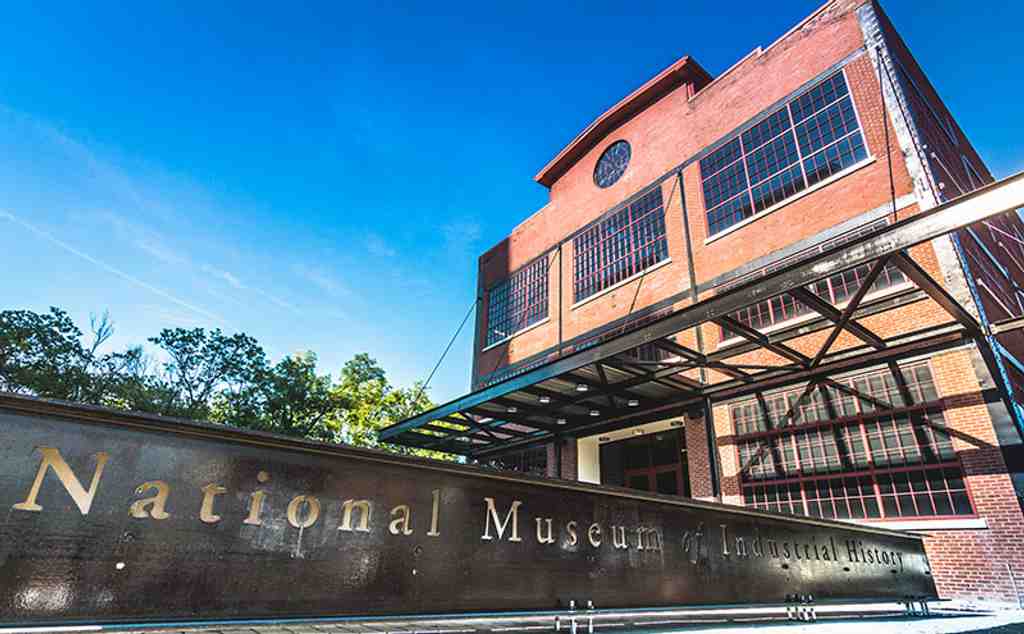
On your right is a long red-brick industrial building with a low rectangular shape, tall grid-like steel windows, and a square corner tower marked with the museum’s name.
This is the National Museum of Industrial History, and it’s a fitting last stop because the building itself tells the story before you ever cross the threshold. You’re standing at the old Bethlehem Steel Electric Repair Shop, first put to work in nineteen thirteen, then reworked over the years as the plant changed around it. In a way, one of the museum’s biggest artifacts is the museum itself. Not every exhibit gets to be its own container.
This place embodies preservation after industry. Bethlehem chose not to treat its industrial remains as junk or as untouchable ruins, but as shared memory and future inspiration. The museum opened in August of twenty sixteen, though getting there was messy. Bethlehem Steel had helped start the idea in the late nineteen nineties, and Senator Daniel Patrick Moynihan encouraged a Smithsonian connection. Then came years of delay, legal trouble, and a grand jury report that blasted the project for waste, mismanagement, conflicts of interest, and bloated salaries. The Pennsylvania Attorney General found no criminal wrongdoing, but gave the museum a blunt deadline: open within two years or face dissolution. Construction restarted in late twenty fourteen, and the staff made it.
Inside, the story gets wonderfully mechanical. The opening core of the museum came from a long-term loan of nearly a hundred industrial machines from the Smithsonian’s collection tied to the eighteen seventy-six Centennial Exposition, linking Bethlehem to Philadelphia and to the national story of invention. If you glance at the app, you can see the giant Corliss steam engine in Machinery Hall. It weighs one hundred fifteen tons, and staff, volunteers, and community partners spent years restoring it so it could run again during special demonstrations. That’s not just display work. That’s mechanical resurrection with paperwork.
But the museum does not only celebrate steel and muscle. It also widens the lens. The iron and steel galleries trace Bethlehem Steel at its peak, when it employed thirty-one thousand people and drew workers from across Europe. The Silk Gallery tells the parallel story of women and children in the Lehigh Valley silk mills, which at one point employed even more people than steel here. On your screen, the Jacquard loom gives you a sense of that world. Children carried twenty-pound bobbin trays for hours. Industry, as usual, loved efficiency more than tenderness.
So here’s the question this building asks: when a city turns a former plant into a museum, what is it really trying to save... the machines, the labor, the power, the pride, or the identity that formed around all of them? Probably all of the above, and not always comfortably. A museum can honor achievement while still asking who held the office keys and who worked the longest shift.
That question became personal in twenty nineteen, when Glenn Koehler and other staff members helped recover artifacts from Bethlehem Steel’s former headquarters before demolition erased them. So even the command center from the beginning of our walk survives here in fragments, translated from corporate control into public memory.
And that may be the real payoff of Bethlehem. The railroad office, the patron’s chapel, the university labs, the stadium crowds, the storefronts, the parish doors... none of them stood apart from this industrial world. They were its language. Now this museum helps the city read its own handwriting.
If you go inside, the museum is open Wednesday through Sunday from ten in the morning to five in the afternoon.




