
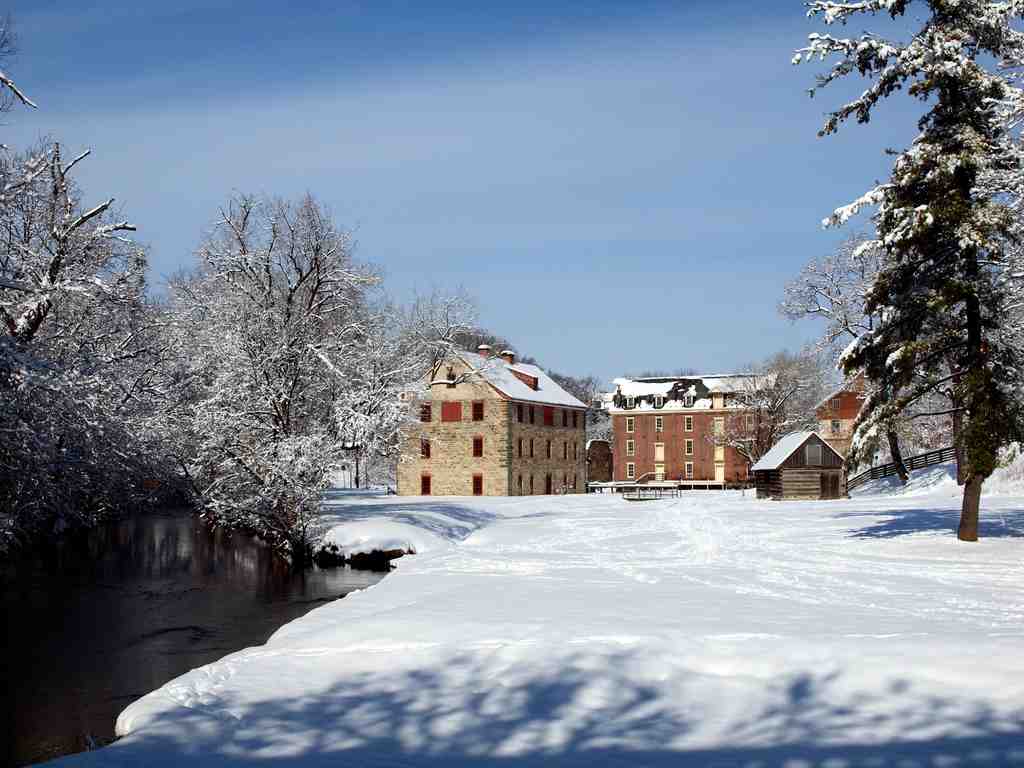
On your right, look for the cluster of old mill buildings along the creek: a sturdy gray-stone structure with red shutters near the water, backed by larger brick industrial buildings.
Welcome to Bethlehem’s Colonial Industrial Quarter… which is a fancy way of saying: this was America’s earliest industrial park, before anyone had invented the word “business casual.” The Moravians set this ten-acre work zone right along Monocacy Creek because the creek did two crucial jobs for free: it helped power machines, and it sat next to a spring that provided clean drinking water. In the 1700s, that’s basically winning the infrastructure lottery.
Early on, the workshops here started out as simple log buildings-practical, quick, and not exactly built for Instagram. But the place grew fast. By 1743, the Moravians had already built a saw mill, a soap mill, wash houses, a grist mill, an oil mill, a tannery, a blacksmith shop, and even a brass foundry. Then the list just kept getting longer-by 1747, there were dozens of trades operating here: bakers, weavers, dyers, coopers, tailors, cobblers, carpenters… the whole “we can make it ourselves” mindset taken to an extreme. Basically, Bethlehem was trying to be its own tiny supply chain… and doing a pretty good job.
As the community expanded, those log buildings got replaced with bigger limestone structures through the late 1740s into the early 1770s-more durable, more fire-resistant, and a little more serious-looking. By the mid-1750s, the number of trades had grown to around 50, turning this into one of the densest concentrations of industry in the American colonies.
Even outsiders noticed. John Adams visited during the Revolutionary era and wrote home that Bethlehem was a “curious and remarkable town,” praising how far they’d pushed the mechanical arts-especially the mills. He rattled off the grist mills, fulling mills for processing cloth, an oil mill, a bark-grinding setup for the tannery, and a dye house that could produce “all colours.” When John Adams is impressed by your machinery… you’re doing something right.
This whole area is also part of the Historic Moravian Bethlehem District-recognized nationally in 2012, and as of July 2024, officially on the World Heritage List. Not bad for a place that, at one point, fell on hard times.
Because here’s the twist: by the mid-1800s, a lot of the original 18th-century buildings got repurposed or torn down. And by the 1950s… this stretch had become an automobile junk yard. History’s glamorous like that. It took a wave of local civic energy and preservation work-especially in the 1960s-to clean it up, study it archaeologically, and restore what could be saved.
And then there’s the creek itself. Monocacy is beautiful, but it has always had a habit of flooding. Over centuries, floodwater left behind layers of silt and soil, raising the ground level here by nearly six feet. That’s why some doorways-like at the tannery nearby-sit oddly low today. The landscape literally climbed upward over time, like the site was slowly being re-buried.
Today, the city owns these buildings and ruins, and Historic Bethlehem Museums and Sites manages them-keeping this place from becoming, you know, a used muffler lot again. And it still draws crowds for big annual events, too-Musikfest, the Celtic Classic… even a historic Turkey Trot run. Nothing says “colonial industry” like modern people sprinting past it in neon sneakers.
When you’re set, The Tannery is a 2-minute walk heading south.




