
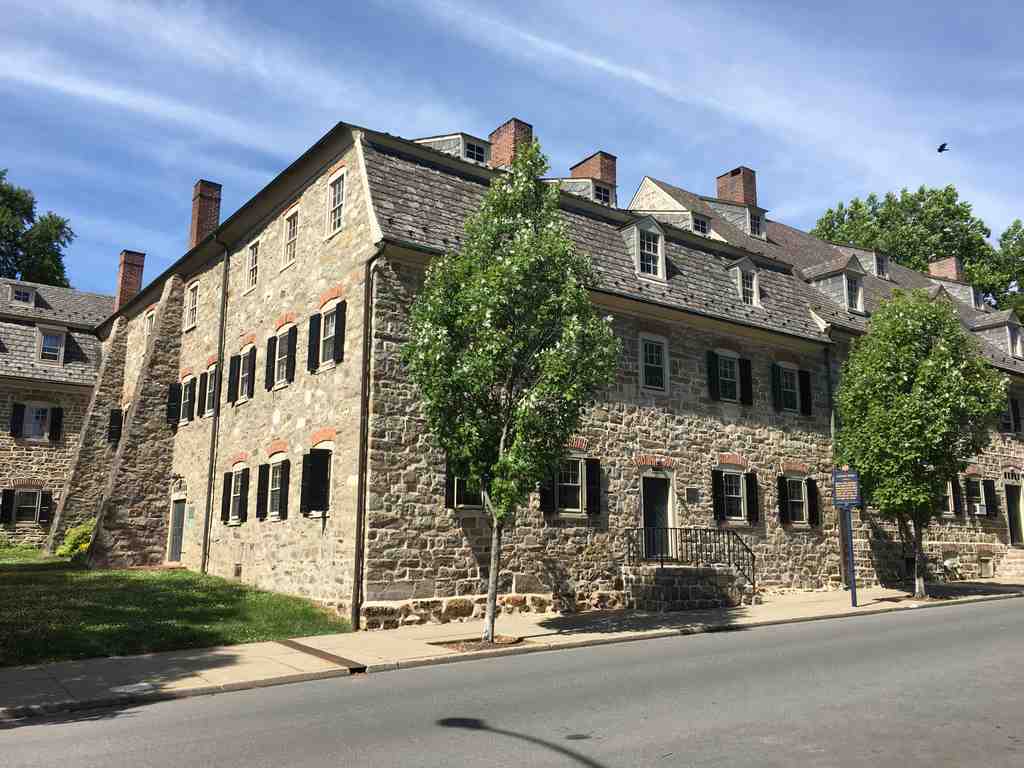
On your right, look for the long, sturdy limestone building with black shutters and little red brick arches over the windows, stretching back under a slate-gray roof with dormers and chimneys.
This is the Single Sisters’ House, and it’s been pulling its weight in Bethlehem since 1744. The Moravians built it first as a “choir house” for single men and boys-about fifty men and a handful of younger kids living together under one very organized roof. It was also a bit of a flex: Bethlehem’s first limestone building, done in a clean Colonial Germanic style… practical, handsome, and not interested in showing off too much. Except it kind of does anyway.
If you glance along the side, there’s a vertical sundial dated 1744-one of the oldest timekeepers in town. When your community is built around shared work schedules, you don’t just “wing it” and hope the sun’s doing the right thing.
This place wasn’t only about beds and chores, either. In the same year it opened, the Collegium Musicum-often called one of the earliest orchestras in America-started up here. Imagine the sound: fiddles and voices drifting out through these windows, mixing with the everyday clatter of communal life. And upstairs, a Moravian missionary named John Pyraleus ran what’s considered the first school in the colonies focused on teaching American Indian languages. In other words, this building helped turn Bethlehem into a serious little hub of learning and culture early on.
Then came the great switch. The men outgrew the place and moved into a new house in 1748. That’s when Anna Nitschmann-spiritual leader of the Single Sisters-pushed hard to claim this building for the women. She won. On November 15, 1748, twenty-one single sisters and twenty-nine girls moved in. The lower floors became workspaces for crafts and production; the top floor was dorm-style sleeping. It had what you’d want in a self-contained world: a chapel space and a kitchen-because even deep spiritual life runs on dinner.
As the choir grew, the building grew with it: a 1752 addition added a dining hall and more sleeping space, celebrated with a shad banquet at noon-music included, naturally. Later, more expansion, more reinforcement, even stone buttresses in 1756 when folks got worried the structure needed extra muscle.
This house kept adapting. By the mid-1800s, rooms shifted into apartments for unmarried, independent Moravian women-a rare arrangement in a world that usually insisted women needed a man to make the math work. Here, women cooked, sewed, taught, gardened, led, made art-often on equal footing with men. After the communal economy ended, residents paid their share; in 1772, the weekly fees added up to about thirteen pounds a year-roughly around $3,000 in today’s money, plus clothing and laundry. Independence wasn’t free, but it was possible.
In the 1960s, part of the basement served as a fallout shelter. In the 1980s, the dining room became an aerobics room. History is nothing if not flexible.
Today, part remains residences, and part is museum space in the wider Historic Moravian Bethlehem district-now a World Heritage Site. Not bad for a building that started as a very serious boarding house with a sundial.
When you’re ready, the Colonial Industrial Quarter is about a 6-minute walk heading west.




