
On your right, look for a broad French-limestone mansion with a heavily rusticated base of deep-cut stone blocks, tall arched openings, and a recessed carriage entrance tucked into the Ninety-first Street side.
This house is Fifth Avenue doing costume drama with a very serious budget. Otto Hermann Kahn, the financier and philanthropist, completed it in nineteen eighteen as his family’s town residence, and he did not aim for modesty. He and his architects, J. Armstrong Stenhouse and C. P. H. Gilbert, modeled the place on the Palazzo della Cancelleria in Rome, so the message was clear: old-world authority, imported to Manhattan, no waiting.
That message mattered. Andrew Carnegie had bought this corner back in eighteen ninety-eight partly to protect the value of his own mansion nearby. He sold only to what he considered congenial neighbors... which is a polite Gilded Age way of saying he wanted control over the block. When Kahn bought this plot in nineteen thirteen for around six hundred seventy-five thousand dollars, roughly more than twenty million today, he wasn’t just buying land. He was being admitted into a carefully staged piece of New York society.
And Kahn understood staging. If you glance at the app image, the Fifth Avenue front shows the trick beautifully: a Roman palace translated into pale stone, with that strong cornice and balustrade at the top acting like a crown. The first and second floors are rusticated to resemble a Renaissance palazzo, and above them the facade smooths out, as if the house gets more aristocratic the higher it rises.
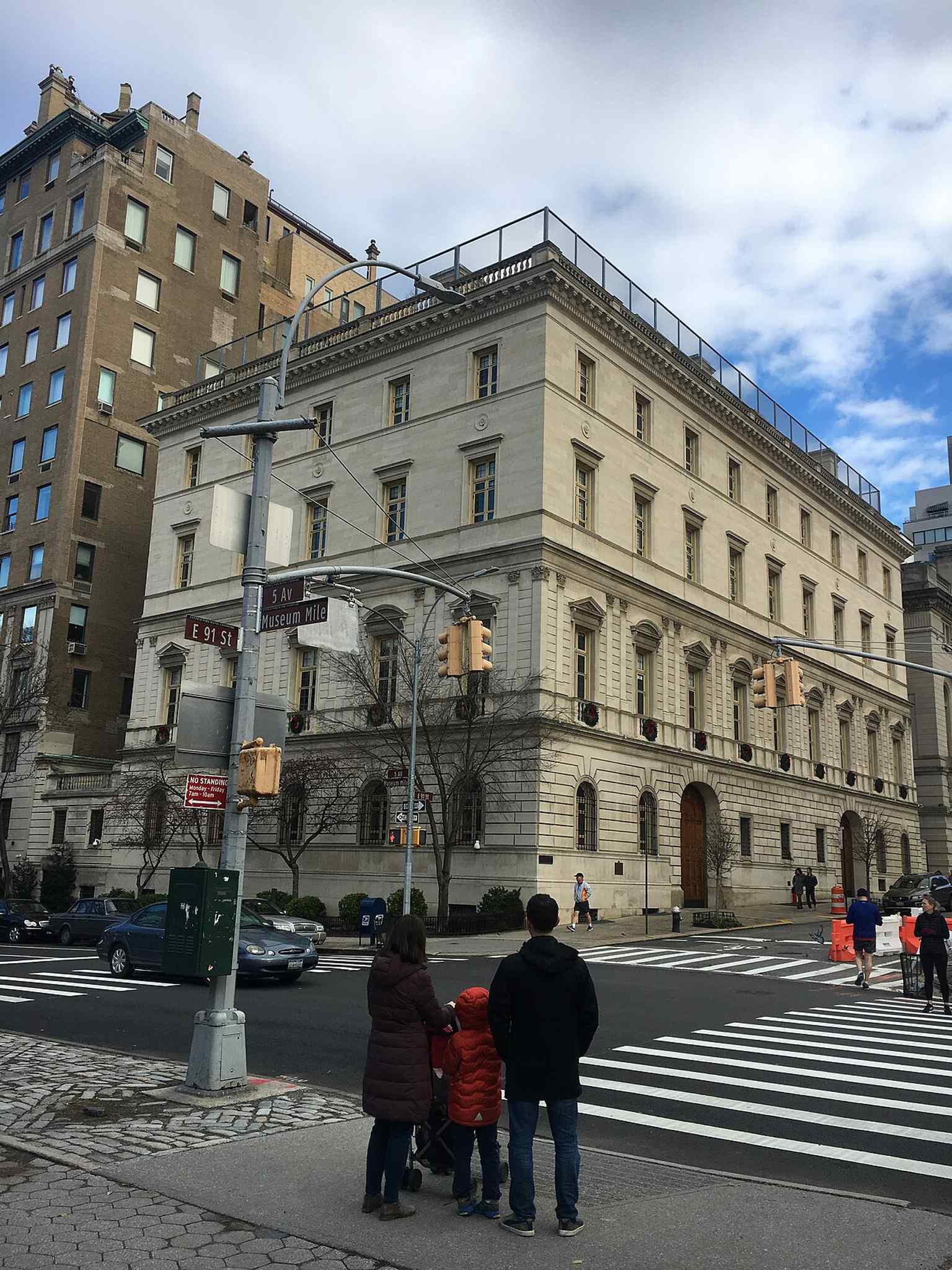
Kahn had reasons to build identity into stone. He was a Jewish immigrant from Germany, a senior partner at Kuhn, Loeb and Company, and despite immense wealth he faced the antisemitism of New York high society often enough to move repeatedly. So this mansion reads as taste, yes... but also as argument. He could claim the avenue in flawless Italian. New York has always respected a convincing accent, especially in limestone.
The social theater inside was just as carefully directed. The covered carriage passage on Ninety-first Street - a porte-cochere, meaning a sheltered drive-in entrance for carriages - delivered guests into an oval hall. There, visitors dropped calling cards into a bowl, while Kahn could discreetly watch arrivals from a concealed window in a stone tower. Efficient, elegant, and just a touch imperial. The grand second floor, the piano nobile or main ceremonial level, held the dining room, salon, library, theater, ballroom, and art gallery under ceilings nearly twenty feet high.
If you check the second image, you can read that carriage entrance more clearly, tucked behind those arches like a private stage door for society.
This was a home, but it also functioned as a salon, concert venue, and occasional art market. The Kahns hosted musicales, a debutante ball, a Persian art show and sale, and even rehearsals for their son Roger’s jazz orchestra. Meanwhile Otto Kahn, in one of New York’s better little contradictions, often took the subway downtown to work.
By the early nineteen thirties, the mansion’s private era was ending. After Kahn died in nineteen thirty-four, the Convent of the Sacred Heart bought the house and converted it into classrooms, offices, and a chapel. In Manhattan, permanence often survives by becoming useful.
That matters for what comes next. One block north, another mansion gathers many of the same threads - wealth, Jewish identity, art, philanthropy, and the strange afterlife of private grandeur. Head on to the Felix M. Warburg House.





