
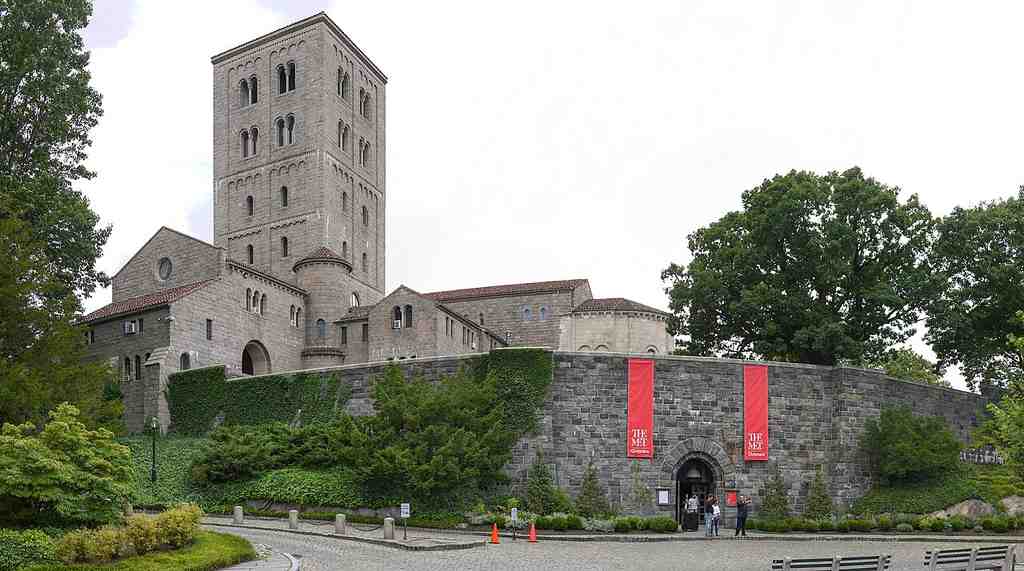
Ahead of you, a pale limestone and granite mass rises in stepped terraces, with blocky tower-like forms and pointed Gothic windows that make the hilltop look half fortress, half monastery.
A medieval museum on a Manhattan ridge still feels like a deliciously impossible idea. And that’s the first secret of The Cloisters: this is not the Middle Ages simply surviving in place. This is a curated past, assembled from imported stone, reconstructed courtyards, and carefully edited mood, so the hill can feel older than the city around it.
The beauty gets even stranger when you know how intentional it was. Preserving fragile pieces of Europe here meant transforming this whole crest of Upper Manhattan. In nineteen thirty, John D. Rockefeller Junior bought the land; in nineteen thirty-one, he gave it to the Metropolitan Museum of Art. He wanted elevation, distance, and that long sweep over the Hudson. Architect Charles Collens then designed a building that could seem to grow out of the rock while folding in actual medieval fragments from places like Cuxa, Saint-Guilhem, Bonnefont, and Trie-sur-Baïse.
And behind all that polished generosity, there’s one wonderfully unruly character: George Grey Barnard. Barnard was a sculptor, collector, and charming chaos machine who roamed the French countryside hunting medieval carvings, buying columns and capitals from farmers, dealers, and ruined religious sites. He loved the romance of fragments more than tidy scholarship. He once described himself almost like a knight on a bicycle, rescuing forgotten stone from fields and streams.
Most visitors never realize this museum had a rough draft. In nineteen fourteen, Barnard opened an earlier medieval-style museum on Fort Washington Avenue, a churchlike brick installation filled with rescued pieces. It was improvised, atmospheric, and a little ruin-like - basically the first version of the dream standing in front of you now. When his finances collapsed, he sold his collection to Rockefeller in nineteen twenty-five for a significant sum. That sale turned one man’s obsession into an institution.
Take a moment and study the building itself... the heavy stone, the terraces, the way the walls tuck around space instead of spreading wide. Does it feel like something discovered on the hill, or something planted here very carefully so it could pretend to be discovered?
If you want a quick visual for that whole transformation story, take a peek at the before-and-after image in the app.
Inside, the theater continues. The museum holds about five thousand works of medieval European art, but it doesn’t behave like a neutral container. Chapels, gardens, tapestries, stained glass, and carved cloisters all collaborate to create a feeling. If you glance at your screen, the Cuxa Cloister shows the trick beautifully: pink marble columns, a square garden, and the sense that silence itself has architecture.
When The Cloisters opened in nineteen thirty-eight, people praised it for stirring the imagination, not just displaying objects. That’s the real ambition here - beauty with a little stagecraft under it. To understand why this place belongs exactly here, though, you have to read the hillside beyond the museum walls. Fort Tryon Park, about a seven minute walk away, tells that part of the story.
If you want to come back and go inside, The Cloisters is open from ten to five every day except Wednesday.




