
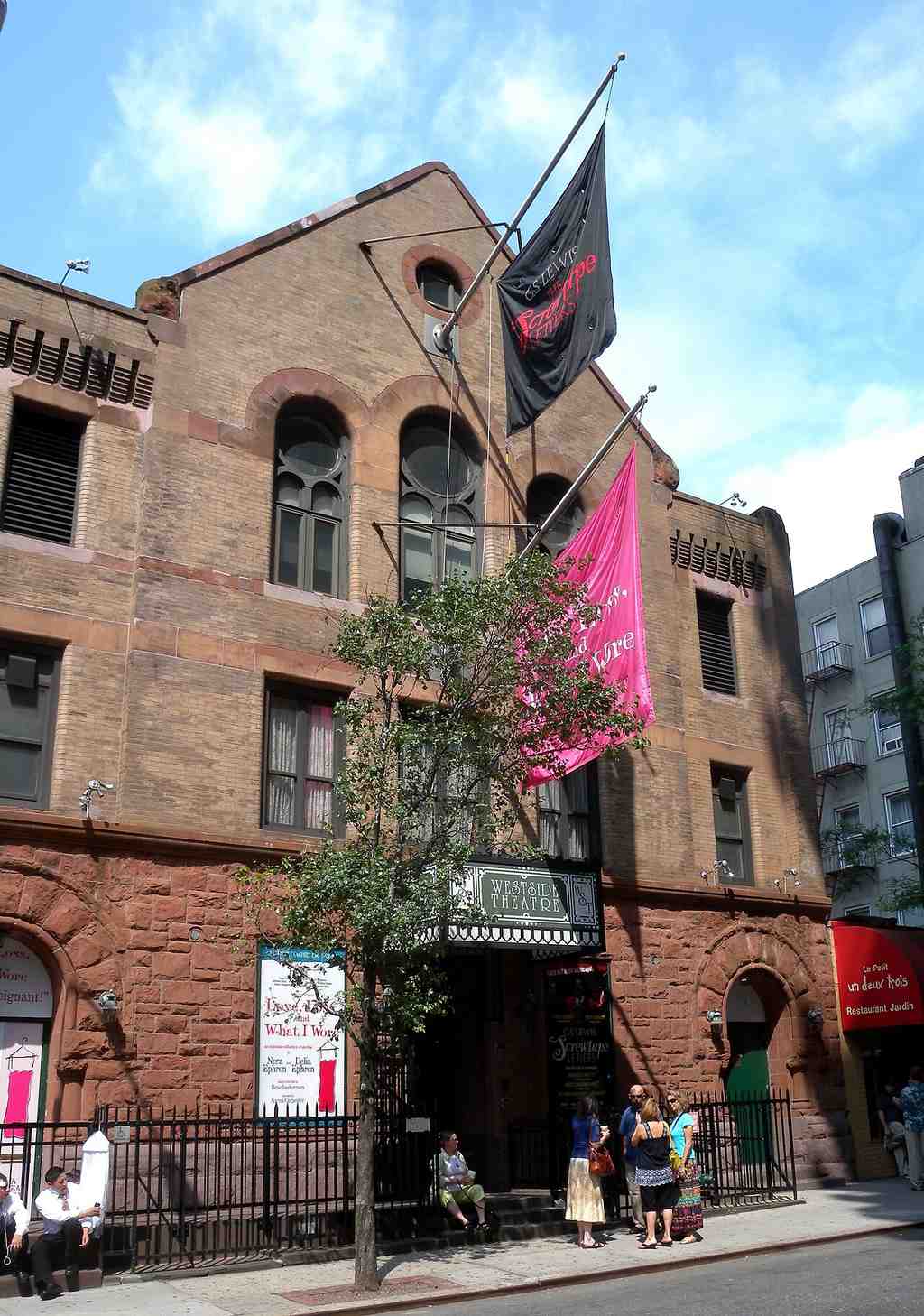
Look to your left for a solid red brick building with tall arched windows and a sturdy stone base, that is the Westside Theatre. It has a surprisingly heavy, grounded look for a theater, right? That is because architect Henry Franklin Kilburn designed it back in eighteen ninety in the Romanesque Revival style, an architectural vibe focused on thick walls and medieval-looking arches, originally built for the Second German Baptist Church.
It held onto its holy roots until the nineteen sixties, but this neighborhood has a way of loosening a collar. By the nineteen seventies, the hymnals were gone and the space was bouncing as a string of underground nightclubs. Then, in nineteen seventy-six, the disco balls came down and the theatrical lights went up. Check out your screen to see its original heavy stone and brick church glory.
Inside, they carved out two totally distinct worlds. The Upstairs Theatre seats two hundred and seventy people for traditional shows. The Downstairs Theatre is a bit more intimate, holding two hundred and forty-nine folks around a thrust stage. That is a stage that physically extends out into the room, so the audience sits on three sides of the action, practically breathing the same air as the actors.
Before a major nineteen ninety-one renovation, it went by a few different names, like the Westside Arts Theatre, which you can pull up on your app right now. Under this very roof, audiences have witnessed the off-Broadway magic of Penn and Teller in nineteen eighty-five, and massive hits like Little Shop of Horrors.
If you ever want to grab tickets at the box office, they are open from twelve noon to eight P-M Tuesday through Sunday, and closed on Mondays. It is pretty wild to think about this single building transforming from a quiet sanctuary to a noisy nightclub to a launching pad for theatrical legends. Take your time soaking up all those layers of history. Whenever you feel like moving, we will wander on to our next spot.




