
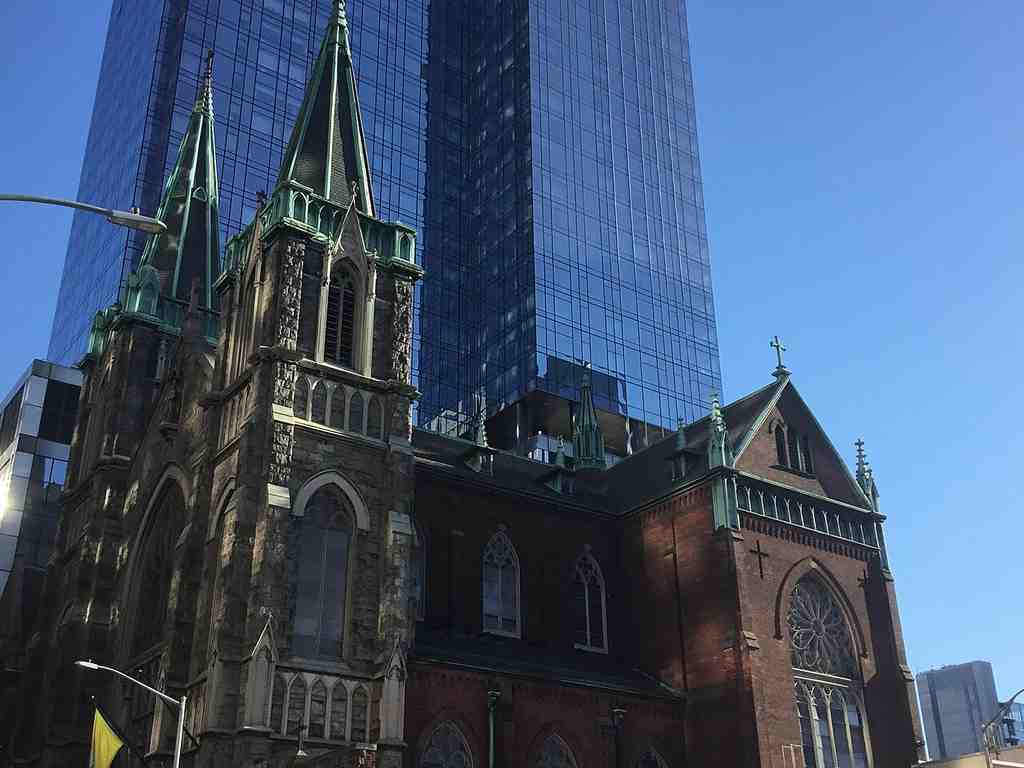
You are looking at a striking French Gothic church defined by its rough gray stone twin towers capped with oxidized green copper spires, which transitions smoothly into a dark red brick body along the side.
Remember Holy Cross Church, which we passed a little while ago? Well, back in eighteen eighty-six, the territory for this very parish was actually carved right out of Holy Cross to serve the booming population of poor Irish immigrants here in Hell's Kitchen. Ground was broken for this building, originally just the Church of St. Raphael, in nineteen oh one. The architect, George H. Streeton, designed those impressive front towers using Manhattan schist. That is the tough, sparkly local bedrock that anchors the city's massive skyscrapers, and here it is trimmed nicely with pale limestone.
Take a peek at the before and after image on your screen to see how over a century of development has completely transformed the surrounding Manhattan streetscape, yet the grand facade of this historic forty-first Street church remains a steadfast anchor of the neighborhood.
By the nineteen thirties, the construction of the Lincoln Tunnel and new railroad tracks tore right through this neighborhood, and the local Irish population plummeted. But while St. Raphael's was struggling, another community was growing. Since the late eighteen hundreds, a wave of Croatian immigrants had been settling in the West thirties, forties, and fifties, working the nearby docks and rail yards. For years, they had no church of their own, until nineteen thirteen, when a young priest named Irenaeus Petričak arrived from Zagreb. He tested out a Croatian language Sunday Mass at another local church, and it was packed to overflowing.
That same year, the community rented a small, disused church on fiftieth Street, spending five weeks scrubbing and painting it themselves. They named it after Cyril and Methodius, two ninth-century Greek brothers who famously translated religious texts and became known as the Apostles to the Slavs.
Fast forward to nineteen seventy-one. The Croatian parish was bursting at the seams, while St. Raphael's was largely empty. The Croatians began renting a rundown gymnasium behind St. Raphael's, redecorating it with motifs of their homeland. A few years later, in nineteen seventy-four, the archdiocese officially handed the keys to the Croatians, merging the rich histories of both parishes into one.
If you look closely at the street signs outside, you will notice this stretch of forty-first Street is also named Cardinal Stepinac Place, honoring the Archbishop of Zagreb who led the church in Croatia through the mid-twentieth century. Inside, the church even holds a bronze bust of him sculpted by the renowned artist Ivan Meštrović.
If you want to step inside to appreciate the peaceful nave, the soaring central hall of the church, the doors are open Monday through Thursday from eight A-M to five P-M, and Sunday mornings from nine to eleven A-M. Take a breath and enjoy the quiet. When you feel ready, let's continue on our route.




