
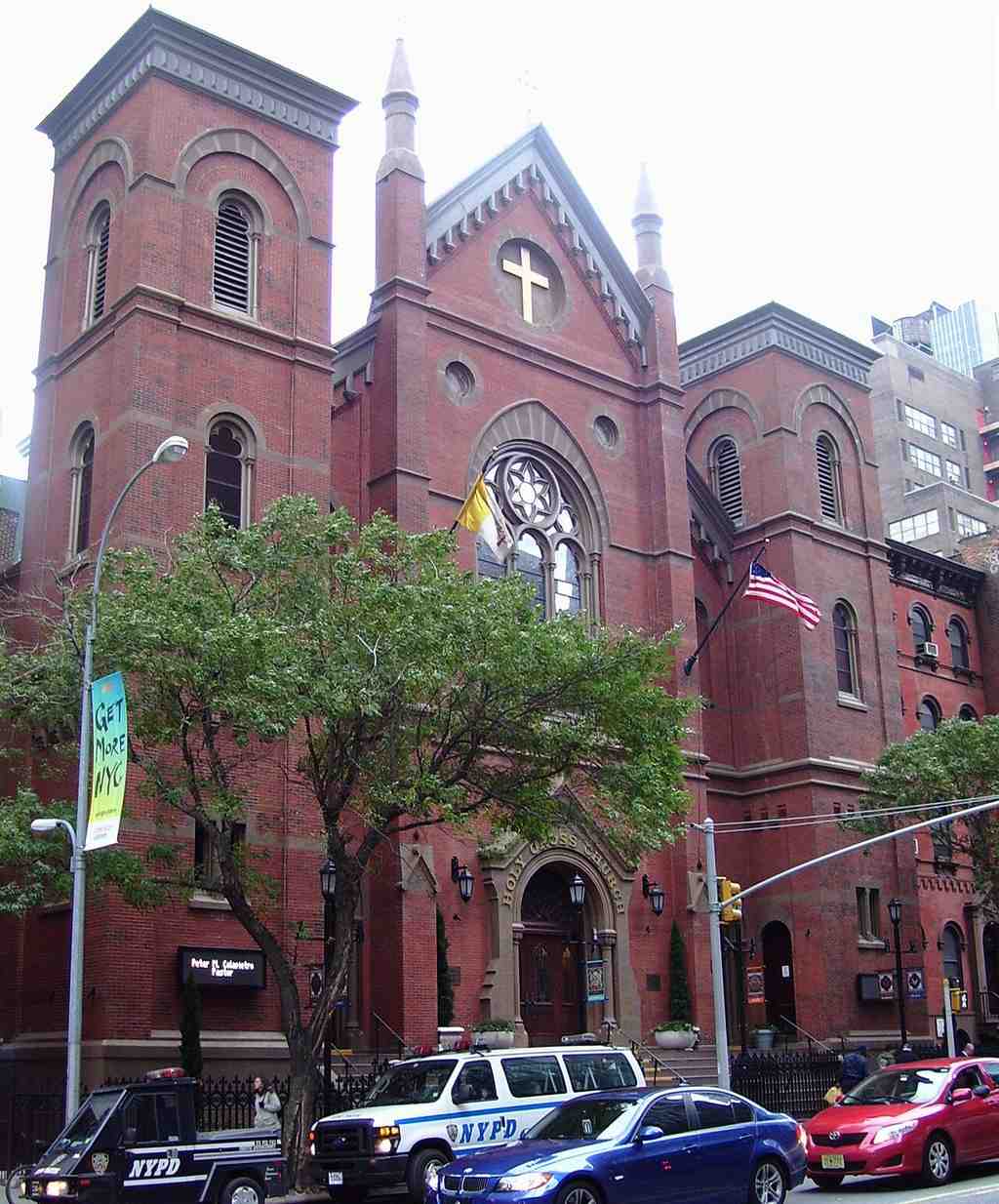
Look right and you will spot a striking red brick facade flanked by twin square towers, with a prominent gold cross gleaming near the peak of its central gable. This is Holy Cross Church, and it is actually the oldest building on Forty-Second Street.
It has got a real survivor's story. Back in eighteen sixty-seven, a lightning bolt struck the previous church on this exact spot, sparking a massive fire that completely destroyed the building and its original organ. But the community did not give up. By eighteen seventy, this current structure was standing tall. It was designed in an Italianate Gothic style, which just means it mixes the pointed arches of traditional Gothic architecture with the sturdy brickwork and symmetry you would see in old Italian buildings.
Inside, the layout is literally shaped like a giant cross, stretching one hundred feet from front to back, topped by a soaring dome. And if you wander in, you are in for a visual treat. The legendary designer Louis Comfort Tiffany created the stunning mosaics below the dome, as well as the stained glass in the upper clerestory windows, which are those high windows that let light flood down into the central hall.
But what really makes this place the beating heart of Hell's Kitchen is the people. Around here, this is practically known as Father Duffy's Church. Reverend Francis P. Duffy was a decorated World War One chaplain for the Fighting Irish, the sixty-ninth New York Regiment. After the war, he became the pastor here. He knew his neighborhood was full of tough, hardworking people, and he met them exactly where they were. In nineteen thirty-two, he even started a special Printers' Mass at two thirty in the morning. That incredibly late service was specifically for the night shift workers at the New York Times and the Daily News who were just finishing up their shifts. Talk about knowing your audience.
To this day, the church runs a food pantry and soup kitchen, keeping that grounded community spirit alive. In two thousand and fifteen, the parish merged with Saint John the Baptist and is now staffed by Capuchin friars, a Catholic order recognized by their brown robes and their dedicated focus on serving the poor.
If you want to peek inside, the church is open daily starting at seven A-M on weekdays, eleven A-M on Saturdays, and eight A-M on Sundays, usually closing up by mid-afternoon. Linger as long as you like. Once you have caught your breath, we will move on.




