
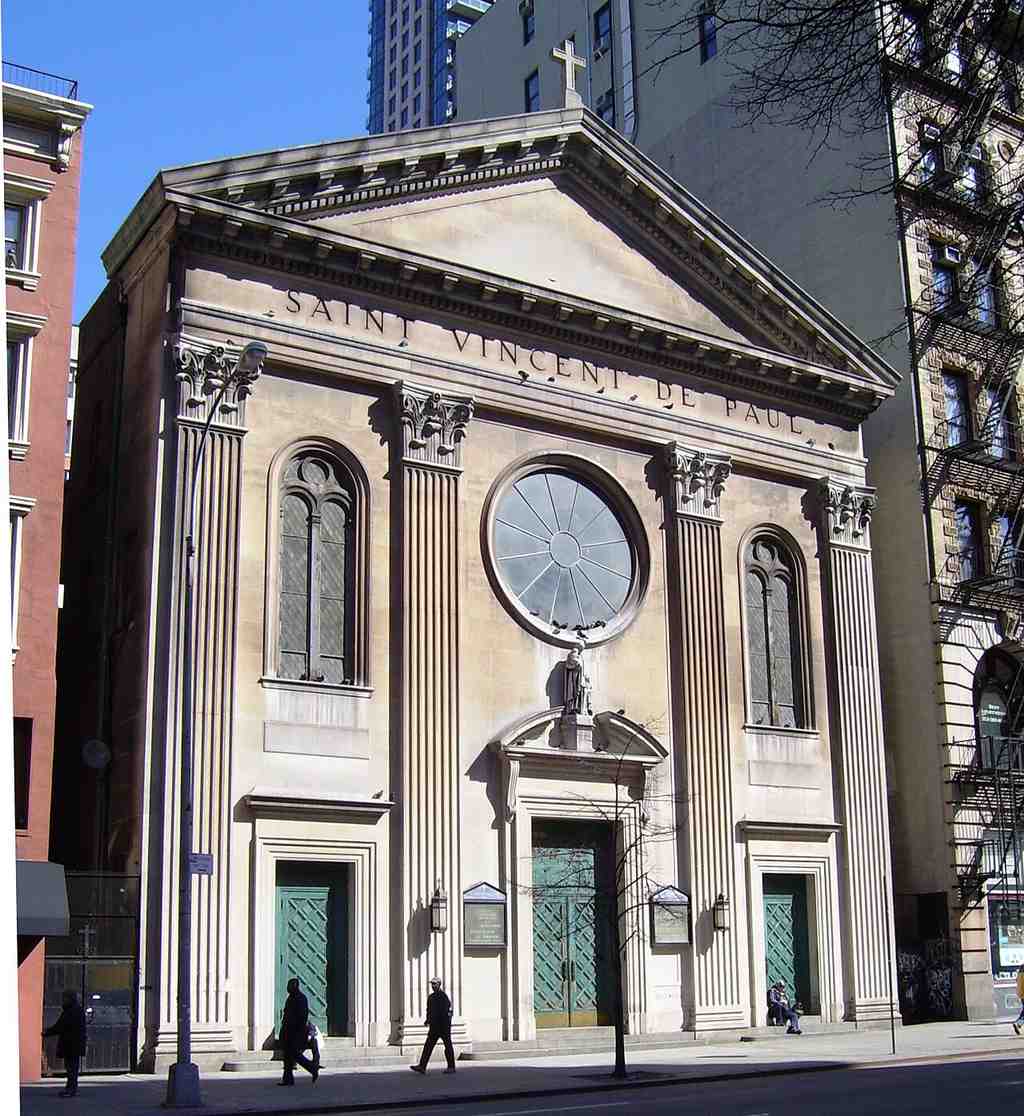
On your right, look for the pale stone church facade with its broad rectangular front, classical lines, and the distinctive round rose window set above the entrance.
This church held far more than Sunday worship... it became the beating French-speaking heart of Catholic New York. St. Vincent de Paul began in eighteen forty-one as a national parish, which means it served a language community rather than just the people living on one set of streets. Its story really starts in France, where the French Revolution had shattered church life. In response, a priest named Jean-Baptiste Rauzan founded the Fathers of Mercy in Lyon in eighteen oh eight. These priests went out mission-style, even door to door, trying to rebuild faith from the ground up.
Then came a dramatic New York chapter. In eighteen thirty-nine, Charles de Forbin-Janson, an exiled French bishop, arrived in the city and discovered something startling: many French-speaking Catholics had started attending Protestant Huguenot churches simply because the services were in French. So he threw down a challenge during Mass at St. Peter’s Church and urged the French Catholic community to create its own church. He backed that challenge with real money too... six thousand five hundred dollars from his own fortune, roughly more than two hundred thousand dollars today.
The first parish stood downtown, but by the eighteen fifties many French residents had moved here to Chelsea, drawn by industry and work. The congregation bought land here, and architect Henry Engelbert designed this new church. The Civil War interrupted construction, but the parish finished it in eighteen sixty-nine. And once this church arrived, Chelsea became a magnet for French life, helping pull in other institutions, including the old French Hospital.
One of the most moving figures here was Father Annet Lafont, the first pastor. He did not stop at sermons. He founded an orphanage, homes for the elderly, and residences for young women looking for work in the city. He also pushed for racial equality with extraordinary courage. From the beginning, this church and its school welcomed Black worshippers and students alongside everyone else. When white families threatened to pull their children out, Lafont personally taught Black children in his own residence. Pierre Toussaint, the Haitian-born former slave who became a celebrated hairdresser and philanthropist, helped support that work. He is now being considered for sainthood.
And the cultural life here... wow. Edith Piaf married here in nineteen fifty-two, with Marlene Dietrich as maid of honor. The great opera singer Armand Castelmary received his funeral Mass here after dying onstage at the Metropolitan Opera. After World War One, the church created a memorial for French and American veterans. Then on the sixth of June, nineteen forty-four, more than one thousand French exiles and French soldiers packed in for a noon Mass, praying as Allied troops began liberating France. Later, Charles de Gaulle himself attended the church’s rededication.
Even after the Fathers of Mercy left in nineteen sixty, weekly Mass in French continued, serving immigrants from about sixty-five nations, especially from West Africa in recent decades. The parish closed in twenty thirteen, and many former parishioners still feel that loss deeply.
Though the parish itself closed in twenty thirteen, the building still carries that living memory with it. When you’re ready, we can continue on to the next stop.




