New York City Audio Tour: Grand Central Gems
Beneath the frantic pulse of Midtown Manhattan lies a silent map of power, scandal, and long-buried rebellion. You are walking over the ghosts of the city’s most influential architects. Uncover these secrets with a self-guided audio journey through the corridors of prestige and hidden history. This experience pulls back the curtain on legendary institutions, revealing stories that never made the guidebooks. Did a clandestine political deal at the Yale Club reshape a national election? Which forgotten scandal once tore through the polished halls of the Manhattan Institute? Why does the architecture of Grand Central Art Galleries whisper of a rebellion that was silenced overnight? Navigate through the towering stone monoliths and winding streets. Feel the weight of history shift under your feet as you transform from a casual observer into a master of city secrets. Start your investigation now and reclaim the streets.
Tour preview
About this tour
- scheduleDuration 80–100 minsGo at your own pace
- straighten2.5 km walking routeFollow the guided path
- location_onLocationNew York, United States
- wifi_offWorks offlineDownload once, use anywhere
- all_inclusiveLifetime accessReplay anytime, forever
- location_onStarts at Grand Central Art Galleries
Stops on this tour
lock_open 3 free previews · 14 unlock with purchase
Hello, and welcome to the tour! I am your guide, Andy, and I am thrilled to show you around Manhattan. Let us kick things off right here outside Grand Central Terminal. I want you…Read moreShow less
Open dedicated page →Hello, and welcome to the tour! I am your guide, Andy, and I am thrilled to show you around Manhattan. Let us kick things off right here outside Grand Central Terminal. I want you to look up at this magnificent building and imagine it is nineteen twenty-three. Back then, if you took the elevator to the sixth floor, you would not find railroad offices. You would step into the Grand Central Art Galleries.
This was not just any gallery. Spanning fourteen thousand square feet, it was billed as the largest sales gallery of art in the world. If you want a sense of the sheer scale, glance at your phone to see the original floor plan from nineteen twenty-three. They managed to pack eight main exhibition rooms, a foyer gallery, and a grand reception area right above the bustling train tracks.
The gallery was the brainchild of a cooperative founded in nineteen twenty-two by notable painters like John Singer Sargent and Walter Leighton Clark. They wanted to bring American art to a broader audience, and they came up with an ingenious business model. It was essentially a high-stakes art lottery. Artists who wanted to join had to donate one piece of art every year for three years as their initiation fee. On the other side, non-artists, known as lay members, paid an initial fee of six hundred dollars, which is about eleven thousand two hundred and fifty-six dollars today. In return, they got to choose one of those donated artworks.
But how did they decide who got first pick? With a highly dramatic annual drawing. Picture this: a ritzy gala with high-society folks nervously clutching their lists of top thirty choices. A child would pull names from a sealed, thoroughly shaken glass jar. First name called got first pick. Pull up your app to see a photo of founder Walter Leighton Clark presiding over the drawing in nineteen thirty-three. The tension in that room must have been thicker than oil paint! In nineteen forty-one, legendary film star Gloria Swanson even presided over the drawing, dressed to the nines in a simple black costume and a massive black hat.
There was always a flair for the dramatic here. In nineteen fifty-seven, three hundred and fifty well-heeled art lovers gathered for the opening of an exhibition by Gordon Grant. Suddenly, a transformer fire knocked out all the power. The fancy crowd had to play an impromptu game of follow-the-leader, creeping down the dark, twisting terminal stairways to the street guided by a single flashlight beam!
The galleries thrived here for twenty-nine years before the railroad decided to redevelop the space in nineteen fifty-eight, forcing them to relocate and eventually close in nineteen ninety-four.
Even though the art is gone, the grandeur of this space still echoes with that high-society drama. If you want to explore the terminal today, it is open every day from nine A-M to ten P-M. Take a moment to soak this in. When you are ready, we can head to the next stop.
If you look to your left, you are near the gateways to Grand Central Madison. But the real marvel, and a fair bit of New York drama, is hiding deep below the pavement. Beneath the…Read moreShow less
Open dedicated page →If you look to your left, you are near the gateways to Grand Central Madison. But the real marvel, and a fair bit of New York drama, is hiding deep below the pavement. Beneath the historic Grand Central Terminal sits a massive commuter rail hub for the Long Island Rail Road, or L-I-R-R, operated by the Metropolitan Transportation Authority, known locally as the M-T-A.
The idea to bring Long Island trains to Manhattan's East Side was first tossed around back in nineteen sixty-three. It was eventually revived as the East Side Access project. Now, if you know anything about New York construction, you know it rarely goes exactly to plan. In two thousand and four, the project was estimated to cost four point four billion dollars. By twenty seventeen, that price tag had ballooned to an eye-watering eleven point one billion dollars.
You can glance at your screen to see the sheer scale of the Madison Concourse, which makes up a big chunk of the station's seven hundred thousand square feet. To get to the trains, commuters have to navigate a staggering forty-seven escalators. That is more escalators than the rest of the entire L-I-R-R network combined. These moving staircases plunge commuters deep into the earth. Check out your screen to see the dizzying installation of one of these wellways in twenty eighteen. One of these escalators is actually the longest in the entire city, dropping folks more than ninety feet down to a mezzanine level that sits one hundred and forty feet beneath Park Avenue.
The grand opening was finally set for late twenty twenty-two, but it was abruptly delayed. The culprit was a single ventilation fan that could not exhaust enough air. After sorting that out, they finally opened the doors on January twenty-fifth, two thousand and twenty-three.
The station has its own very specific quirks. If you are tired, good luck finding a place to rest. The ticketed waiting area only has twenty-nine seats. And do not get too comfortable. If you sit there for more than ninety minutes, you can be slapped with a fifty-dollar fine. The M-T-A bluntly stated that unless there is a massive service delay, nobody should be waiting around that long. They also had to buy a special battery-powered rescue locomotive just to tow broken-down passenger trains through the tunnels, because the regular locomotives were simply too wide to fit through the route.
Despite the quirks, it is a place of incredible beauty. The concourses are filled with site-specific art, including an immense one hundred and twenty-foot mosaic by Yayoi Kusama called A Message of Love, Directly from My Heart unto the Universe. There are also glass mosaics by Kiki Smith featuring turkeys, a seagull, and a deer, specifically designed so New Yorkers could text each other and say, I will meet you by the deer.
This subterranean maze is a true testament to the stubborn, beautiful, and sometimes chaotic spirit of this city. Take your time enjoying the architecture around the entrance, and whenever you are ready, we will head to our next destination.
Right in front of you is Grand Central Terminal, but we are actually here to talk about a phantom building. A massive skyscraper that was almost dropped squarely on top of this…Read moreShow less
Open dedicated page →Right in front of you is Grand Central Terminal, but we are actually here to talk about a phantom building. A massive skyscraper that was almost dropped squarely on top of this magnificent structure. They called it Grand Central Tower.
Back in the nineteen fifties, train travel was tanking. People were buying cars and discovering the joy of jet planes. The New York Central Railroad was bleeding money. So, they looked up at the empty sky above the station and saw dollar signs. Due to local zoning laws, they had a ton of unused air rights, which is basically the legal permission to build vertically into the empty space above a property.
In nineteen fifty-four, they considered a plan by architect I-M Pei for an eighty-story, sixteen-hundred-foot tower that would have been the tallest in the world. He later tweaked it into a hyperboloid, a massive hourglass-shaped tower reinforced with a lattice of diagonal beams that was supposedly sturdy enough to survive a nuclear bomb. Thankfully, that idea fizzled out, and they built the Pan Am building just to the north instead.
But the railroad was still broke. In nineteen sixty-eight, a developer leased the air rights for three million dollars a year, which is roughly twenty-six million dollars today. They hired famed architect Marcel Breuer to design a towering monolith.
Take a glance at your phone to see a rendering of Breuer's first proposal. He designed a nine-hundred-fifty-foot stone-clad tower that would have been cantilevered over the main concourse. Cantilevered just means the upper floors jutted outward into midair, supported entirely by a central core rather than columns directly underneath them. It looked like a giant concrete anvil resting right on top of the station. Constructing the lobby alone would have destroyed the terminal's historic waiting room.
New Yorkers absolutely hated it. Critics called it a grotesquerie. Former First Lady Jacqueline Kennedy Onassis fiercely opposed the project, arguing it was cruel to strip the city of its architectural heritage. The city's Landmarks Preservation Commission, or L-P-C for short, rejected it, calling the design an esthetic joke.
Breuer tried again in nineteen sixty-nine. If you check your screen one more time, you can see his second concept. This time, his fifty-nine-story building would have demolished the entire terminal facade, saving only the indoor concourse. The L-P-C shot that down too. The railroad sued the city, sparking a bitter legal war that dragged on for nearly a decade.
Finally, in nineteen seventy-eight, the U-S Supreme Court ruled in favor of New York City. The landmark law was upheld, preventing the tower's construction and saving the terminal from being swallowed whole by a corporate skyscraper.
Because of that massive fight, Grand Central stands today without a concrete giant sitting on its shoulders. Take your time admiring the unobstructed view of this beautiful survivor. Whenever you are ready to keep moving, our next stop awaits.
Show 14 more stopsShow fewer stopsexpand_moreexpand_less
You can easily spot Saint Agnes Church by its light grey stone facade, classical triangular roofline, and the simple stone cross standing tall at the very peak. Back in eighteen…Read moreShow less
Open dedicated page →
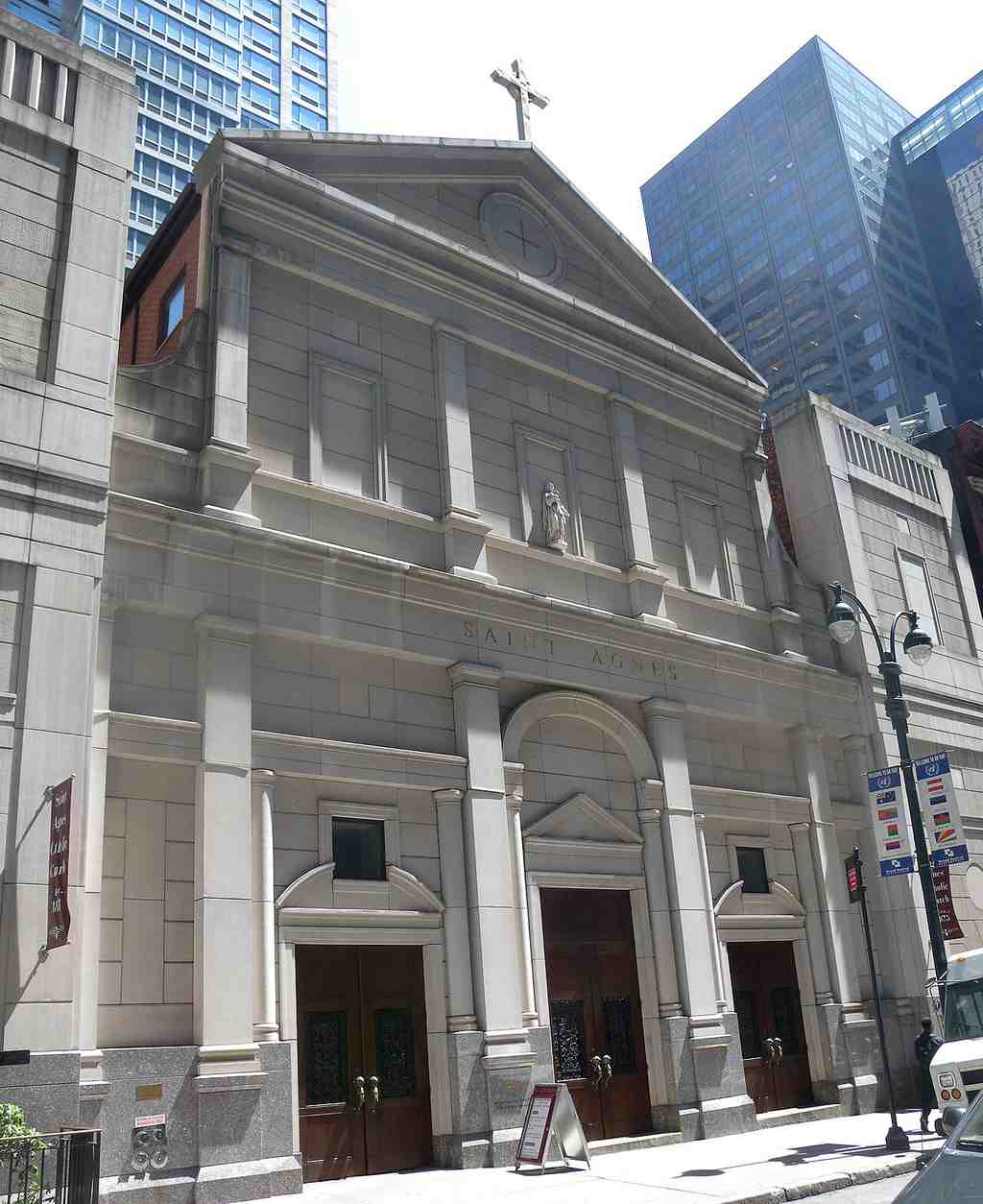
St. Agnes ChurchPhoto: Jim.henderson, Wikimedia Commons, CC0. Cropped & resized. You can easily spot Saint Agnes Church by its light grey stone facade, classical triangular roofline, and the simple stone cross standing tall at the very peak.
Back in eighteen seventy-three, this parish was created for the hardworking Italian laborers who were building the brand new Grand Central Depot just down the street. The first pastor, Reverend Harry Cummings Macdowell, literally rented out a hall above a meat and produce market on Forty-Second Street for his temporary chapel, handing out paper flyers on the street to drum up a congregation.
The church eventually got its own permanent building, but let us just say Saint Agnes has had a literal baptism by fire. Twice, actually. The first massive blaze happened on Christmas Eve in eighteen ninety-eight. It gutted the place but miraculously left the tall stone towers standing. Fast forward almost a century to the tenth of December, nineteen ninety-two, and disaster struck again. Another devastating fire reduced the main worship hall to ashes, leaving just the outside walls and those incredibly stubborn towers upright.
Cleaning up the nineteen ninety-two ruins cost two million dollars, and building the glorious new structure you see today cost another six million dollars. They finally reopened in nineteen ninety-eight. The architects modeled the new design after the Church of the Gesù, a famous classical church in Rome, but they carefully kept those resilient original stone towers flanking the sides of the new building.
This place is not just known for surviving infernos, though. For over half a century, it was basically a national broadcasting hub. Archbishop Fulton J Sheen hosted his massively popular radio and television shows right from here. His dramatic broadcasts, including a legendary episode analyzing the death of Soviet leader Joseph Stalin, were hugely influential in reshaping mainstream twentieth-century American views on the Catholic faith.
It is a beautiful monument to the sheer stubborn resilience of New York City. Take a moment to appreciate its history, and when you are ready, let's keep walking.
Look to your right. You are standing outside the headquarters of an organization that has quite literally changed the world. This is the Chanin Building, and since nineteen…Read moreShow less
Open dedicated page →Look to your right. You are standing outside the headquarters of an organization that has quite literally changed the world. This is the Chanin Building, and since nineteen ninety-four, it has been the global nerve center for the International Rescue Committee, or the I-R-C.
Now, if you want to talk about origin stories, this one is tough to beat. Picture this. It is nineteen thirty-one in Germany, and a group of left-wing political factions forms the International Relief Association to help victims of state oppression. By nineteen thirty-three, when the Nazis took power, a brilliant, frizzy-haired physicist decided he needed to step in. Yes, Albert Einstein himself helped form an American branch to assist those fleeing Adolf Hitler's government.
Let me tell you about one of their most dramatic chapters. In nineteen forty, a man named Varian Fry went to Marseille, France, for the Emergency Rescue Committee, a group that would soon merge with Einstein's organization. Fry arrived just weeks after the fall of France. He pulled together a scrappy, underground team and spent thirteen months smuggling over two thousand political, cultural, and academic leaders out of Vichy France, right under the noses of the Nazis. He even passed a map of Mediterranean minefields from a refugee straight to British intelligence. Talk about a real-life spy thriller.
In nineteen forty-two, after the U-S entered the Second World War, these groups merged to form the International Rescue Committee. Fast forward to today, and the I-R-C is a global humanitarian titan. Led by their C-E-O, former British Foreign Secretary David Miliband, they operate in more than forty countries and twenty-six U-S cities. In twenty twenty-four alone, they reached an astonishing thirty-six and a half million people with humanitarian services. They are the first responders who show up when the world falls apart, whether it is helping Ukrainian refugees keep their homes warm during winter, or setting up mobile health clinics in crisis zones.
Take a look at your screen for a glimpse of this global reach. You will see a photo of an I-R-C doctor conducting a check-up on a young Syrian refugee in a clinic in Jordan, a perfect example of their life-saving health programs. And if you check the next image, you can see a great shot of the Chanin Building itself, this very skyscraper you are standing in front of, which has housed these incredible efforts for decades. The I-R-C tackles everything from emergency response to resettling refugees, earning a top-tier A rating from CharityWatch along the way. They operate on a massive budget of hundreds of millions of dollars, yet they remain remarkably efficient, with the vast majority of their funding going straight to the people who need it most.
If you ever need to stop by their offices, they are open Monday through Friday from nine A-M to five P-M. Take a moment to look up at the building and imagine the millions of lives touched by the work done right inside those doors, and when you are ready, we can head to our next stop.
You are standing in front of what used to be a little slice of Zen in Manhattan. This was Kajitsu, a Japanese restaurant that moved to Murray Hill in two thousand and thirteen.…Read moreShow less
Open dedicated page →You are standing in front of what used to be a little slice of Zen in Manhattan. This was Kajitsu, a Japanese restaurant that moved to Murray Hill in two thousand and thirteen. They specialized in shojin ryori, which is traditional Japanese Buddhist cuisine. These highly seasonal, meticulously prepared vegetarian dishes earned them a coveted Michelin star, plus four out of five stars from Time Out New York. Legendary composer Ryuichi Sakamoto was a regular here, and he actually curated their background playlist! Imagine a world-famous musician picking the perfect soundtrack for your dinner. Downstairs at Kokage, they served handmade soba, which are thin buckwheat noodles. They also had a cafe for wagashi, or traditional Japanese sweets. This building even hosted New York's only Ippodo tea room for full tea ceremonies. If you glance at your screen, you can see a chasen, the intricate bamboo whisk they used to prepare their frothy matcha. It was a true culinary oasis in the concrete jungle. Whenever you are ready, let us stroll to our next destination.
Look to your left and you will see a massive, six-hundred-and-twenty-nine-foot-tall wedge-shaped skyscraper clad in dark, reflective glass, rising from a distinctive slanted base.…Read moreShow less
Open dedicated page →
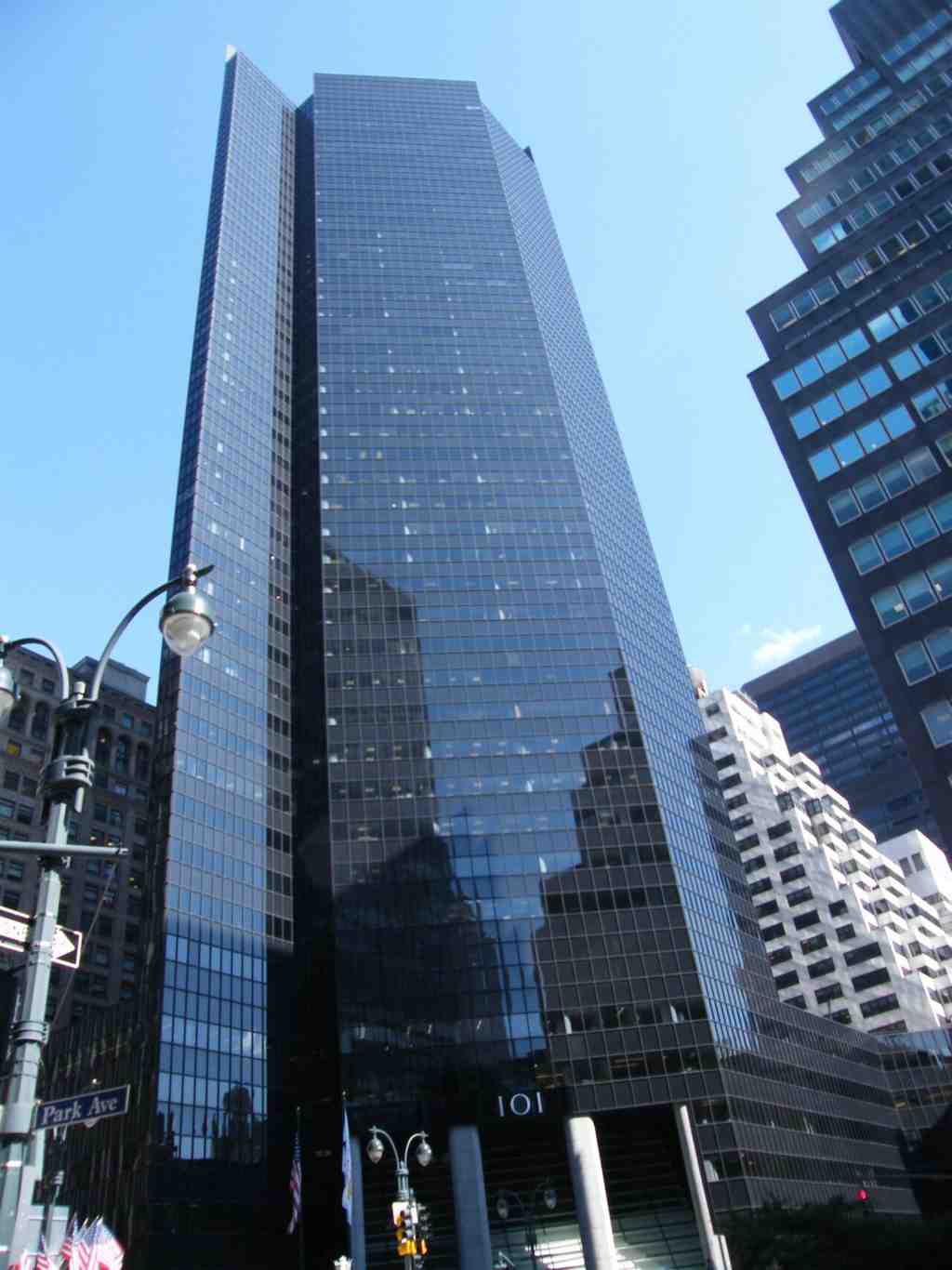
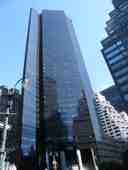
101 Park AvenuePhoto: Americasroof, Wikimedia Commons, CC BY-SA 3.0. Cropped & resized. Look to your left and you will see a massive, six-hundred-and-twenty-nine-foot-tall wedge-shaped skyscraper clad in dark, reflective glass, rising from a distinctive slanted base. Designed by Eli Attia Architects and opened in nineteen eighty-two, one zero one Park Avenue is not just an office building, it is a veritable Manhattan celebrity.
It is so massive that the U-S Postal Service gave it its own zip code: one zero one seven eight. It is one of only forty-one buildings in Manhattan with that exclusive bragging right. If you check your app, I have included a shot of its towering exterior from a distance. Inside, alongside fancy corporate law firms and tech headquarters, you will find virtual golf and the wonderfully quirky Museum of the Dog.
But you have probably seen this building before, even if you have never set foot in New York. This dark glass giant has a killer resume in Hollywood. If you are a child of the nineties, you might recognize it as the fictional Clamp Center from Gremlins Two: The New Batch. It was George Costanza's office building in the ninth season of Seinfeld, the site of a tense rooftop showdown in Miami Vice, and it even served as a crash site in the two thousand and twelve blockbuster, The Avengers. Aliens practically leveled the place on screen, but clearly, the architecture held up nicely!
Whether it is housing fictional gremlins, real-life purebred dog portraits, or George Costanza sleeping under his desk, this skyscraper is a legendary slice of New York pop culture. Whenever you are ready to keep moving, we can stroll on down to our next stop.
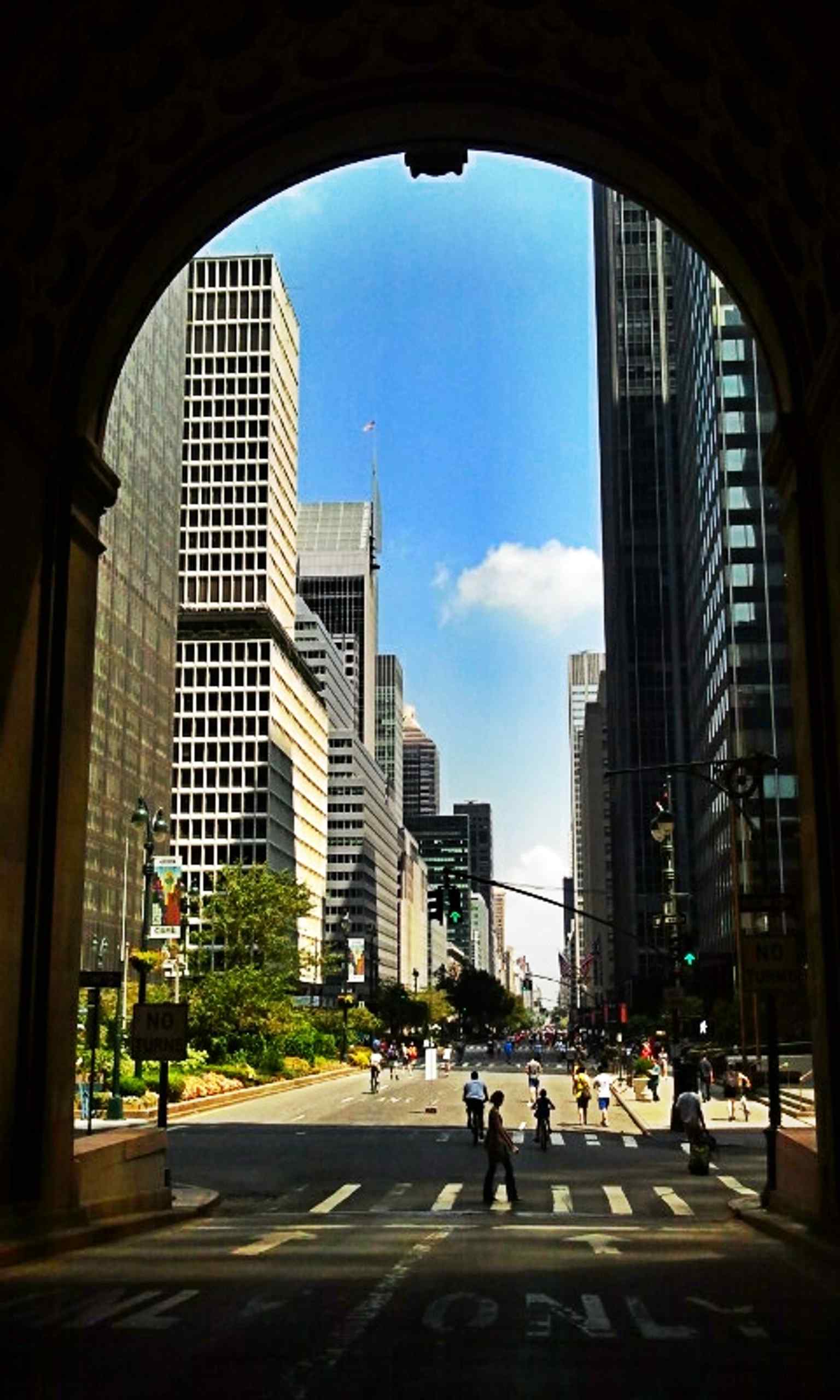
Take a look to your left. That massive elevated roadway wrapping around Grand Central Terminal is the Park Avenue Viaduct. To really appreciate this, imagine New York City back…Read moreShow less
Open dedicated page →Take a look to your left. That massive elevated roadway wrapping around Grand Central Terminal is the Park Avenue Viaduct.
To really appreciate this, imagine New York City back in the early nineteen hundreds. Park Avenue was completely severed by the old train depot. The southern half was a quiet, upscale neighborhood, while the northern half was a loud, open railway trench. In nineteen hundred, a brilliant railroad engineer named William J. Wilgus proposed a wild idea. He wanted to build an elevated highway that would simply sweep traffic up into the air and carry it right around the new Grand Central Terminal.
Simple, right? Well, not exactly. The architects fought bitterly over the design, and the city's subway builders could not decide where to put the new stations. By the time construction finally began in nineteen seventeen, World War One had broken out, meaning the builders could not even get their hands on the necessary steel.
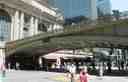
Finally, the western half of the roadway opened in nineteen nineteen. The southern stretch, between fortieth and forty-second streets, is an absolute beauty. If you pull out your phone, you can see a great shot of its three steel arches. These elegant curves were modeled after the famous Pont Alexandre the Third bridge in Paris. But here is the funny part, they are not actually arches at all. They are cantilever beams, which are essentially long, rigid structures anchored at only one end, disguised as arches just to look pretty. The giant steel girders were forged in New Jersey, floated up the East River, and dragged through the city streets by fifty-two horses. The initial project cost seven hundred sixty-eight thousand thirty-two dollars, which is roughly thirteen point five million dollars today. Not bad for a piece of engineering magic.
The southern section of the viaduct (40th-42nd Streets) features three steel arches, which were included for aesthetic considerations and are based on Paris's Pont Alexandre III.Photo: Gigi alt, Wikimedia Commons, CC BY-SA 3.0. Cropped & resized. Traffic eventually got so heavy that they had to build the eastern leg in nineteen twenty-eight, and they had to route the whole thing right through a skyscraper. Glance at your screen again to see the triple-story arches where the viaduct's roadways swoop directly under the Helmsley Building. The engineers laid the road on giant S-curves supported by stanchions, or vertical pillars, that miraculously do not even touch the building's frame.
This soaring roadway changed Park Avenue from a disconnected local street into the most modern highway in New York, and it also created a fascinating covered space right underneath its central arch. We will explore the plaza's wild history next, so whenever you are ready, let's keep walking.
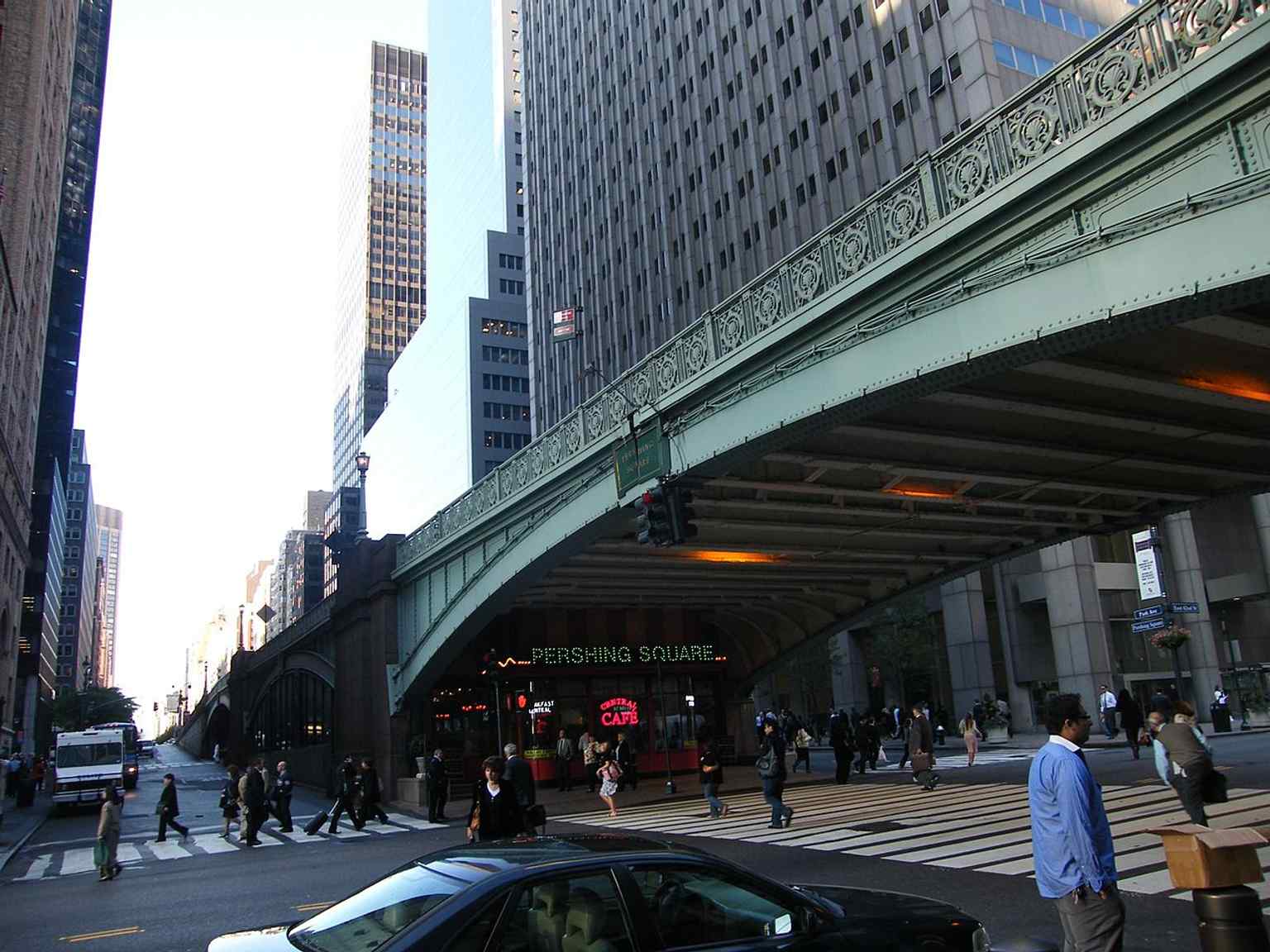
The Park Avenue Viaduct was originally proposed in 1900 as part of the Grand Central Terminal construction, aiming to alleviate city traffic.Photo: Americasroof (talk), Wikimedia Commons, CC BY-SA 3.0. Cropped & resized. 
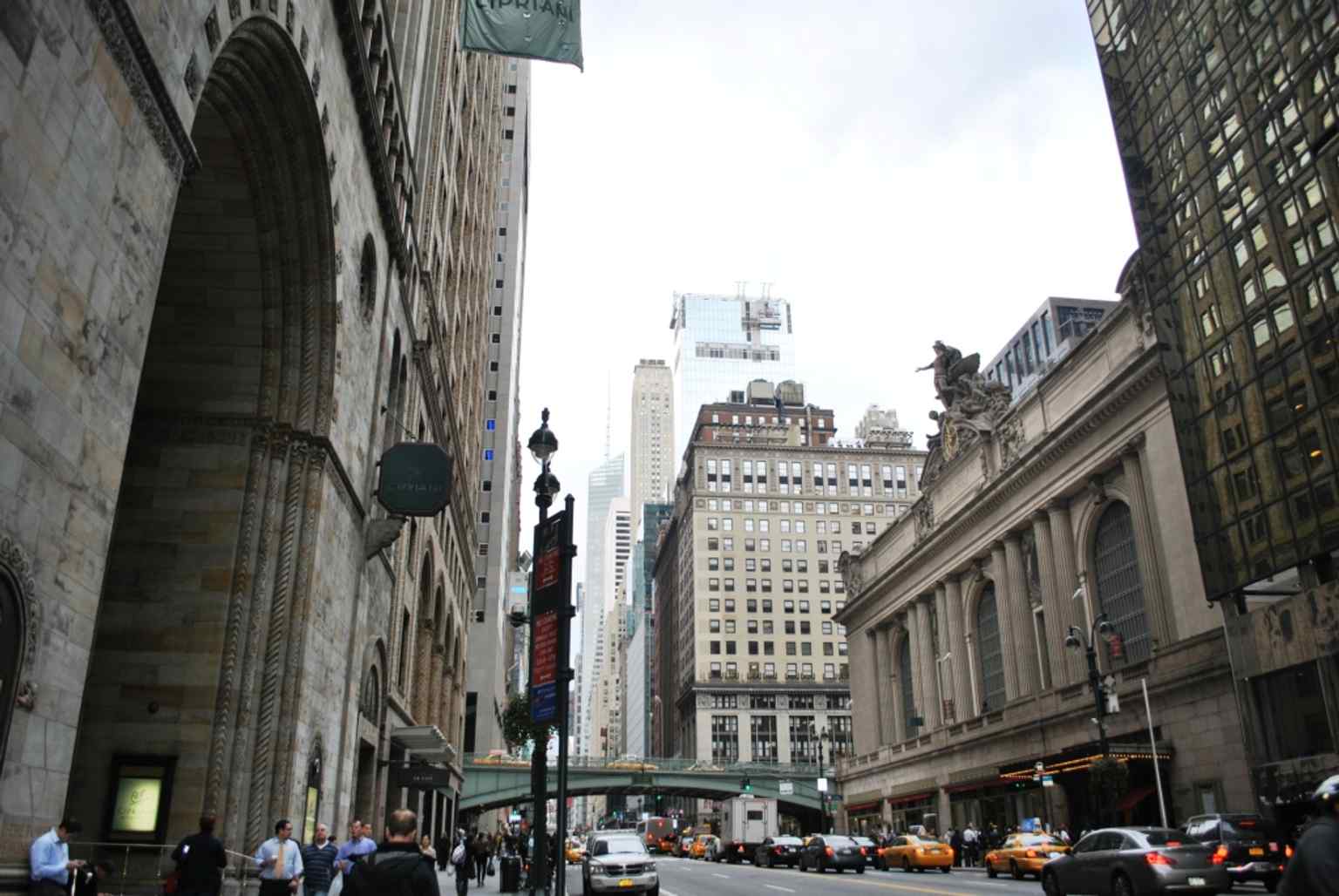
The viaduct rises to a T-intersection just north of 42nd Street, elevated over the street-level entrance to Grand Central Terminal below.Photo: Elisa Rolle, Wikimedia Commons, CC BY-SA 3.0. Cropped & resized. Look for the space stretching beneath and alongside the elevated bridge, defined by wide concrete pedestrian walkways and the striking steel and glass brick structure tucked right…Read moreShow less
Open dedicated page →
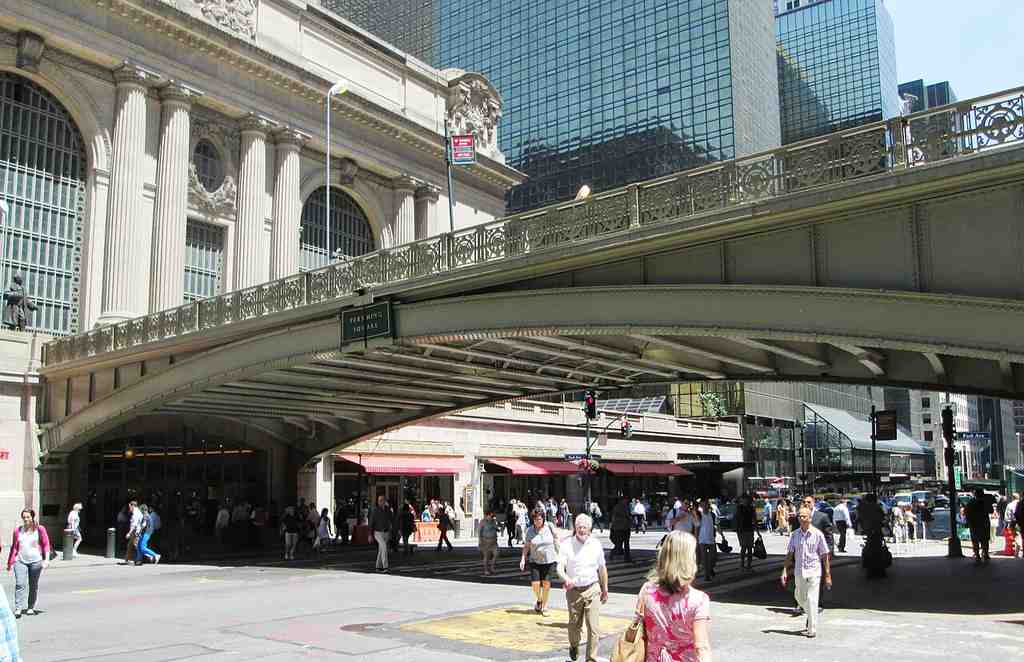
Pershing Square, ManhattanPhoto: Beyond My Ken, Wikimedia Commons, CC BY-SA 4.0. Cropped & resized. Look for the space stretching beneath and alongside the elevated bridge, defined by wide concrete pedestrian walkways and the striking steel and glass brick structure tucked right under the viaduct's central arch.
Welcome to Pershing Square. Named in nineteen nineteen after World War One General John J. Pershing, this spot was initially supposed to be a massive, block-long open plaza featuring a grand three-story memorial called Victory Hall. But Fiorello La Guardia, the fiery politician who would later become mayor and get an airport named after him, absolutely hated the idea and shut it down. Take a glance at your screen to see a historical nineteen nineteen rendering of what they originally envisioned for the space. The city then tried to sell the empty lot in May of nineteen twenty for two point eight million dollars. To put that in perspective, that is over forty million bucks in today's money. When the auctioneer asked for bids, absolutely no one raised a hand. Crickets! Eventually, a real estate investor bought it and chopped the block up for massive office buildings. So, the grand Pershing Square name ended up getting slapped onto just the service roads alongside the viaduct.
Let us talk about that enclosed space right under the bridge. Originally, it was a trolley barn, a large municipal garage where electric streetcars were parked and repaired overnight. In nineteen thirty-eight, the city decided to dress it up, building that steel and glass brick structure to serve as a tourist information center for the nineteen thirty-nine New York World's Fair. During World War Two, the space was taken over by the U-S-O, the United Service Organizations, to offer support and entertainment for military personnel. Over the next few decades, the space had an identity crisis. It became a visitors bureau, then an unemployment office in the nineteen eighties, and eventually a deeply glamorous discount retail shop.
In the nineteen nineties, a local partnership pitched an idea to close the roads to traffic and turn the space under the bridge into a high-end restaurant. They hired a restaurateur named Michael O'Keeffe to operate it. The city had budgeted two million dollars for the renovation, but O'Keeffe was a total perfectionist. He demanded the use of slot-headed screws, since those were the only type available when the viaduct was originally built. He also insisted on importing chairs and electric cords all the way from Paris, and demanded a painstaking hand-rubbed paint scheme. This obsession with historical detail drove the renovation costs up to five million dollars and pushed the grand opening back by several months. But the Pershing Square Cafe finally opened its doors in nineteen ninety-seven.
In recent years, the city finally realized that people preferred walking and eating here rather than dodging taxi cabs. Starting in twenty eighteen, the local government spent millions of dollars to permanently close the roadways. They ripped out the old traffic lanes and built the beautiful asphalt and concrete pedestrian plazas with built-in rain gardens that you are standing on right now.
It took a century of false starts and squabbles, but General Pershing finally got a beautiful public square. Take your time enjoying the new plaza, and whenever you are ready, we can stroll to our next spot.
Look to your left and spot the towering, fifty-five-story stone skyscraper soaring into a flat-topped crown, distinct for the pointed, neo-Gothic arched windows near its peak.…Read moreShow less
Open dedicated page →
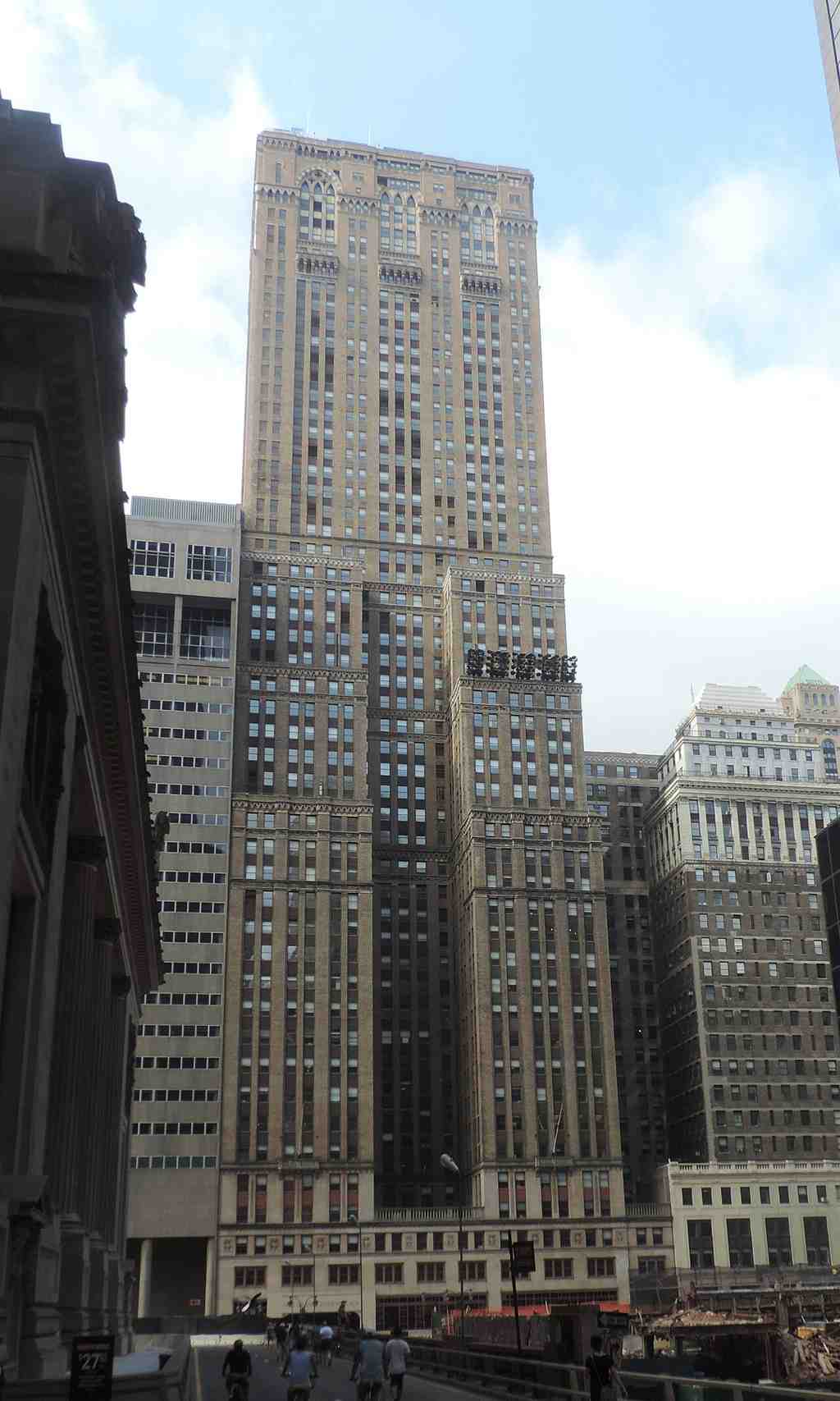
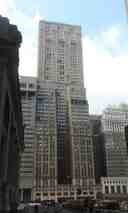
One Grand Central PlacePhoto: Jim.henderson, Wikimedia Commons, CC BY 3.0. Cropped & resized. Look to your left and spot the towering, fifty-five-story stone skyscraper soaring into a flat-topped crown, distinct for the pointed, neo-Gothic arched windows near its peak. This is One Grand Central Place, though for decades folks knew it as the Lincoln Building. It spans so much office space that it was assigned the unique ZIP code of one zero one six five. And neo-Gothic just means it was designed with the dramatic arches and vertical lines of a medieval cathedral, stretched up into the Manhattan skyline.
Completed in nineteen thirty, this place held onto its namesake President in a very literal way. In nineteen fifty-six, the owner paid three thousand dollars, or roughly thirty-four thousand dollars today, for a three-foot bronze model of Abraham Lincoln. It was cast from the sketches used to create the famous Lincoln Memorial statue in Washington. Take a peek at your phone for a neat nineteen twenty-nine shot of this massive structure under construction.
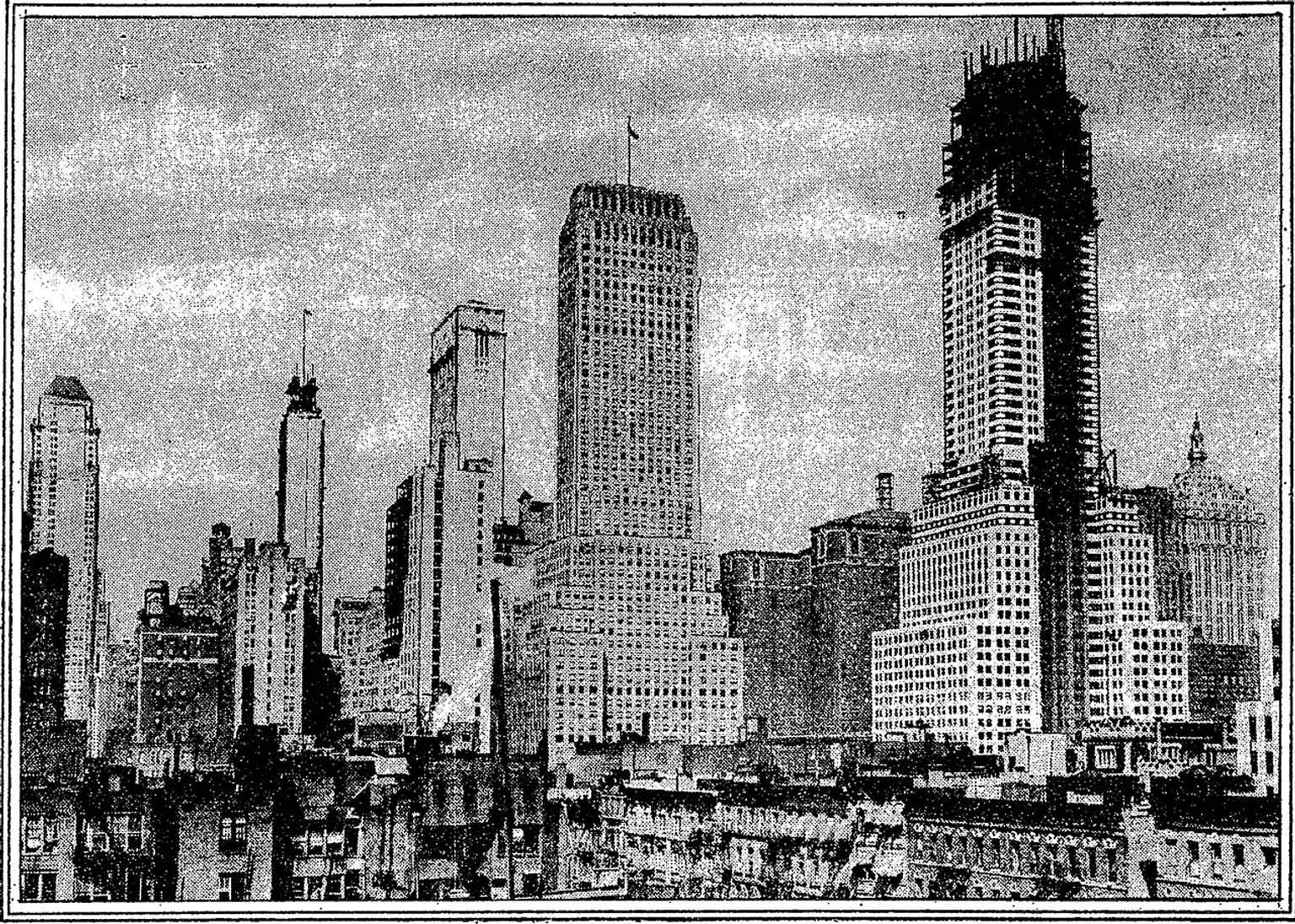
This 1929 photo captures the Lincoln Building, now One Grand Central Place, under construction on 42nd Street, just before its completion in 1930.Photo: William Frange (1890-1968), Wikimedia Commons, Public domain. Cropped & resized. In two thousand and nine, the building was renamed One Grand Central Place and got an eighty-five million dollar face-lift. The renovation brought renovated elevators and crisp air-conditioning, but it temporarily evicted poor Abe. The statue was loaned out to an estate in Massachusetts, but thankfully it returned to the lobby on April fifteenth, twenty fifteen. This building also made a dubious mark on modern history in March twenty twenty, becoming the site of New York's first reported person-to-person spread of the virus during the COVID nineteen pandemic.
It is quite a resilient place, and incredibly, the building is open twenty-four hours a day, every day of the week. Feel free to admire the soaring facade, and whenever you are ready, our route continues.
One Grand Central Place, originally the Lincoln Building, is a 55-story neo-Gothic office building in Midtown Manhattan, with direct in-building access to Grand Central Terminal.Photo: Kidfly182, Wikimedia Commons, CC BY 4.0. Cropped & resized. Take a look at the Hale Building, easily spotted by its light stone facade, dark marble columns, and grand arched windows. Opened in nineteen twenty-seven, it was a major hub for…Read moreShow less
Open dedicated page →
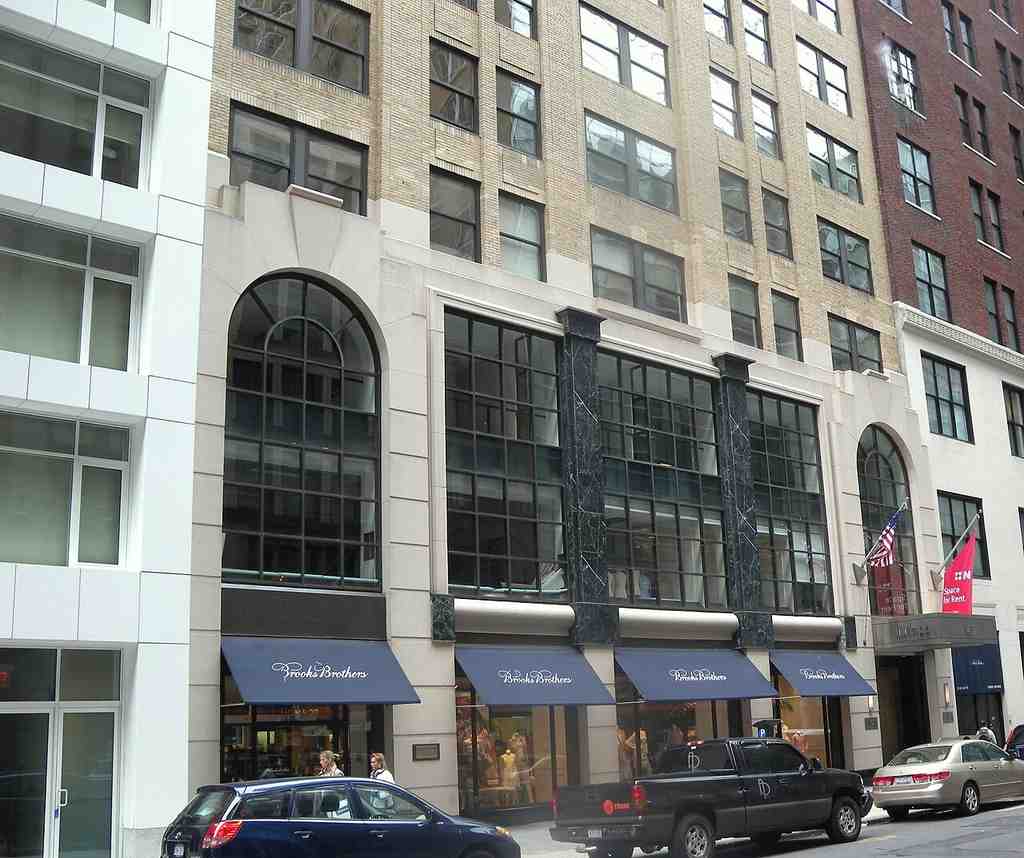
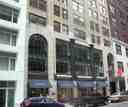
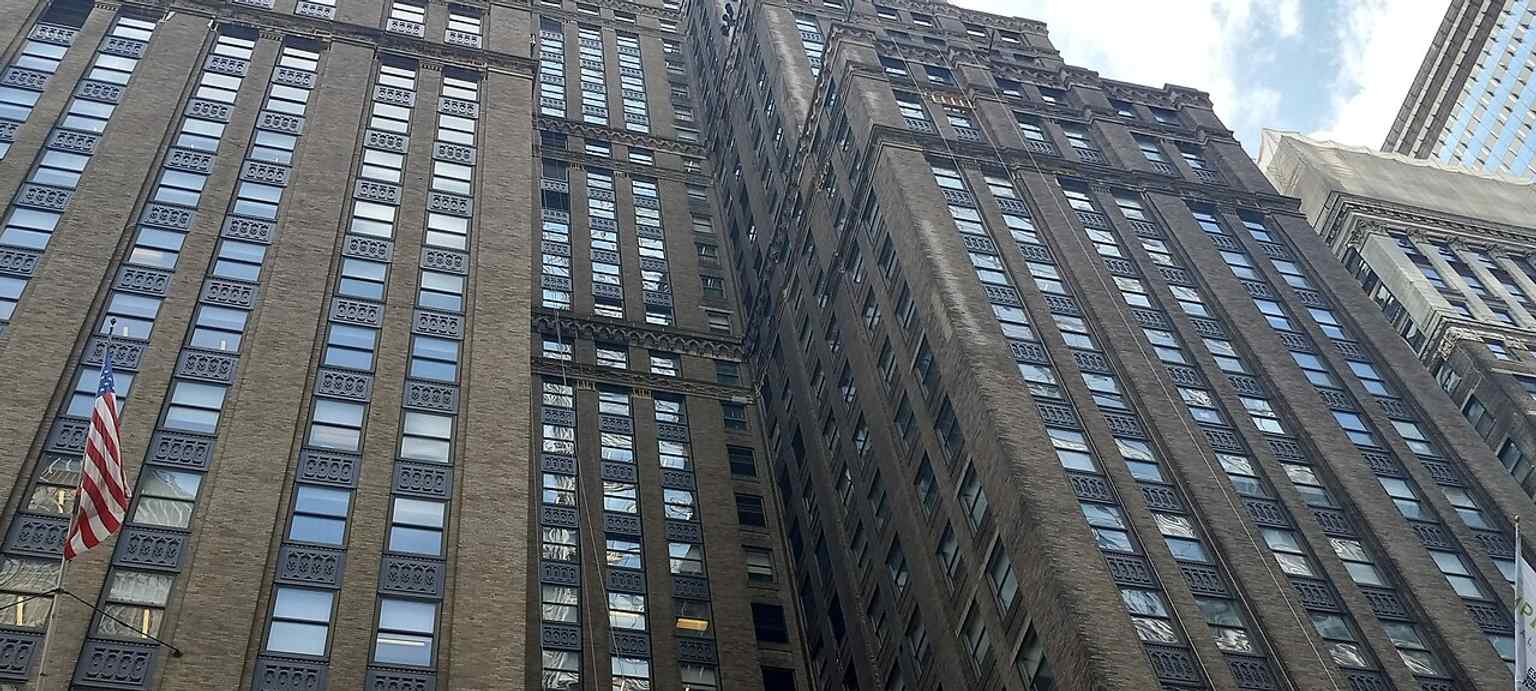
Hale BuildingPhoto: Jim.henderson, Wikimedia Commons, CC0. Cropped & resized. Take a look at the Hale Building, easily spotted by its light stone facade, dark marble columns, and grand arched windows. Opened in nineteen twenty-seven, it was a major hub for businesses during the Great Depression. The Hale Desk Company originally leased sixteen thousand square feet here just to show off their executive desks. Check out your screen for a neat before and after look at this property. The nineteen thirties were tough, and the building hit the auction block in nineteen thirty-six. A trustee, which is a financial institution managing the property's assets, won it for one million seven hundred fifty thousand dollars, or roughly thirty-eight million dollars today. Take a peek at the app for a two thousand and eleven view of the street. Brooks Brothers opened up shop here in two thousand and eight, eventually buying the whole building in two thousand and nineteen for one hundred six million dollars. It is funny how a building that sold desks now sells the suits you wear behind them.
Take a good look at those grand arched windows, and let's keep walking when you are set.
So, look to your right at this sleek office building. You might be wondering why I have stopped you in front of twenty-two Vanderbilt. Well, beneath that modern granite and glass…Read moreShow less
Open dedicated page →So, look to your right at this sleek office building. You might be wondering why I have stopped you in front of twenty-two Vanderbilt. Well, beneath that modern granite and glass beats the structural heart of a lost New York legend, the New York Biltmore Hotel.
Pull up your screen to see a nineteen seventeen postcard of what this place used to look like. Designed by Warren and Wetmore, the same architects who shaped Grand Central Terminal, the Biltmore opened on New Year's Eve, nineteen thirteen. It was the glittering crown jewel of Terminal City, a massive commercial development built right over the train tracks. Building this twenty-six-story Italian Renaissance Revival masterpiece, an architectural style meant to echo the grand palaces of fifteenth-century Italy, cost ten million dollars back then. That is roughly three hundred million dollars today. They used four million pieces of common brick and two million pieces of gray brick just for the facade alone!
And the inside? Pure magic. If you tap your app, you can catch a glimpse of a lavish black-tie dinner held there in nineteen fourteen. The Biltmore had one thousand rooms, its own Turkish baths, which were essentially luxurious indoor steam rooms, and even a basement reception space known as the Kissing Room for people greeting arriving train passengers. But the most famous spot was the Palm Court. It had a gorgeous vaulted ceiling, marble walls, and a massive gilded clock. The famous phrase, meet me under the clock, was practically perfected here. Famous writers like F Scott Fitzgerald and J-D Salinger used to meet their editors right under that very timepiece. It was also the unofficial headquarters for the Democratic Party, where politicians hatched deals right inside those swanky Turkish baths.
But all that glamour met a tragic, sudden end in August nineteen eighty-one. Developer Paul Milstein had bought the building. Knowing preservationists were trying to get the Landmarks Preservation Commission, a city agency that protects historic architecture, to step in, Milstein did not wait around. On August fourteenth, he abruptly announced the hotel was closing. That very same day, overnight guests were told to pack up, and demolition crews marched right in. They started ripping down the ornate plasterwork and tearing out the doors while parts of the hotel were literally still open to the public! By the time a judge's restraining order expired a few days later, the beautiful interiors had been completely gutted.
Almost nothing was salvageable. They stripped the grand old hotel down to its steel skeleton and rebuilt it into the office tower you see today. Only the famous lobby clock survived, safely put in storage and later reinstalled in the modern lobby.
It is a slightly heartbreaking piece of New York history, but at least the steel bones of the old Biltmore are still holding this corner up. If you want to peek inside the modern retail spaces, they are open most days from nine or ten in the morning until six in the evening, with a slightly later eleven o'clock start on Tuesdays.
Take a moment to appreciate the surviving history here, and whenever you are ready, our tour rolls on.
On your left stands the Yale Club of New York City. And when I say stands, I mean it towers. At twenty-two stories, this neoclassical behemoth-an architectural style reviving the…Read moreShow less
Open dedicated page →On your left stands the Yale Club of New York City. And when I say stands, I mean it towers. At twenty-two stories, this neoclassical behemoth-an architectural style reviving the grand symmetry and towering columns of ancient Greece and Rome-is located at fifty Vanderbilt Avenue and remains the largest college clubhouse ever built.
It opened its doors in June nineteen fifteen. Take a peek at the historic image on your screen to see how the Yale Club's towering neoclassical facade remains a distinguished fixture along Vanderbilt Avenue amidst nearly a century of changing cityscapes. The architect, Yale alumnus James Gamble Rogers, designed it in conjunction with the construction of Grand Central Terminal. But the specific spot was chosen for a rather dramatic reason. The founders believed this very location was where another famous Yale alum, Nathan Hale, was hanged by the British Army for espionage during the American Revolution. If you check your app, you can see a photo of the plaque on the exterior commemorating him. Though modern historians now dispute the exact site of Hale's execution, the club firmly planted its flag here in his honor.
Inside, it is practically a self-contained city for its eleven thousand worldwide members. There are three dining spaces, four bars, a hundred thirty-eight guest rooms, squash courts, a barber shop, and a swimming pool famously known as the plunge. The main lounge features soaring ceilings, roaring fireplaces, and portraits of five U-S presidents who were members: William Howard Taft, Gerald Ford, George H-W Bush, Bill Clinton, and George W Bush.
The club has seen its share of drama and colorful history. During Prohibition, the club supposedly stockpiled enough liquor in advance to keep its members comfortably lubricated until the ban on alcohol was finally repealed in nineteen thirty-three. And speaking of scandals, the club shocked the old-money establishment in July nineteen ninety-nine when it became the first Ivy League club in New York to relax its dress code to business casual. This sparked absolute pearl-clutching and polite scorn from rival clubs, but the Yale Club held firm.
Social progress here could be slow, however. When Yale College finally allowed women to enroll in nineteen sixty-nine, the club quickly followed suit and admitted them as members. But they did not let women into the bar or dining room until nineteen seventy-four, and the plunge swimming pool remained strictly off-limits to female members until nineteen eighty-seven.
The building has even hosted national sports history. Following the events of two thousand and one, the Heisman Trophy ceremony was temporarily moved from downtown and hosted right here in two thousand and two and two thousand and three. Through it all, the clubhouse has stood strong, surviving everything from Prohibition to a two thousand and seven lawsuit where a former U-S Solicitor General sued for one million dollars after tripping on a stage with no handrail, which the club eventually settled out of court.
For those curious, the Yale Club operates from six A-M to midnight, Monday through Sunday. Enjoy the view of this imposing clubhouse, and when you are ready, we will head to our next stop.
On your left is the Manhattan Institute for Policy Research. It might just look like an unassuming building from the outside, but inside, this place has been cooking up policies…Read moreShow less
Open dedicated page →On your left is the Manhattan Institute for Policy Research. It might just look like an unassuming building from the outside, but inside, this place has been cooking up policies that have shaped everything from local police beats to the Oval Office.
The Institute was born in nineteen seventy-eight, founded by Antony Fisher and William J. Casey. Originally, it had the incredibly catchy, roll-off-the-tongue name of the International Center for Economic Policy Studies. Thankfully, they rebranded to the Manhattan Institute in nineteen eighty-one. Since then, it has operated as a major conservative think tank, a research group that develops and promotes specific public policies, firing out books, articles, and its quarterly magazine, City Journal.
During the nineteen eighties, the institute became a heavy hitter in Washington. In nineteen eighty-one, program director George Gilder published Wealth and Poverty. Reviewers literally called it the bible of the Reagan administration. It shot up the bestseller lists, selling over one million copies. The book boldly questioned the character of the poor, claiming they simply refused to work hard. Naturally, it sparked massive debate, with some calling it a brilliant creed for capitalism and others finding it highly questionable.
But the Manhattan Institute is not just about federal economics. They have deep roots in local urban affairs. If you remember the mayoralty of Rudy Giuliani in the nineteen nineties, you know his administration famously adopted the broken windows theory of policing. The idea was that cracking down on minor offenses like vandalism prevents major crimes. Well, Giuliani practically took tutorials from City Journal editors to build his campaign policies. Later, the institute even embedded experts into the Detroit Police Department to implement the exact same strategies, with home invasions there allegedly dropping twenty-six percent in a single year.
It is not just conservative politicians who have leaned on the Institute's research. Check out your screen for a surprising team-up. That is Cory Booker speaking at an institute event in two thousand and eight. Back when Booker was the mayor of Newark, New Jersey, he partnered with the Manhattan Institute to tackle the difficult issue of prisoner reentry. They used a work-first model to connect ex-offenders with immediate, paid jobs upon release. And it actually worked, placing over one thousand people in jobs paying an average of nine dollars and thirty-two cents an hour.
The institute also had a massive impact on the N-Y-P-D after the tragedy of September eleventh, two thousand and one. At the N-Y-P-D's request, they formed the Center for Tactical Counterterrorism to help officers pivot to becoming first preventers of mass-casualty attacks. They even warned against building a United Nations structure over the Queens Midtown Tunnel, pointing out it would basically gift wrap the tunnel as a terrorist target.
Love their politics or hate them, you cannot deny that the ideas born inside this organization have spilled out onto city streets and national stages for decades. Take a moment to let all that political history sink in. When you are ready, we can head to the next stop.
Look to your left and you will spot the Roosevelt Hotel, a massive nineteen-story block of light brick and Indiana limestone rising into a series of distinct stepped-back…Read moreShow less
Open dedicated page →Look to your left and you will spot the Roosevelt Hotel, a massive nineteen-story block of light brick and Indiana limestone rising into a series of distinct stepped-back rooflines that give it an elegant, tiered shape.
Opened in September nineteen twenty-four, this grand building was named in honor of U-S President Theodore Roosevelt, who had passed away a few years prior. It cost twelve million dollars to build, which is roughly one hundred and ninety-five million dollars today. Now, remember how we talked about buildings sitting right over the train tracks? Well, about two-thirds of the Roosevelt is perched directly over two levels of subterranean tracks. To keep guests from bouncing out of their beds every time a train rolled by, engineers built the hotel's foundations on thick, vibration-absorbing lead pads. Talk about a solid night's sleep.
When it first opened its doors, the Roosevelt was the height of modern luxury and had some pretty wild features for its time. It boasted an in-house doctor, a childcare service that included a play area called the Teddy Bear Cave, and get this, a dog kennel on the roof. It was the very first hotel in New York City to offer a place for your pampered pooch to stay while you lived it up downstairs. They even pumped cool air from the ventilation system directly into the telephone booths so you wouldn't sweat while making a call.
And oh, did people live it up here. The Roosevelt Grill, the hotel's famous dining room, was the winter home of bandleader Guy Lombardo and his Royal Canadians. Starting in nineteen twenty-nine, they broadcast their New Year's Eve performances live on the radio from that very room. If you have ever belted out the song Auld Lang Syne at the stroke of midnight, you have the Roosevelt Hotel and Guy Lombardo to thank for popularizing that tradition.
The hotel also had a heavy political footprint. In the mid-twentieth century, the Republican Party loved this place. New York Governor Thomas E Dewey practically lived here. During the nineteen forty-eight presidential election, he, his family, and his staff huddled in a fifteenth-floor suite listening to the election returns. Spoiler alert for history buffs: despite the infamous newspaper headline claiming Dewey defeats Truman, things did not go Dewey's way that night.
You might also recognize the grand interiors from the big screen. The ballroom was used in the nineteen eighty-seven movie Wall Street, and the hotel served as a backdrop for shows like Mad Men and movies like Maid in Manhattan.
In recent decades, the building took a completely different path. After a long period of ownership by Pakistan International Airlines, or P-I-A, the hotel closed its doors to guests in late twenty twenty due to financial losses. Then, in twenty twenty-three, it found a new, unexpected purpose, reopening its doors as a massive processing center and shelter for asylum seekers arriving in the city, earning it the nickname of the new Ellis Island.
It is technically open twenty-four hours a day, seven days a week, though its days of hosting grand galas and rooftop dog kennels are behind it for now. Take a moment to admire those elegant setbacks. When you're ready, we can move along.
Look up at that soaring, dark rectangular tower featuring an expansive glass facade with tight vertical lines resting on a wider, stepped-back base. This is two forty-five Park…Read moreShow less
Open dedicated page →
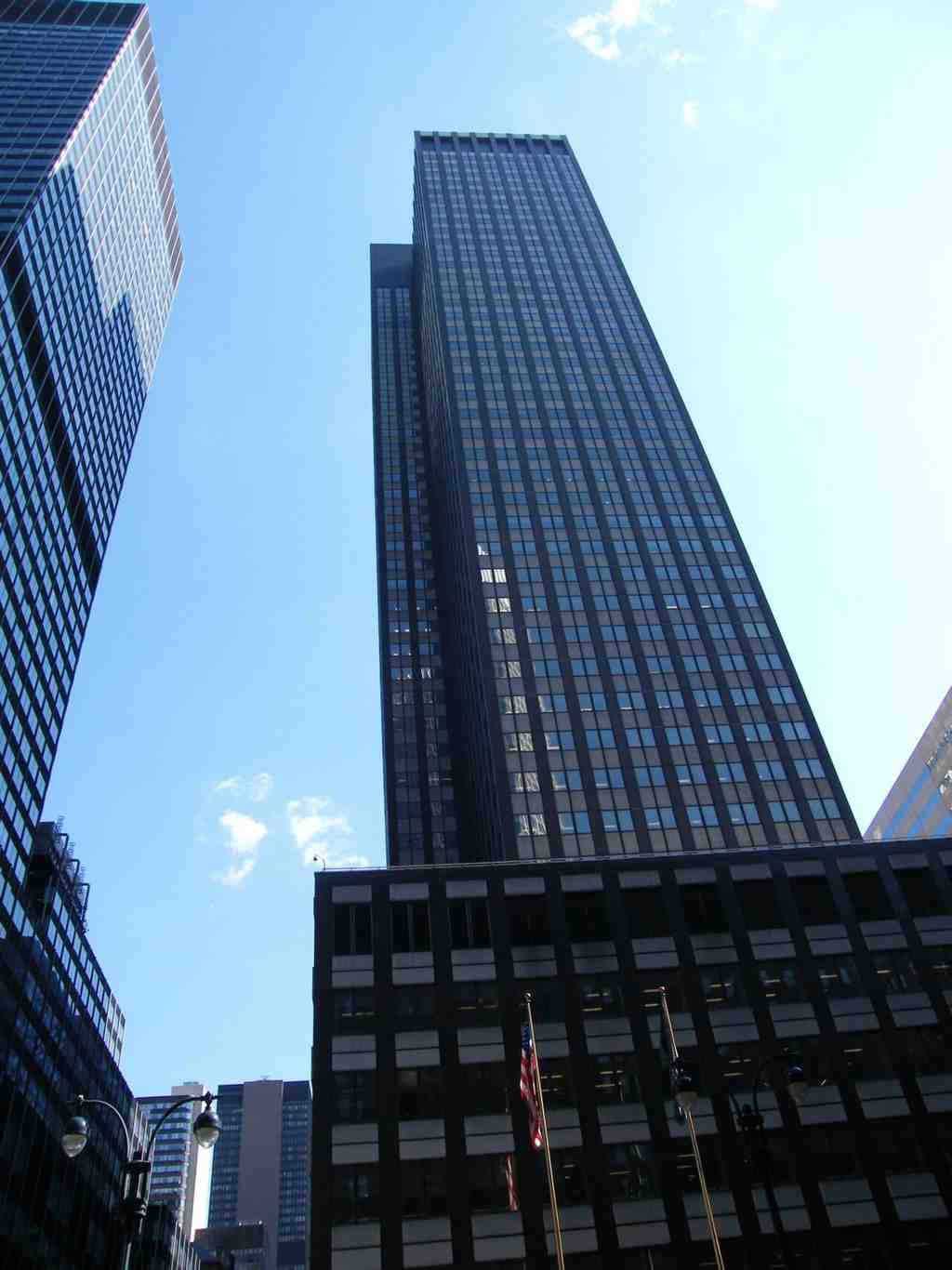
245 Park AvenuePhoto: Americasroof, Wikimedia Commons, CC BY-SA 3.0. Cropped & resized. Look up at that soaring, dark rectangular tower featuring an expansive glass facade with tight vertical lines resting on a wider, stepped-back base. This is two forty-five Park Avenue, standing six hundred and forty-eight feet tall. Completed in nineteen sixty-seven and designed by the firm Shreve, Lamb and Harmon, it spans forty-eight floors. If you check your screen, you can see a great shot of the entire skyscraper. It is another one of those rare Manhattan behemoths large enough to operate under an exclusive ZIP code, one zero one six seven.
Before this monolith arrived, the site hosted the Grand Central Palace exhibition hall, which was demolished in nineteen sixty-four. Since then, this address has been a revolving door of corporate drama. It was once named for the American Tobacco Company, and later Bear Stearns, who moved three thousand employees here in nineteen eighty-seven.
But the real theatrics began in twenty seventeen. A Chinese conglomerate, meaning a massive multi-industry corporation, named H-N-A Group bought the building for two point two one billion dollars. It was one of the highest prices ever paid for a New York skyscraper. They pulled this off using complex debt, including mezzanine financing, a real estate term for a high-risk secondary loan.
As happens so often with high-risk debt, the gamble failed. By twenty eighteen, H-N-A faced severe financial difficulties and began aggressively selling off assets. They sold a stake to S-L Green, an office R-E-I-T, or Real Estate Investment Trust. H-N-A eventually went bankrupt, and S-L Green took total control in twenty twenty-two, later selling a forty-nine point nine percent share to a Japanese developer.
Today, they are busy renovating, adding a golf lounge and wellness center to keep major financial tenants like Societe Generale happy. It is a true monument to the wild, ever-shifting fortunes of New York real estate. Gaze up at this modern monolith, and when you are ready, we will keep going.
On your left is a soaring rectangular tower featuring a sheer facade of dark glass panels separated by striking vertical metal mullions. Welcome to two seventy-seven Park Avenue.…Read moreShow less
Open dedicated page →
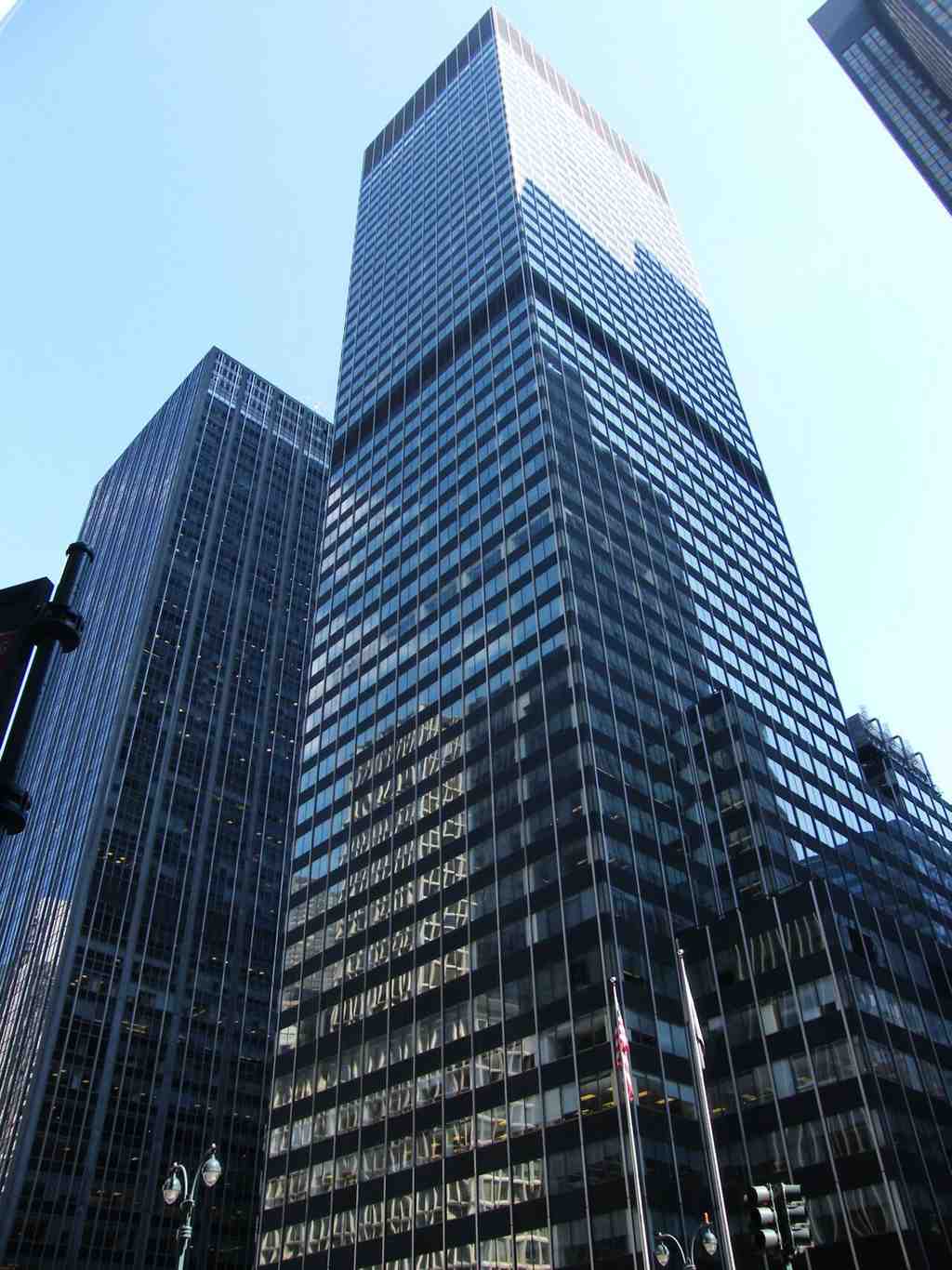
277 Park AvenuePhoto: Americasroof, Wikimedia Commons, CC BY-SA 3.0. Cropped & resized. On your left is a soaring rectangular tower featuring a sheer facade of dark glass panels separated by striking vertical metal mullions. Welcome to two seventy-seven Park Avenue. This fifty-story skyscraper is so vast it operates entirely under the unique zip code one zero one seven two.
The real estate drama here goes way back. In the eighteen seventies, landowner Elizabeth Kip fought a bitter legal battle over this exact parcel. The city needed the land to expand the nearby train depot and used eminent domain, a legal process allowing the government to force the sale of private property for public use. They made her sell it for two hundred twelve thousand five hundred dollars, roughly six million dollars today.
Later, an elegant apartment building stood here, serving as the headquarters for John F Kennedy's presidential campaign. The current tower opened on July thirteenth, nineteen sixty-four, and has hosted a wild mix of tenants, from Penthouse Magazine to Chemical Bank. Check your screen for a look at the building back when Chemical Bank was a major occupant. Today, the tower houses executives from J-P Morgan Chase. It is still owned by its original developer, the Stahl Organization, who recently poured one hundred twenty million dollars into modernizing the property. Take a glance at your app to see how much the street level plaza has transformed over the last sixteen years. They even added a fancy new restaurant. From bitter nineteenth century land disputes to modern billion dollar mortgages, this plot of dirt is a magnet for high stakes drama.
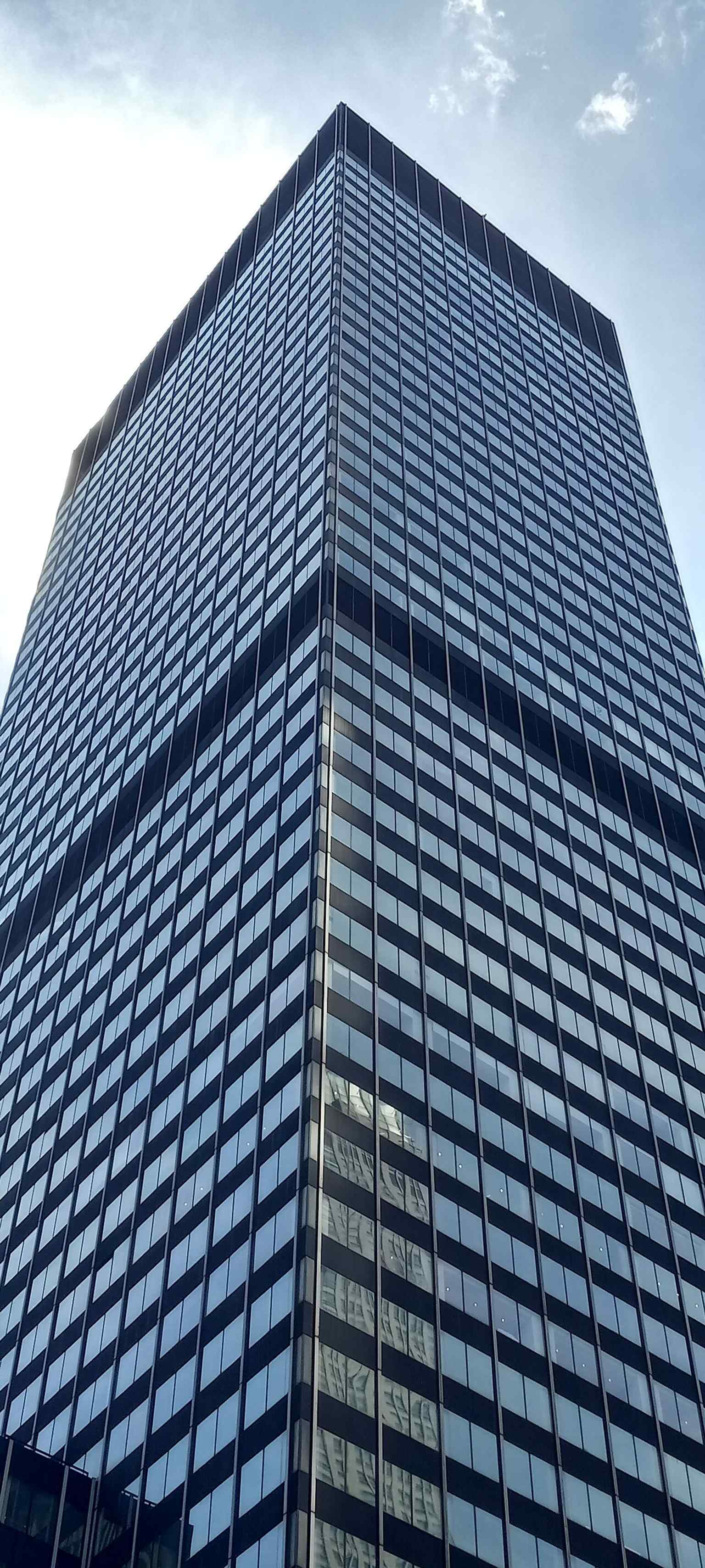
This 50-floor office building, 277 Park Avenue, stands 687 feet tall in Midtown Manhattan, and was recently renovated starting in 2022.Photo: Kidfly182, Wikimedia Commons, CC BY 4.0. Cropped & resized.
Frequently asked questions
How do I start the tour?
After purchase, download the AudaTours app and enter your redemption code. The tour will be ready to start immediately - just tap play and follow the GPS-guided route.
Do I need internet during the tour?
No! Download the tour before you start and enjoy it fully offline. Only the chat feature requires internet. We recommend downloading on WiFi to save mobile data.
Is this a guided group tour?
No - this is a self-guided audio tour. You explore independently at your own pace, with audio narration playing through your phone. No tour guide, no group, no schedule.
How long does the tour take?
Most tours take 60–90 minutes to complete, but you control the pace entirely. Pause, skip stops, or take breaks whenever you want.
What if I can't finish the tour today?
No problem! Tours have lifetime access. Pause and resume whenever you like - tomorrow, next week, or next year. Your progress is saved.
What languages are available?
All tours are available in 50+ languages. Select your preferred language when redeeming your code. Note: language cannot be changed after tour generation.
Where do I access the tour after purchase?
Download the free AudaTours app from the App Store or Google Play. Enter your redemption code (sent via email) and the tour will appear in your library, ready to download and start.
If you don't enjoy the tour, we'll refund your purchase. Contact us at [email protected]
Checkout securely with