
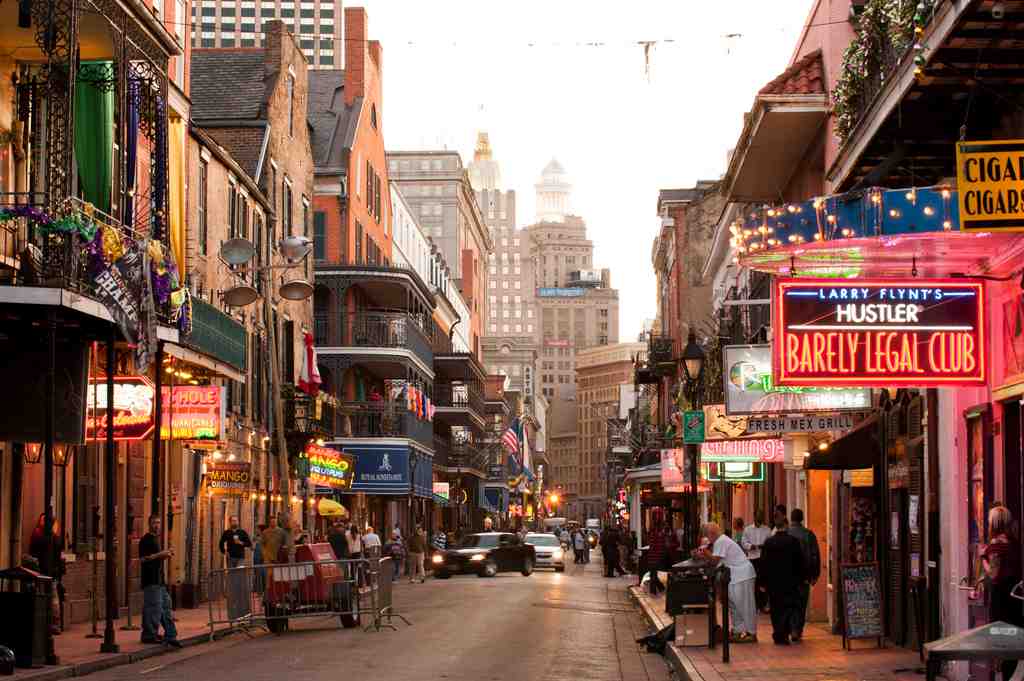
To spot Bourbon Street, just look straight ahead-there’s a lively, narrow street packed with colorful neon signs on both sides, vibrant balconies dripping with beads and flags, and the hum of people and traffic mixing in the evening air.
Welcome to Bourbon Street! As you stand here, let your senses wake up: the scent of spicy Cajun food drifts through the air, slick neon lights flicker above the sidewalks, and distant laughter spills from open doorways. This isn’t just a street, it’s a living, breathing legend-a party you can walk through, any day, any night.
But peel back the beads and bustle, and you’re walking on layers of history as thick as New Orleans gumbo. Picture it: in 1718, French explorer Jean Baptiste Le Moyne de Bienville founded the city. Just a few years later, royal engineer Adrien de Pauger drew up these very streets, naming them to honor saints and French royalty-including the House of Bourbon. Ironically, after a mighty fire in 1788, many of the elegant buildings were rebuilt by the Spanish, so if you see more Spanish than French in the ironwork and balconies…well, you’ve got history’s fingerprint right in front of you!
Later, the Americans took over with the Louisiana Purchase of 1803, swapping the elegant Rue Bourbon for the slick new Bourbon Street. As you look around, imagine the port bustling with ships carrying sugar, tobacco, and fortunes made and lost overnight. By the 1840s, New Orleans was bigger and wealthier than just about any city in America outside New York.
But this wasn’t your average southern city. The mix of French, Spanish, Creole, and American influences created a unique stew of culture-and, naturally, attracted travelers hoping for a taste. By the late 1800s, the neighborhood was famous for its wild side: gambling dens, brothels, and music halls where jazz was born. Just down the block, you’ll find Galatoire’s-opened in 1905, it’s been drawing dinner crowds that zigzag down the sidewalk for decades. If you’re ever hungry for tradition or a long wait, you know where to go!
After World War II, Bourbon Street turned into a nightlife mecca. Imagine the 1950s-over 50 burlesque and striptease shows lighting up the night. Just like Erle Stanley Gardner’s detective novels hinted, the street shimmered with mystery and, let’s be honest, a bit of cheeky charm!
The 1960s brought a wave of reform-police raids, clubs shutting down, and then a push to make Bourbon more tourist-friendly. Soon it was a pedestrian mall, with new souvenir shops elbowing in beside old jazz bars, turning some folks nostalgic for the "real" New Orleans. In 2018, a giant saxophone from Belgium landed right here-a new tribute to the music that pulses through this place.
But Bourbon hasn’t always had an easy time. When Hurricane Katrina hit in 2005, this street, set on high ground, was among the survivors. The city poured energy into bringing the party back, knowing tourism is the lifeblood here. From advertising drives to celebrity pitches, the call went out: “Come fall in love with Louisiana all over again.” And thousands did, keeping New Orleans humming.
More recently, COVID-19 turned the music down-bars shuttered, parades paused, traditions put on hold. The city felt the loss deeply, both in its pocketbook and its soul, as cafés and music clubs struggled to hang on.
And, of course, Bourbon has faced dark days too-like the tragic attack on January 1, 2025, when the city’s spirit was tested but never broken.
Now, as you stand in front of this neon-lit party, you’ll notice every type of nightlife-Mardi Gras madness, hurricanes and hand grenades (the drinks, don’t worry!), world-famous jazz at Musical Legends Park, drag shows, and burlesque right beside old voodoo shops. There’s even Café Lafitte-in-Exile, the country’s oldest gay bar, and the Velvet Line where New Orleans celebrates Southern Decadence with style!
Remember, the real music of Bourbon Street is the people-locals and tourists, musicians, chefs, bartenders, all rubbing elbows and trading stories long into the night. Now, take a breath, listen for that next saxophone riff, and let the street work its magic. Laissez les bon temps rouler-let the good times roll!


