
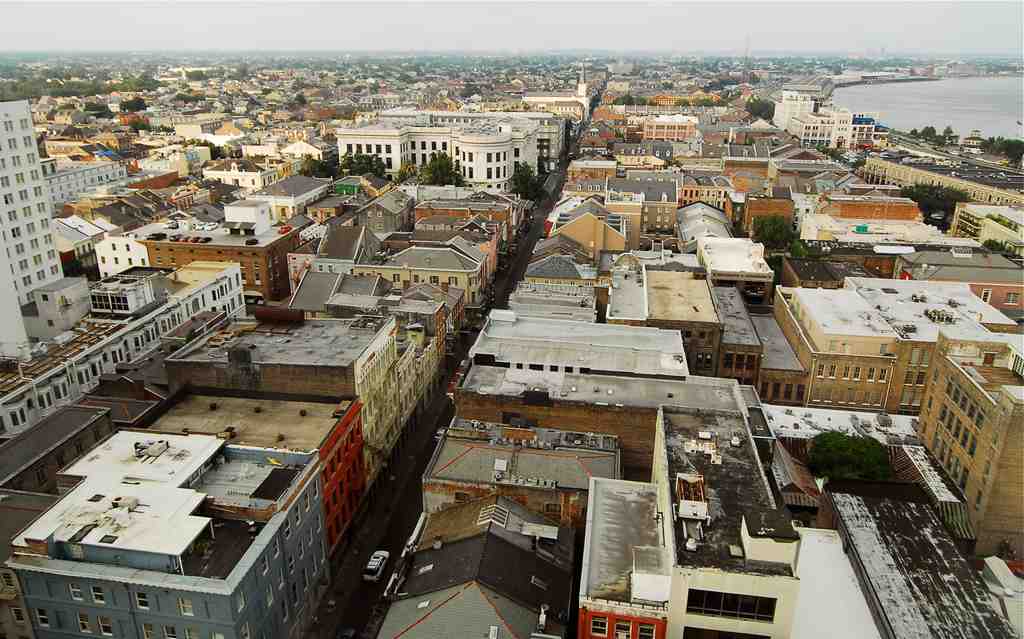
Look ahead for a patchwork of pastel buildings, balconies, and narrow streets tucked right near the river-you're staring into the heart of the French Quarter, a wonderful maze that stretches from Canal Street up to Esplanade Avenue.
Alright, my friend, you’re now right on the edge of where it all began! The French Quarter-locals just call it “The Quarter”-is New Orleans’ oldest neighborhood, and, honestly, it’s the city’s soul wrapped up in cast-iron lace and sugar-dusted beignets! Picture this: it’s 1718, and Jean-Baptiste Le Moyne de Bienville has just picked this very spot out of sweltering wilderness to plant the flag of Nouvelle-Orléans. Back then, there was nothing here but swamps, wild cypress trees, and about a million mosquitoes (okay, maybe just half a million).
City architect Adrien de Pauger soon laid out this neat little grid you see here-he even named the streets after French royalty and saints. That’s why you get Bourbon Street, named long before anyone dreamed of to-go cups or jazz parades. Strolling these narrow blocks, you’re walking an area that’s watched empires rise and fall. One fire after another in the late 1700s meant the Spanish, who’d taken over by then, rebuilt almost everything-and not a moment too soon! Their rules: no more wooden houses (too flammable), and bring on the fire-resistant bricks and stucco. They swapped sharp French rooftops for flat Spanish tiles but let the local flavor shine through with those wrap-around galleries and balconies-half French, half Caribbean, and totally one-of-a-kind.
Jump ahead to the nineteenth century, and you’d find a place packed with Creoles-descendants of French and Spanish settlers-and a brand new group of Americans pouring in after the Louisiana Purchase. Canal Street wasn’t just a road, it was a cultural DMZ: the famous “neutral ground” where French and Anglophone folks, as different as gumbo and apple pie, hashed out business and maybe a few arguments over which language was better for cursing the hot weather.
Back then, the economy thrummed with plantation cash-cotton, sugar, tobacco, all shipped by enslaved people and sold right through the riverfront. By 1840, New Orleans was America’s third biggest city, and its river was second only to New York’s! Lavish parties, grand buildings with fancy cast-iron galleries, and hungry prospectors all left their marks, along with huge waves of Irish and Sicilian immigrants whose traditions and food helped flavor the neighborhood. They say that by 1905, half of the Quarter was Italian-so if your nose picks up a hint of muffaletta or you see a bakery selling cannoli, thank “Little Palermo!”
The Quarter took a wild turn come Prohibition and the bohemian 1920s, when artists, musicians, and free spirits flocked here-drawn by cheap rent, a little mystery, and a whole lot of atmosphere. Preservationists, worried about bulldozers and endless hotels, fought to save the Quarter’s charm. They got the Vieux Carré Commission started in 1925, and a decade-long tug of war kept the area from being replaced by a freeway! Just imagine-today you could have been standing under an overpass instead of under the smiling eyes of wrought-iron balconies.
Through hurricanes, like Katrina in 2005, the French Quarter has survived each storm, protected by high ground and strong levees. When other parts of the city flooded, the Quarter stayed mostly dry, its stories and jazz notes still drifting along the cobbled streets. Of course, it’s no stranger to a bit of spooky fun: ghosts, legends, and a vampire tale or two are practically part of the visitor’s package deal!
Today, the Quarter is a swirling blend of locals, tourists, jazz, tarot cards, gumbo, and glittering beads. From Jackson Square and its stately Pontalba Buildings to the thumping pulse of Bourbon Street, there’s art, music, and a pinch of mischief at every step. So while you’re here, soak up the colors, the clang of a streetcar, the laughter tumbling down every alley, and remember-you’re not just seeing history. You’re a part of it, right in the middle of New Orleans’ magical old square.
Interested in knowing more about the geography, demographics or the education


