
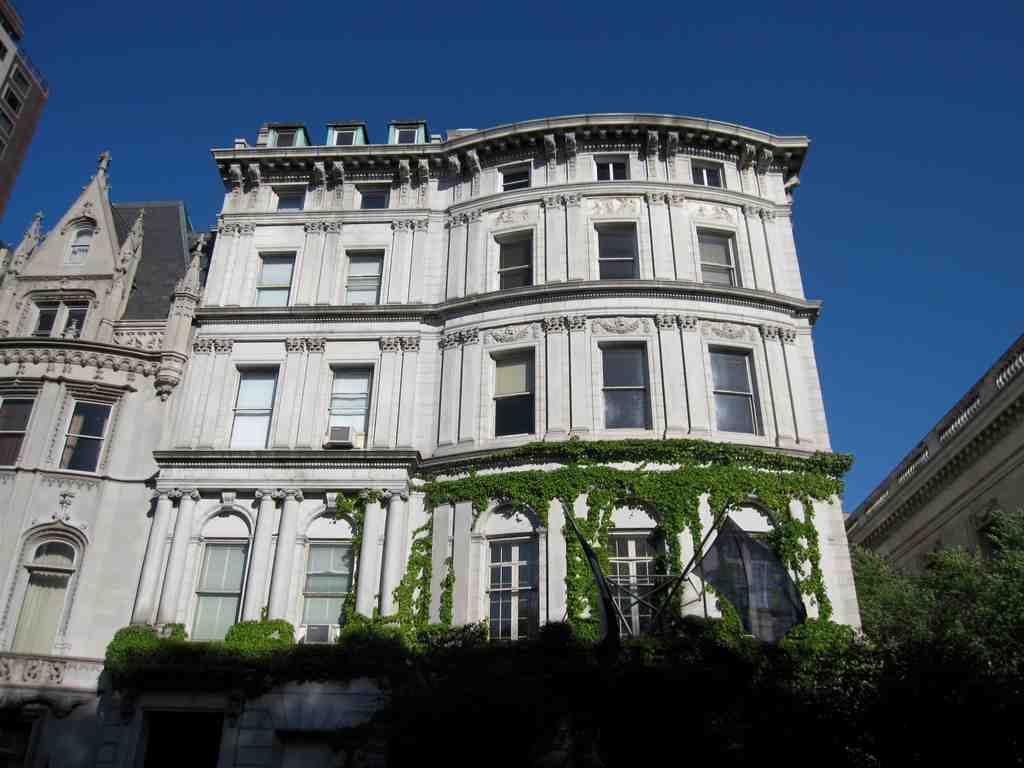
Look directly at the five-story pale gray-granite building characterized by its prominent horizontal stone bands, known as entablatures, and a grand row of round-arched windows along the second floor.
This is the Payne Whitney House, commissioned back in nineteen hundred and two as a wedding gift by a reclusive Standard Oil tycoon for his nephew.
But do not let this serene, perfectly ordered exterior fool you. Behind this immaculate gray-granite facade lies a masterclass in architectural delays and escalating frustration. The bride, Helen Hay, waited so long for her bespoke home that she gave birth to two children before the doors ever opened. The construction dragged on for so many years that Helen became thoroughly exasperated. She told her architect she felt like chucking the whole project to just buy a nice, ready-made house.
The architect responsible for her misery was the legendary Stanford White. White was utterly obsessed with perfection. Instead of simply building the house, he spent years scouring Europe, buying up antique doors, tapestries, and entire centuries-old ceilings. He even purchased a marble statue of a naked youth to install in the entranceway. The family largely ignored the sculpture as a simple garden ornament for nearly a century, constantly splashing it with fountain water, until art historians finally authenticated it as a genuine work carved by a teenage Michelangelo.
Between the art and the antiques, White blew over one million dollars on furnishings alone, which is roughly thirty-five million dollars today. You can imagine the uncle's reaction to that invoice.
Take a moment to step back and look closely at the shape of the front wall. Notice how the entire granite face is not actually flat. It bows slightly outward toward Fifth Avenue. That curve is a subtle but incredibly expensive architectural flex, precisely engineered to catch the light from different angles and give the heavy stone an almost fluid, living quality.
White, unfortunately, never saw his curving masterpiece completed. He was murdered on the roof of Madison Square Garden in nineteen hundred and six. Because he had personally hand-selected every single item, his firm had to painstakingly decipher his remaining sketches to finish the interiors exactly as he intended. The family finally moved in in nineteen hundred and nine.
It is a brilliant example of how families in this neighborhood used architecture to project absolute power. We will see another dramatic example of this ambition just a one-minute walk south at the James B. Duke House.
Oh, and if you want to peek inside, the French embassy operates a bookstore here, open until six PM most days and five PM on Sundays.




