
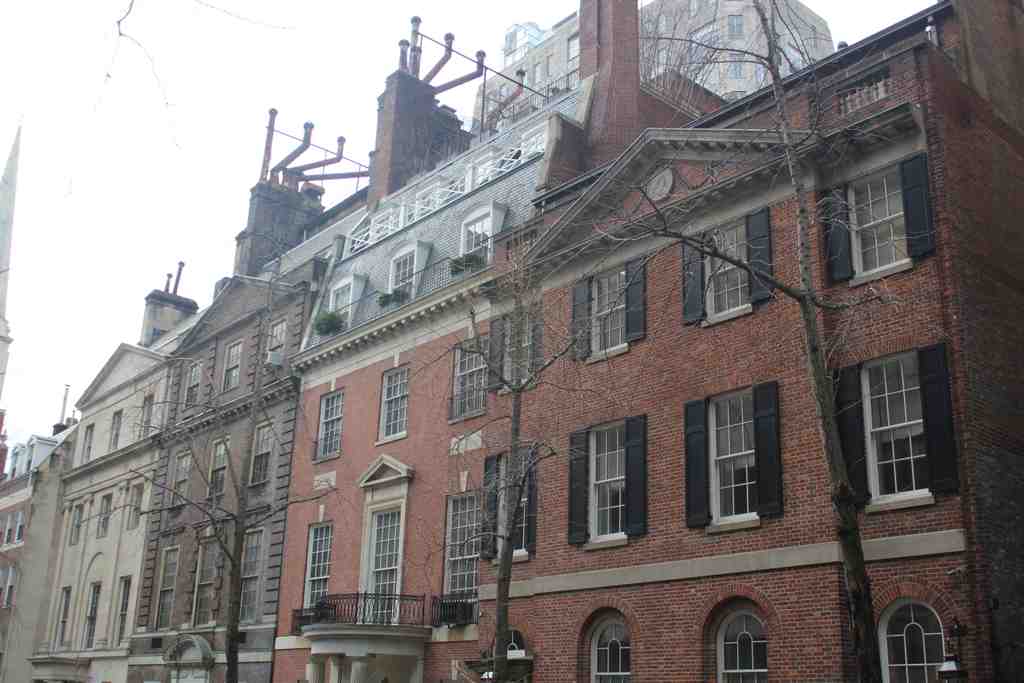
On your right, you will see a grand row of stately brick and stone townhouses, defined by their classical pediments, those decorative triangular structures above the roofline, and steeply pitched slate roofs dotted with projecting dormer windows.
In the nineteen twenties, the ultra-wealthy faced a uniquely urban problem. Other people's buildings were blocking their sunlight. Truly a tragedy. But if you were a Whitney, an Astor, a Morris, or a Dillon, you did not just buy a house. You bought the entire block behind it on East Seventy-Ninth Street just to stop developers from erecting high-rise apartments. They created sweeping, sun-drenched private gardens right here in the middle of Manhattan.
Take a look at your screen to see the easternmost house in this row, number one thirty. That elegant facade made of French limestone belonged to Vincent and Helen Astor. Helen turned the interior into a sprawling musical salon, famously hosting the legendary conductor Arturo Toscanini for a massive gala before he left for Europe in nineteen thirty-eight. The Junior League of New York eventually took over the building in nineteen forty-nine. The organization found the eighteenth-century style interiors so pristine, they barely had to change a thing to move in. You can still see people coming and going, as the Junior League operates out of here Monday through Friday from nine A-M to five thirty P-M.
But here is the thing about architectural legacies in this neighborhood. They are constantly mutating. What starts as a titan's private sanctuary inevitably becomes a stage for something else entirely. What starts as a titan's private sanctuary inevitably becomes a stage for something else entirely.
Take number one twenty-four, the brick neo-Georgian mansion, an architectural style mimicking the formal symmetry of old English estates, sitting just down the row. For decades, it served as the residence for Iraq's ambassador to the U-N. Behind that elegant exterior, the house fell into bizarre neglect. The famed decorator Mario Buatta lived next door and noted the inside remained entirely empty, save for a single, life-sized portrait of Saddam Hussein. In two thousand and three, during the fall of Baghdad, the last Hussein-era ambassador shouted his love for New York to a swarm of reporters, right before suffering a final indignity. His driver accidentally parked in the wrong spot and locked him out of his own chauffeur-driven limousine. Decades later, neighbors caught the Republic of Iraq illegally running a commercial gym out of the basement. City officials shut that down rather quickly.
I will let you in on a detail most locals do not even know. When the city finally started protecting its architectural soul, the Landmarks Preservation Commission designated these specific houses as the very first protected structures on the Upper East Side, starting in nineteen sixty-seven. They set the absolute precedent for historic preservation in New York.
Wealth built these walls, but the law froze them in time. Next, we are going to look at what happens when ambition ignores the laws of physics. We are heading to a church that almost collapsed under its own architectural weight. The Church of St. Ignatius Loyola is an eight-minute walk away.




