
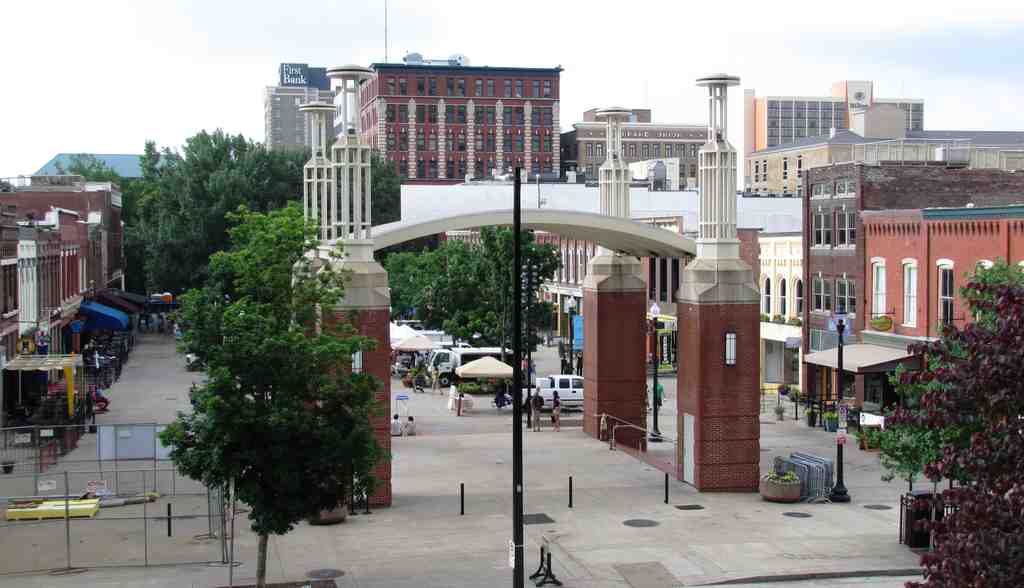
You are now arriving at Market Square, which will be on your right, marked by a striking entrance gateway where thick red brick pillars support a sweeping white metal arch topped with slender, lantern-like towers.
Step into this wide open pedestrian plaza. Take a moment to look down the stretch of storefronts and imagine the sheer volume of wagons that used to park right where you are standing. Established in 1854, Market Square has always been the bustling, equal-footing heart of Knoxville. A local newspaper once called this the most democratic place on earth, where the rich and the poor, the white and the black, jostled each other in perfect equality. That open freedom stands in sharp contrast to the severely confined lives of Hagar and Jack, whom we discussed earlier. While their movements were strictly controlled by the people who claimed to own them, out here in the square, the hidden hands of everyday regional farmers and working folks proved they were the true economic engine of the city.
Of course, keeping this square alive has been a constant battle between those who want to bulldoze the past and those who refuse to let it go. The centerpiece of this plaza used to be a massive, century-old Market House. By the 1950s, Knoxville Mayor George Dempster, the very same man who invented the Dempster-Dumpster trash system, decided the old building was a dingy fire hazard that stood in the way of downtown modernization. Preservationists fought fiercely to save it.
The debate was ultimately settled by a fourteen-year-old boy named Tommy Hope. In December 1959, Tommy was sneaking a cigarette near his family florist stall inside the Market House. He accidentally ignited a sheaf of tissue paper, causing a spectacular blaze that did $170,000 in damage, or about 1.7 million dollars today. Overwhelmed with guilt as firefighters battled the flames, the teenager eventually confessed, telling police he just could not live with the secret anymore.
With the building gutted, the city happily brought in the wrecking balls. In 1961, they replaced the historic structure with a modern open-air mall featuring a series of concrete, mushroom-shaped canopies.
The people of Knoxville absolutely hated them. These strange shapes completely stripped the area of its historic character.
Traditionalists despised these modernist toadstools so much that Cas Walker, a colorful local politician and regional grocery tycoon, permanently closed his cash store on the square in sheer protest. He loudly declared the new design would fail within five years without the old Market House to anchor it.
For decades, the ugly concrete toadstools sat there, a bleak monument to the perils of urban renewal. But the defenders of Knoxville history never stopped pushing back. Finally, in 1986, preservationists won out. The city tore down the canopies and began the long process of restoring the historic pedestrian commercial area you are walking through right now. The original bell from the old Market House was even salvaged and is still displayed at the south end of the square.
Our next stop is a ten-minute walk away, heading toward World's Fair Park. As we leave the historic bricks behind, I am going to guide you to a towering golden sphere with a rather mysterious blemish. Follow the path, and I will meet you at the Sunsphere.


