
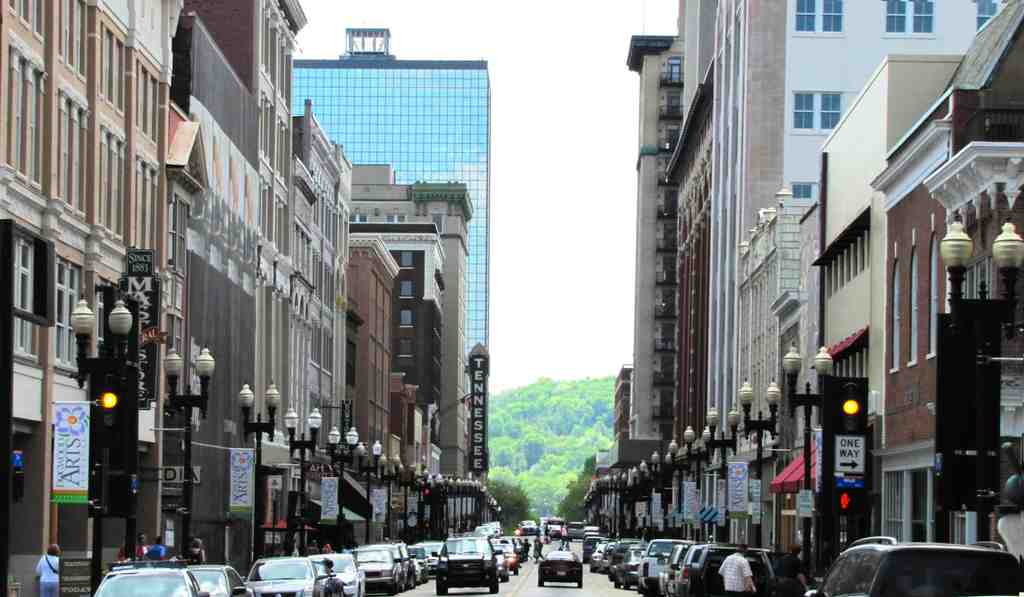
On your right is Gay Street, a long urban corridor framed by multi-story brick and stone facades, lined with rows of black metal streetlamps, and marked by a glowing vertical sign for the Tennessee Theatre.
Earlier on our tour, I touched on the wild, often violent history that defined early Knoxville. Well, this is the street he galloped down during his legendary escape, waving at children as he stole the sheriff's favorite horse. Welcome to Gay Street, the undeniable cultural heart of Knoxville. This thoroughfare perfectly captures the city's peculiar habit of losing its own history to disasters and wrecking balls, only to fiercely claw it back from the brink of oblivion.
In eighteen fifty-four, Gay Street became Knoxville's first paved road. It was laid down with macadam, which is simply a compacted layer of small broken stones. Before that, you were basically just walking through the mud. By eighteen ninety-seven, those stone streets hosted a colossal fire that started in a hotel basement. The patrol officer on duty officially theorized that rats had chewed on loose matches, igniting the blaze. Because naturally, when an entire city block burns down, you blame the local rodents. The inferno caused a million dollars in damage, which equates to roughly thirty-five million dollars today. Authorities actually had to dynamite a building just to create a fire break. The blaze even claimed the life of a rare albino mule belonging to a visiting circus, sparking a thoroughly bizarre local legend that the animal's ghost cursed the block to perpetual ruin.
Yet, Knoxville stubbornly rebuilt the grand brick structures you see today. But the true survival of Gay Street lives in the words of the writers who immortalized it. Take James Agee. In nineteen fifteen, a young Agee walked these very sidewalks with his father to see a movie at the Majestic Theater. He later poured those exact memories into his Pulitzer Prize-winning novel, A Death in the Family. He captured the exhilarating smell of stale tobacco, rank sweat, and perfume in the theater. He vividly recalled the great bright letters of storefront signs, feeling a swell of childhood pride just for knowing how to pronounce the name of the towering Sterchi Brothers furniture building. Those raw, lingering memories of this street were so profoundly evocative they later inspired composer Samuel Barber to create his famous soprano composition, Knoxville Summer of nineteen fifteen.
Cormac McCarthy also wandered this corridor, using its mid-century drugstores and grand hotels as the gritty backdrop for his novel Suttree. And speaking of grand hotels, the Andrew Johnson Hotel down the street holds a tragic place in American music history. It was the last place country music legend Hank Williams was seen alive. Facing a heavy financial penalty if he missed a show in Ohio, a severely ill Williams was carried out of the hotel and placed into the back seat of his baby blue Cadillac. He died of heart failure in that car just hours later.
From phantom mules to Pulitzer winners to country music ghosts, Gay Street has seen an incredible parade of brilliance and tragedy. Now, let us leave the main thoroughfare behind. We are heading to Market Square, just a three-minute walk away, promising a space where the rigid social lines of the city finally began to blur.


