
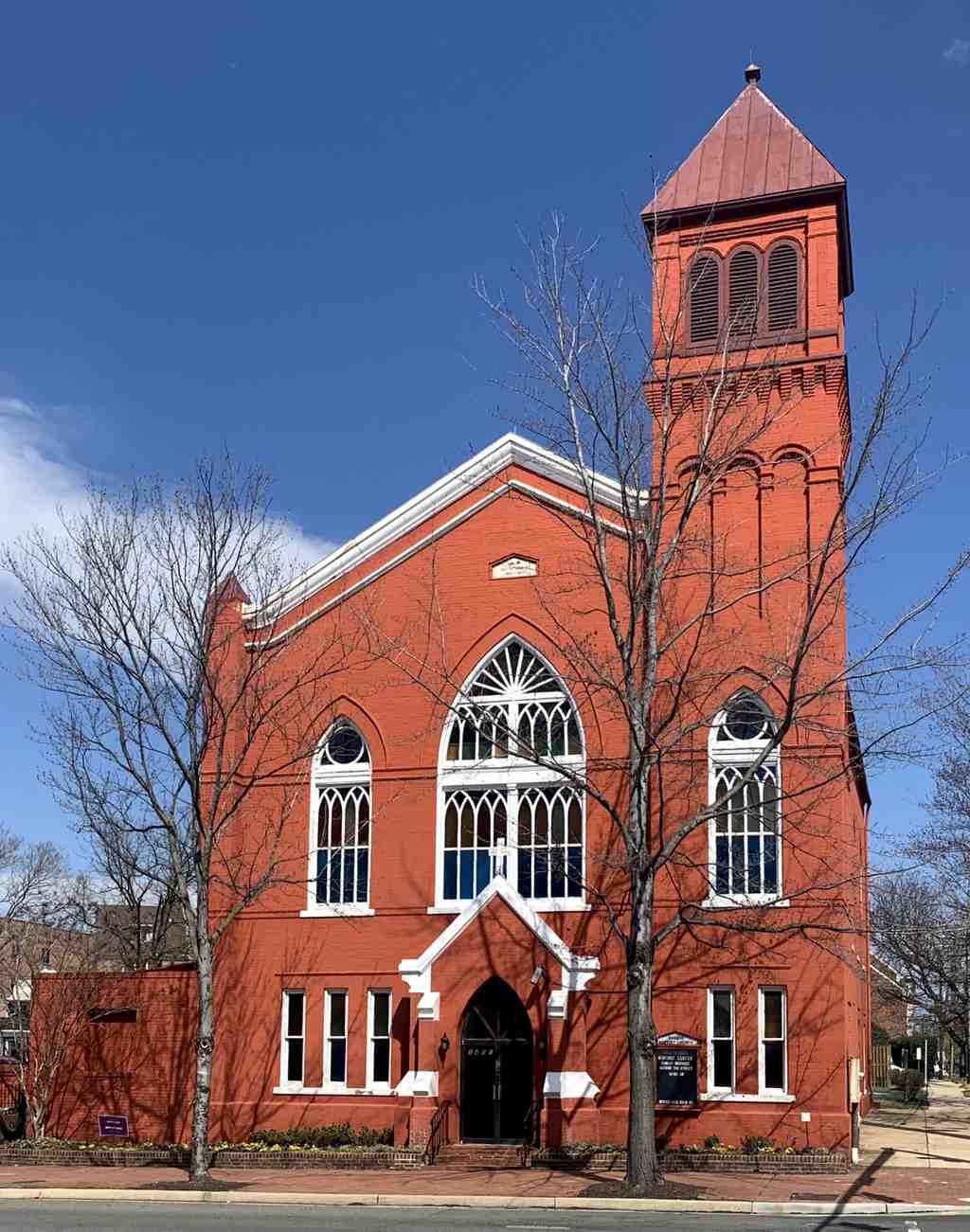
On your left is Shiloh Baptist Church, a striking red brick Gothic Revival building with tall arched windows and a prominent square bell tower topped with a steep pointed roof.
When you look at a building like this, you are seeing community resilience through faith made visible in brick and glass. For newly freed Black Americans, a church was never just a place to pray. It was the absolute center of survival, a safe harbor, and the mortar that held a newly free society together. The American Civil War shattered the old brutal order of things and served as the profound catalyst that allowed these independent communities to finally form in the open. During that conflict, the Union army established L'Ouverture Hospital nearby to treat wounded Black soldiers and house escaped slaves seeking freedom, who were classified under military law as contraband refugees.
It was there, in a hospital mess hall in 1863, that fifty African Americans gathered to worship. They were led by Reverend Leland Warring, a former slave who became a teacher and minister. Finding a permanent home was not easy. They moved to a barracks, which burned down. They built a chapel, and that burned down too. Finally, in 1873, they bought a plot of land right around here for a hundred and seventy-five dollars... which is about four thousand five hundred dollars today.
But the road to this specific brick sanctuary was paved with some serious drama. In 1890, Reverend Warring retired and his son, Henry, took over. Almost immediately, a suspicious faction accused Henry of embezzling a fifteen dollar convention fee and ten dollars in travel expenses... a sum worth around eight hundred bucks today. The majority of the congregation stood by Henry, causing an outraged minority to leave and form their own church. Even one of their wealthiest backers, a local hotel owner named Wash Jackson, walked out.
Despite losing major funding, Henry Warring pushed forward. In 1893, the congregation dedicated this impressive Gothic Revival structure... an architectural style known for its dramatic upward pointing arches that draw the eye toward heaven. It cost around ten thousand dollars to build and furnish, roughly three hundred and thirty thousand dollars today. They packed it with modern circular oak pews, eight stained glass windows, and a massive glass prism reflector hanging from the ceiling. They even hosted a huge industrial fair in the lecture room to showcase the progress of Black craftspeople.
Today, the congregation has grown so much they built a new sanctuary across the street, leaving this historic building to serve as a youth center open with varying hours Wednesday through Sunday.
This space stands as a soaring testament to empowerment and freedom. But the dark history that these founders escaped is woven into the very streets of this city. We are heading three minutes away to the Franklin and Armfield Office next, where we will confront the horrors that made sanctuaries like this one so desperately necessary.


