
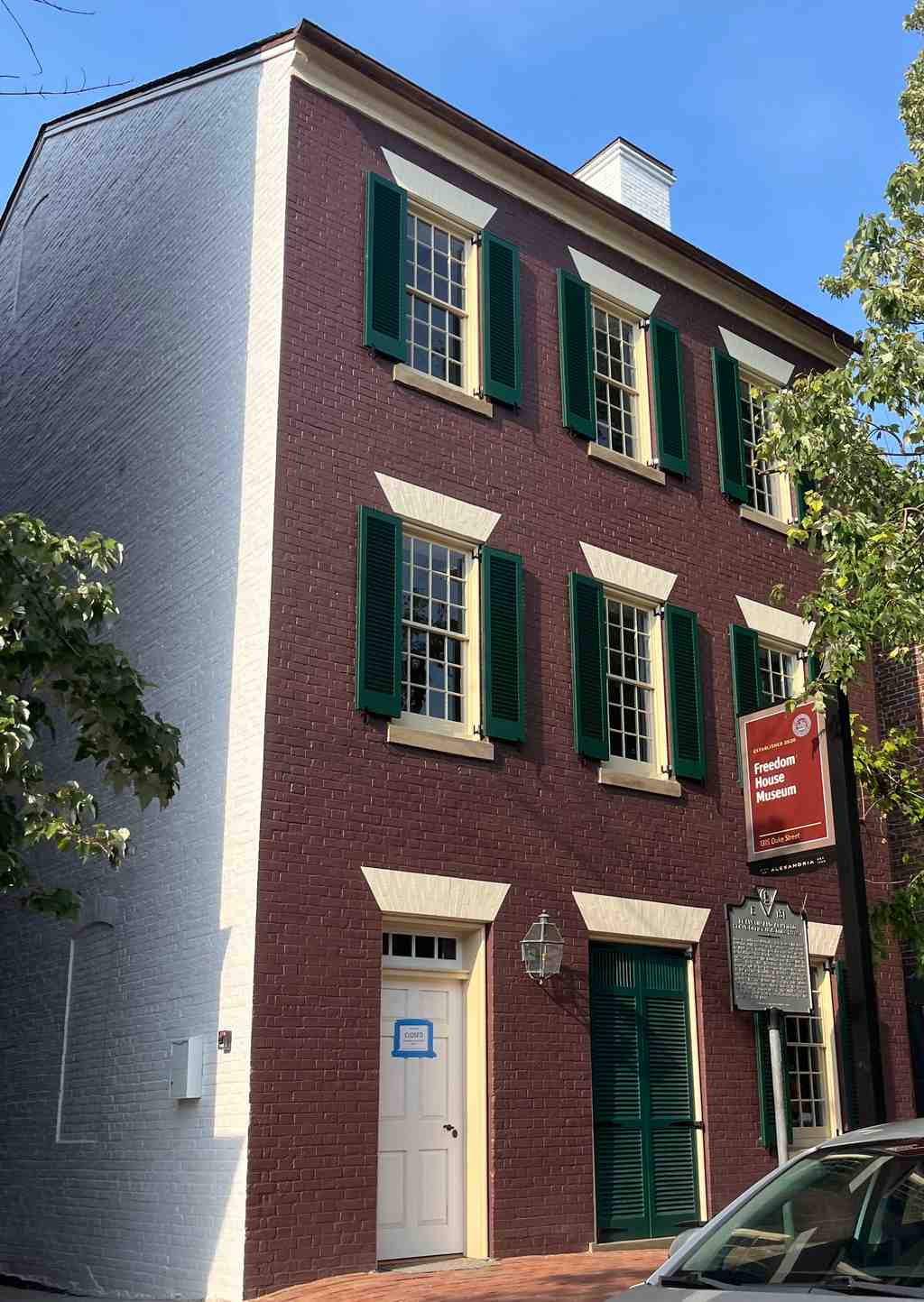
Look at the tall, three-story townhouse right in front of you, anchored by its dark red brick exterior, orderly rows of green shutters, and a simple white front door.
It looks like an ordinary, quiet historic home. But this building represents the dark duality of Alexandria, where everyday city life existed right alongside unimaginable cruelty. Behind this mundane facade was the epicenter of a massive human trafficking network. This was the headquarters of Franklin and Armfield, a firm that operated with ruthless, industrial efficiency to become the largest slave-trading company in the United States, tearing apart thousands of families for profit.
Starting in 1828, Isaac Franklin and John Armfield transformed this Duke Street property into a highly lucrative enterprise. They built high walls and interior chambers fitted with grated iron doors, turning a residence into a holding pen. Take a look at your screen to see an 1836 artwork illustrating the stark reality of those prison-like cages.
The financial magnitude of their operation was staggering. By 1832, this single business was so dominant that five percent of all commercial credit from the Second Bank of the United States... the nation's central federal banking system... was tied directly to them. A young woman sold here as a fancy maid... a sanitized term masking the horrific reality of sex slavery... could fetch two thousand dollars, equivalent to about eighty thousand dollars today.
Franklin and Armfield operated a fleet of ships, but they also orchestrated massive overland forced marches known as coffles. A coffle is a line of captives fastened together by chains or ropes. Once a year, John Armfield would sit on his horse at the front of a procession, armed with a gun and a whip. Behind him, hundreds of enslaved men, women, and children were chained together and forced to march over a thousand miles to markets in the Deep South. To hide the misery from onlookers along the turnpike, traders would force the captives to play banjos and sing, projecting a twisted illusion of compliance.
Later, a firm called Price, Birch, and Company took over the property. But when the Civil War broke out and the Union Army arrived in 1861, the dealers fled. They left behind only one old man, chained by his leg to the floor... a haunting symbol of the thousands whose names and futures were stolen here.
Yet, history has a way of inverting its darkest corners. Late in the war, the Union transformed this very building into L'Ouverture Hospital, named after the famed Haitian revolutionary. Black soldiers recovered from their wounds in the exact same rooms where their people had once been caged. You can check your app to see the before and after of this building's incredible transformation from a place of bondage to the Freedom House Museum.
You can step inside to explore the exhibits during their operating hours, which run Thursday through Saturday starting at eleven in the morning, and Sunday and Monday afternoons.
Let us take a moment of silence for the thousands who passed through these doors...
When you are ready, we will head to our next destination, Alfred Street Baptist Church, which is about a six-minute walk away.


