
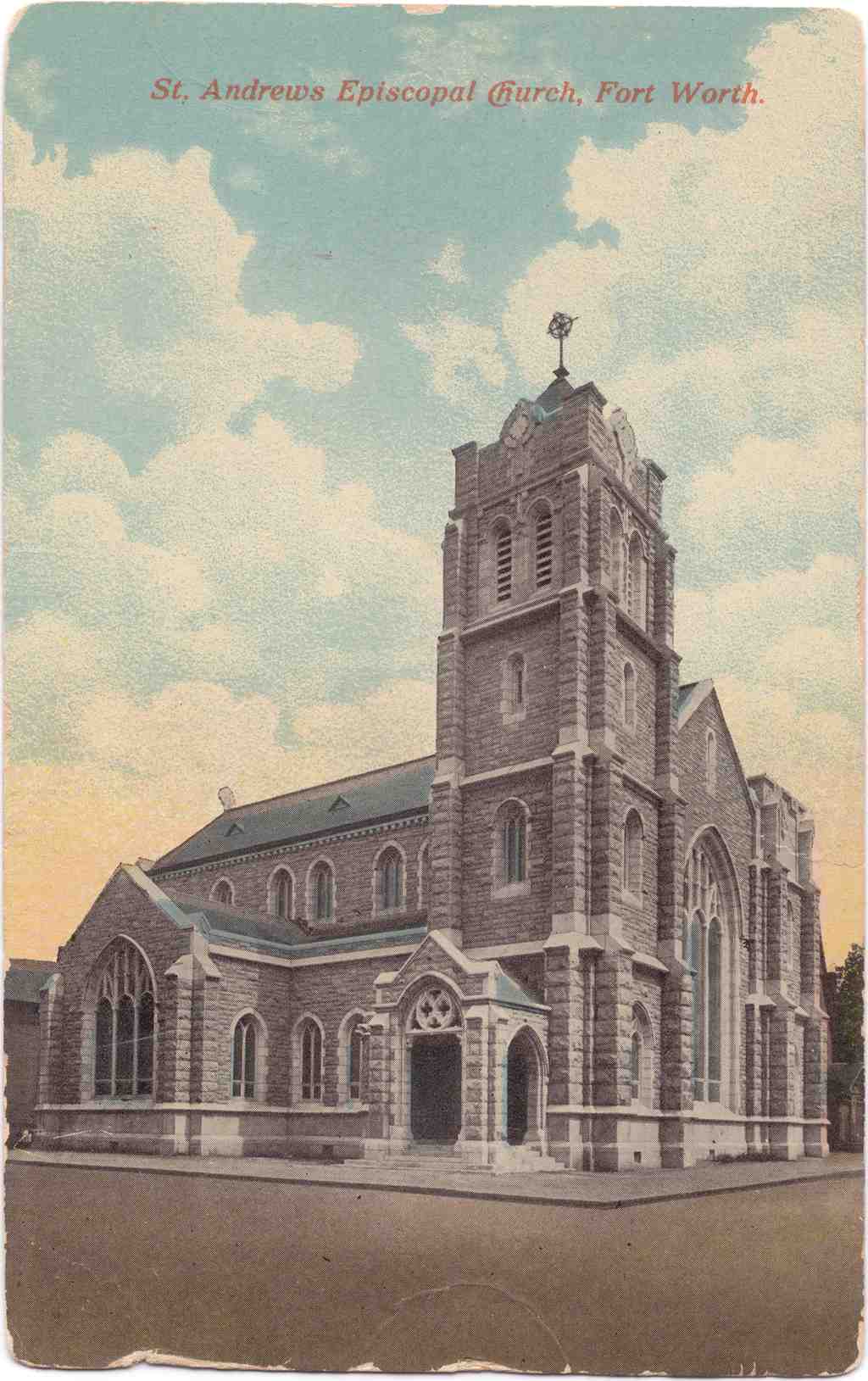
On your right, spot the gray stone Gothic church with a cross-shaped massing, two mismatched corner towers, and a big pointed-arch entry that looks ready to audition for an English village.
After the federal courthouse’s hard-edged authority just back there, St. Andrew’s feels like Fort Worth putting on a different kind of uniform... one stitched from persistence. The Episcopal story here starts with a single recorded service in 1860, but the real foothold didn’t arrive until 1875, when missionary bishop Alexander Charles Garrett organized a mission under the Rev. Edwin Wickens. The first services happened in the Tarrant County courthouse on March 17, 1875. Nothing says “holy ground” like a building designed for arguments.
And then comes my favorite origin detail: Garrett was fundraising from northeastern Episcopalians, and on a train ride a Connecticut clergyman heard the pitch, pledged $500-about $13,000 today-and asked that the new congregation be named for Andrew the Apostle. A whole church, essentially sponsored by a conversation in a railcar. Fort Worth has always been good at improvising.
The cornerstone went down in 1877; parish status followed in 1878. What you’re facing now is the later statement piece: a Perpendicular Gothic Revival design by Sanguinet & Staats, started in 1909 and dedicated May 12, 1912. Notice the gray dolomite stone-quarried in Carthage, Missouri-and those two towers on the northwest and southwest corners, deliberately different, like siblings who refused to coordinate outfits.
Inside, the nave-the long central hall where the congregation sits-leads toward the chancel, the area around the altar. A hand-carved wooden rood screen-basically an ornate divider-was made in Italy from Austrian oak. Most stained glass came from Jacoby Art Glass of St. Louis, while the rose window at the east end was made in England, showing Jesus calling Andrew and Peter.
St. Andrew’s also became a modern battleground for church identity. In 1983 it joined the newly formed Diocese of Fort Worth, known for theological conservatism. In 1997, rector Jeffrey N. Steenson signed the “First Promise” statement, arguing the Episcopal Church’s authority was “fundamentally impaired.” In 2008, the parish and diocese left the Episcopal Church, aligned briefly with the Anglican Church of the Southern Cone, and later helped found the Anglican Church in North America. Through it all, worship here stayed “low-church”-plainer, less ritual-heavy-and they use the 1928 U.S. Book of Common Prayer.
Now... turn your attention toward a site tied to one of downtown’s strangest architectural miscalculations, as we head to Landmark Tower, about a 5 minute walk away.




