
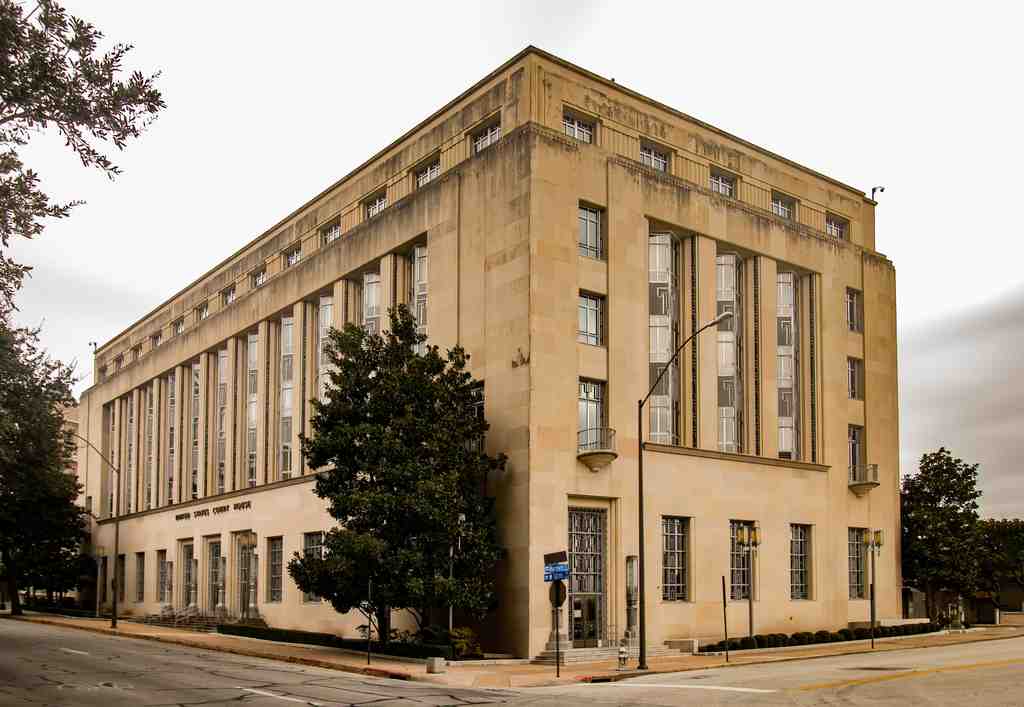
On your left stands a commanding five-story block of smooth limestone, instantly recognizable by the zig-zagging angle of its vertical windows and the sharp, geometric Art Deco carvings above the bronze entrance doors.
This building is a masterclass in how to project stability when the world feels like it is falling apart. It was commissioned in 1930, right as the Great Depression began to tighten its grip on the nation. Congress appropriated over one million dollars-roughly twenty-two million today-to get it built. But the real story here isn't just the money; it is the minds behind the masonry.
To create this, the government forced a collaboration between two men who occupied completely different stratospheres. On one side, you had Paul Philippe Cret. He was a French-born, Beaux-Arts master based in Philadelphia, famous for designing the Folger Shakespeare Library in Washington D.C. He dealt in grand, classical ideas. On the other side, you had Wiley G. Clarkson. Clarkson was a native Texan, a local workhorse who had already shaped much of Fort Worth's skyline.
It was a partnership that theoretically should have clashed. Instead, it produced something brilliant. They created a "Classic Moderne" hybrid. It possesses the strict, logical symmetry of Cret’s classical training-everything is perfectly balanced-but it is clothed in the sleek, streamlined geometry of the Art Deco era. Clarkson and Cret designed it to look like a "solid limestone mass," a psychological anchor for a city reeling from economic chaos. Even the details tell a story; the window spandrels feature moldings with Pueblo Indian motifs, replacing traditional classical scrolls with American geometry.
The creativity did not stop at the architecture. Inside, on the fourth floor, are murals painted by Frank Mechau. Now, Mechau was not your typical studio artist. He was a former railroad cowboy and a prize fighter who used his boxing winnings to pay for art school in Europe. A fascinating character. While his work in D.C. caused a national scandal for being too graphic, his murals here, like The Taking of Sam Bass, celebrate the raw "law of the Wild West" without the censorship controversies.
Since 2003, this courthouse has borne the name of Judge Eldon B. Mahon. He was a man who lived a life that mirrored the twentieth century-from a West Texas grocery clerk to a bomber pilot in the South Pacific. As a judge, he was known as a pragmatist, a "judge's judge" who preferred common sense to legal gamesmanship. His most defining moment was overseeing Flax v. Potts, the lawsuit to desegregate Fort Worth schools. It was a nineteen-year legal saga. By the eighties, Mahon realized that busing students across town was causing more harm than good, famously writing that the result was "simply not worth the ride." He ended the busing program and eventually declared the district "unitary," effectively ruling that the dual school system had been dismantled "root and branch."
It is a place where the weight of the law meets the weight of history. Our next stop is another place of worship, but one with a history of theological rebellion. Let’s head toward St. Andrew's Anglican Church.




