
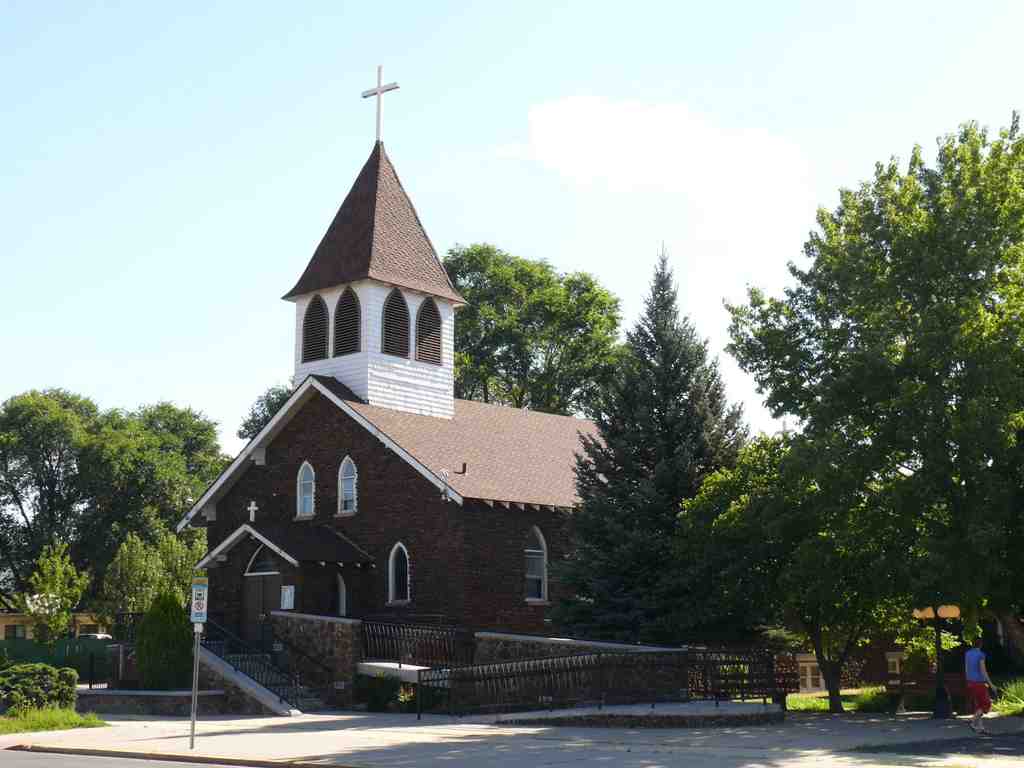
Look across the street at that dark, rugged stone building with its striking white square bell tower and steep pyramidal roof. This beautiful structure was actually born out of deep racial segregation in the 1920s. At the time, the city's main Catholic parish used reserved seating that favored white residents, leaving minorities feeling entirely unwelcome. Hispanic and Basque locals, like pioneer Emily Garcia Alonzo, were frequently turned away at the doors of Anglo establishments. To escape this mistreatment, the Hispanic community rallied to build their own sanctuary, with local sawmill workers funding the construction directly through their weekly payroll deductions.
The sheer scale of their hidden sacrifices is written in these walls. Families sold homemade tamales and enchiladas to buy that same dark volcanic malpais stone we saw at our last stop. The parishioners laid every heavy block by hand. The total cost was sixteen thousand dollars, which is about two hundred and seventy five thousand dollars today, aided by a land donation and a small religious grant. A prominent architectural firm had drawn up professional blueprints, but they were abandoned. Instead, Reverend Edward Albouy drew the plans himself and personally oversaw the heavy labor.
When the doors opened in 1926, the interior was completely bare. The only artwork was a solitary picture of Our Lady of Guadalupe, hand drawn by Jesus Gil, the devoted caretaker and bell ringer, until wooden statues were finally donated a decade later. Over the years, the basement became a vital hub for weddings and quinceañeras, traditional coming of age celebrations for fifteen year old girls, and was eventually renovated into an arts center honoring the neighborhood's roots.
This sacred space almost vanished recently. In 2016, police caught two men who had smashed the outdoor shrine, throwing statues into the street and starting a fire. The men confessed they caused the destruction and lit the blaze simply because they were freezing outside.
Though regular Sunday masses stopped in 1997, the church still glows with hundreds of paper lanterns for a special Mariachi Mass every December. Let us walk about eight minutes to our final stop, South Beaver Elementary School, where these painful lines of segregation were finally erased.




