
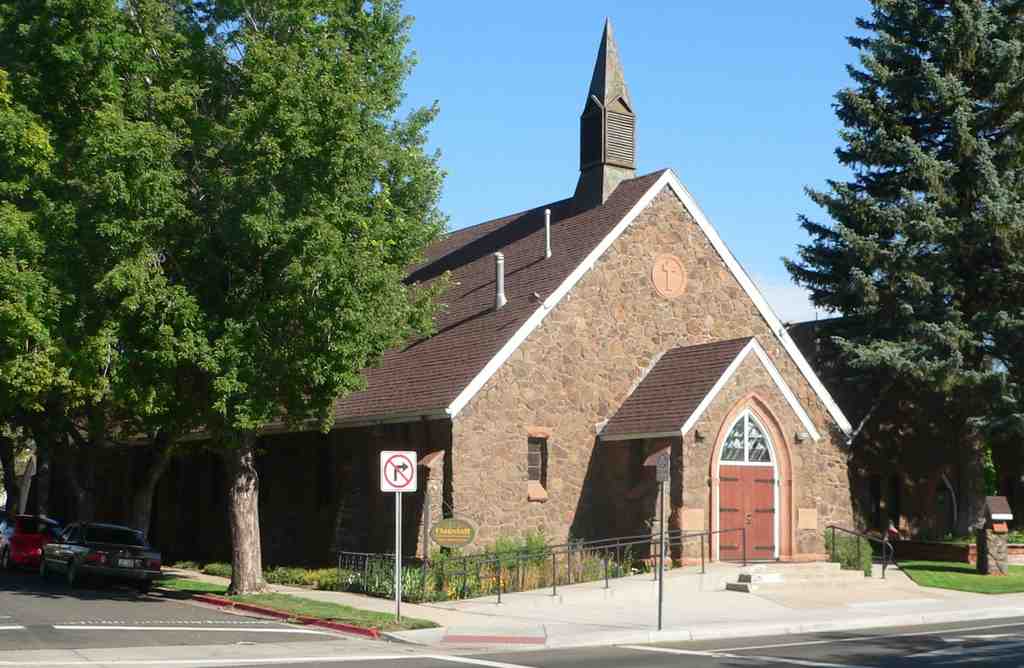
Look to your right for a striking church with a steeply pitched roof built from rough stone, easily spotted by its tall pointed steeple and a beautiful arched wooden doorway. This is the First Baptist Church, but its story actually begins on wheels!
Back in 1926, the congregation was known as the Glad Tidings Chapel Car, and it operated entirely out of a converted Pullman passenger railcar. Picture a dedicated teenager named Harrold Harper serving as the caretaker, carefully rubbing down the golden oak pews, dusting the fine Estey organ, and polishing the ornate pulpit inside a train car before every single service. Talk about devotion in a tight space!
Eventually, they decided to move their mobile church to a permanent location. When the congregation tried to haul the heavy railcar slowly down Beaver Street, the agonizing move was halted first by a sudden snowstorm and then by mechanical failures. It turned into a hilarious Flagstaff comedy, with residents entirely unsure if the church would ever actually reach its destination! They eventually outgrew the train car, which Reverend Dixon later dismantled by hand, pocketing a literal ton of brass screws in the process.
By 1939, this community forged ahead with unyielding spirit to build the permanent home you see right here. Designed in the Gothic Revival style, an architectural tradition known for steeply pitched roofs and tall pointed arches meant to draw the eye toward the heavens, it is deeply rooted in local earth. The volunteers built a rustic foundation of black malpais volcanic rock, and framed the edges with red Moenkopi sandstone. They finished it in just seven months! The project was saved by a final donation of one thousand dollars in 1939, which is about twenty-two thousand dollars today. Money was still so incredibly tight that when the church finally opened, they had no pews, no organ, and no bell!
This beautiful stone building shows exactly what a determined frontier town can achieve together. Now, we are going to visit another congregation nearby that built their sanctuary while facing much heavier social burdens. Let us take a short three minute walk over to Our Lady of Guadaloupe Church.




