
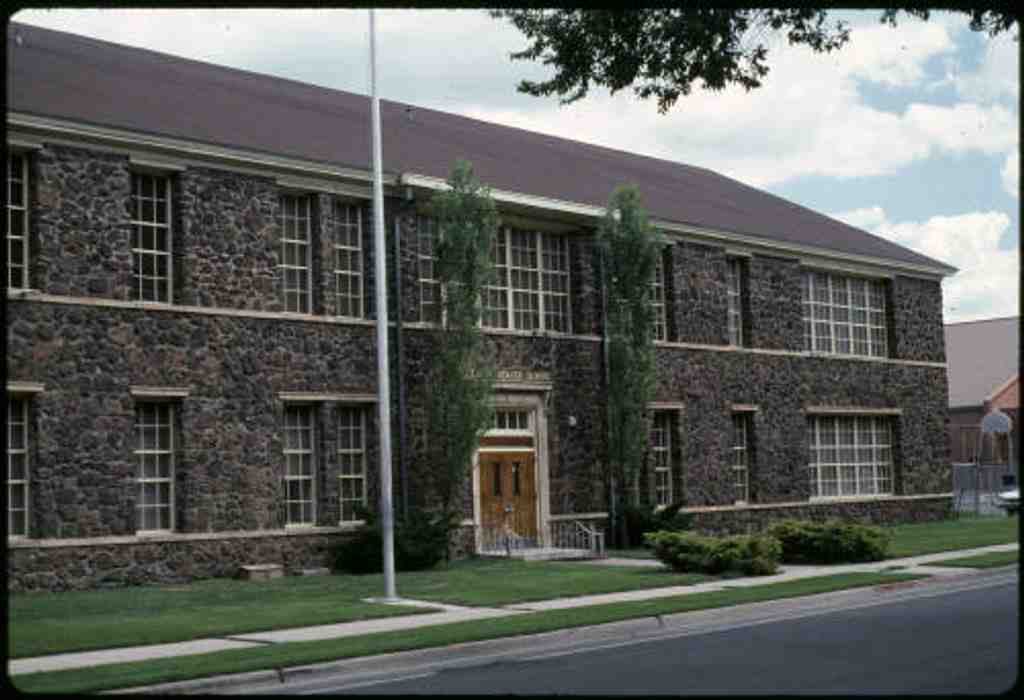
On your left look for a long two-story rectangular building constructed entirely of dark textured volcanic rock with a prominent central entrance featuring wooden double doors. Just eight minutes ago we were at Our Lady of Guadaloupe Church, which is exactly where this building's complex story begins.
Built in 1935 by federal relief programs, South Beaver Elementary was initially constructed as a segregated school for Hispanic students. Local resident Jesse Dominguez recalled the jarring transition, remembering how non-Anglo children from neighborhoods near the church were physically marched out of their old classrooms and relocated directly to this newly designated campus. The reality of racial segregation was incredibly harsh, but the Hispanic community immediately rallied to support their children.
The driving force behind creating this school was Dr. Ralph Oliver Raymond, a local physician who fiercely championed minority education. During historic snowstorms, he would personally deliver bags of beans and rice to the impoverished surrounding neighborhoods, embodying the kind of community action that ensured these families survived. Later, Native American children from the Navajo, Hopi, Havasupai, and Tohono O'odham nations were also integrated into these classrooms. These young students traveled from a federal dormitory, where they slept in large open wings filled with tightly packed bunk beds.
But here is where Flagstaff showed its true grit. In 1952, a full two years before the Supreme Court legally mandated school integration across the entire country, local leaders took decisive action. Superintendent Sturgeon Cromer and principal Wilson Riles proactively transferred African-American students from the closing Dunbar School right here into South Beaver to learn alongside the Hispanic students. It was an incredible, early triumph of integration. We see that same powerful, full-circle progress in a local educator named Mr. Garcia. His grandfather immigrated to work the local sawmills, and Garcia himself grew up facing the region's intense discrimination, yet he eventually returned to this exact building to serve as its principal.
For decades, the school thrived. They even partnered with Northern Arizona University to pioneer hands-on environmental science programs. Despite becoming the district's first magnet school, which is a public school that offers specialized courses to draw diverse students from across the city, a massive enrollment drop forced South Beaver to close in 2010.
That controversial closure broke deep, multi-generational community ties. Fortunately, the university purchased the property in 2015. Because the distinctive Malpais stone facade is listed on the National Register of Historic Places, the exterior must be strictly preserved.
Today, these enduring stone walls house an intensive program for adult English learners. From painful origins to a beacon of ongoing education, this neighborhood has relentlessly pushed forward through shared determination. As our tour concludes, take a moment to reflect on the incredible journey and the remarkably resilient people who forged the vibrant identity of Flagstaff.




