
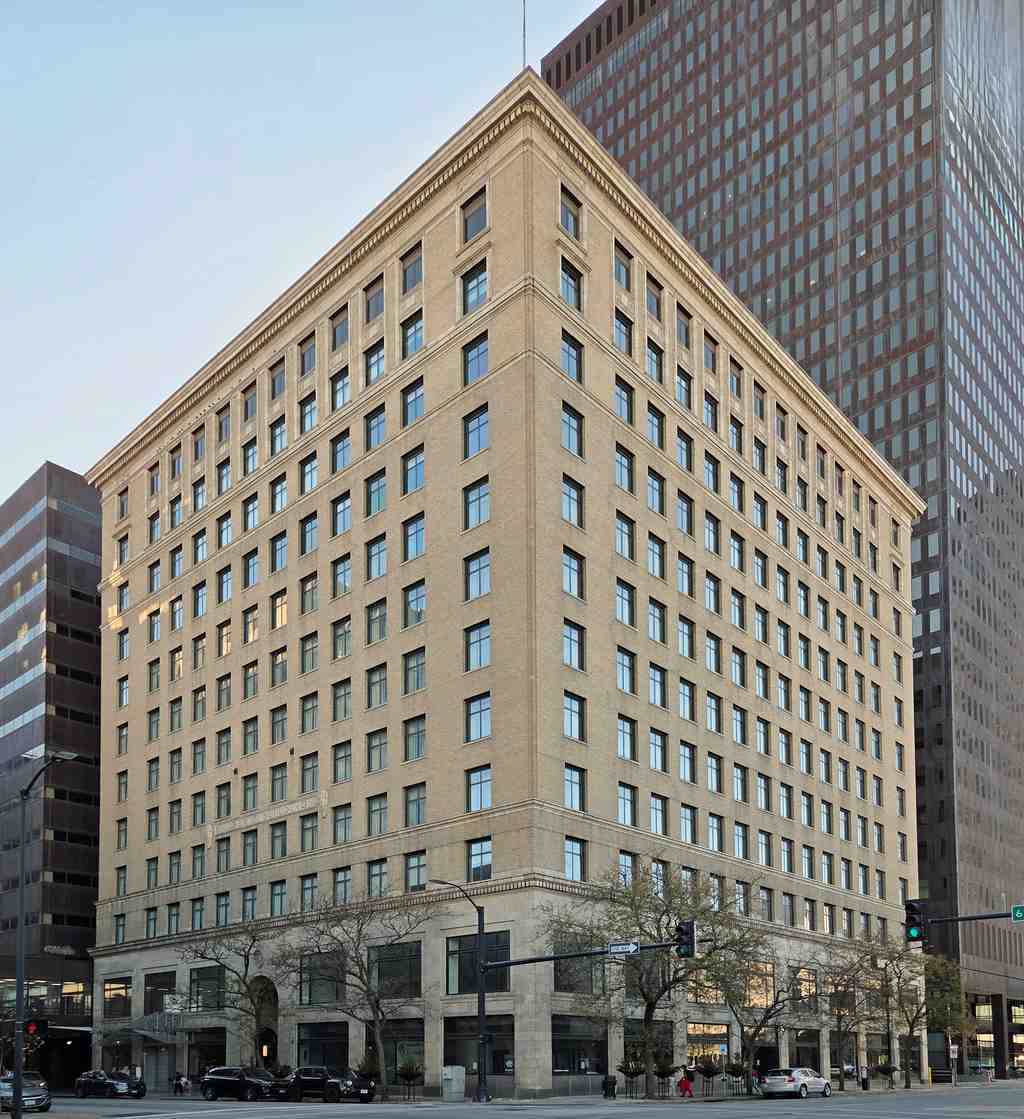
Look to your left and spot the rectangular, twelve-story tower featuring a solid limestone base, creamy yellow brick upper floors, and an ornate, overhanging roofline known as a cornice. Completed in 1924 for one million dollars, which is roughly eighteen million today, the Liberty Building is a classic example of the Chicago School architectural style. This design philosophy emphasizes a distinct base, middle, and top, and yes, it is another imposing structure by the prolific architectural firm.
It was originally built as the headquarters for Bankers Life Insurance, but the real action happened up on the twelfth floor. George Kuhns, the president of Bankers Life, was an avid long-distance radio fanatic. Back then, broadcasting was an expensive, untested frontier. Signals were incredibly faint, and the static was heavy. Kuhns noticed that when people managed to tune into distant, crackling broadcasts, they would constantly ask, who is it. Inspired, he secured the call letters W H O and launched a 500-watt station right from the top of this building in April 1924.
The station was a genuinely quirky operation at first. Broadcasters would playfully identify themselves on air by announcing, this is W H O, who, Banker's Life, Des Moines, and they literally played the song Who from the musical Sunny as their daily theme. But Kuhns's vision quickly paid off. By 1927, the engineers had amplified their signal to 5,000 watts, and W H O became a crucial NBC network affiliate broadcasting from dawn until midnight. The station transformed into an absolute lifeline for rural Iowans who relied heavily on it for agriculture reports, weather updates, and entertainment.
But the invisible airwaves were rapidly becoming a crowded, unregulated mess. In 1928, a newly created government agency called the Federal Radio Commission stepped in to police the chaos, sparking the W H O Radio frequency battle. The commission ordered W H O into a bitter, mandatory frequency-sharing arrangement with W O C, a station in Davenport owned by a chiropractic college.
It was an absolute disaster of a broadcasting marriage. One week, W H O was allowed to broadcast during the day while Davenport took the night shift, and the next week, they were forced to completely swap schedules. Both stations fiercely protested having their broadcast hours suddenly slashed in half. The logistical nightmare of alternating a single frequency across the state created massive friction, eventually driving Bankers Life completely out of the radio business. They simply threw in the towel and sold W H O in 1930 to the Palmer family, the very people who owned the rival Davenport station.
As an aside, you might hear local legends claiming that future U.S. President Ronald Reagan broadcasted his early sportscasts from this very roof. He did indeed work for W H O starting in 1934, but the station had already moved its studios to another building two years prior. Reagan never actually called a game from the Liberty Building, despite what the stubborn rumors insist.
Following a massive modern renovation, the building now houses a hotel and condominiums, carefully preserving historic details like the original terrazzo floors, which are beautifully durable surfaces made of marble chips set in concrete and polished smooth.
We have spent enough time focused on the high-stakes airwaves of the early twentieth century. Now, we are going to shift our focus from the invisible radio signals above us to the literal and spiritual foundations of the city. St. Ambrose Cathedral is just a two-minute walk away. Let us head over.




