
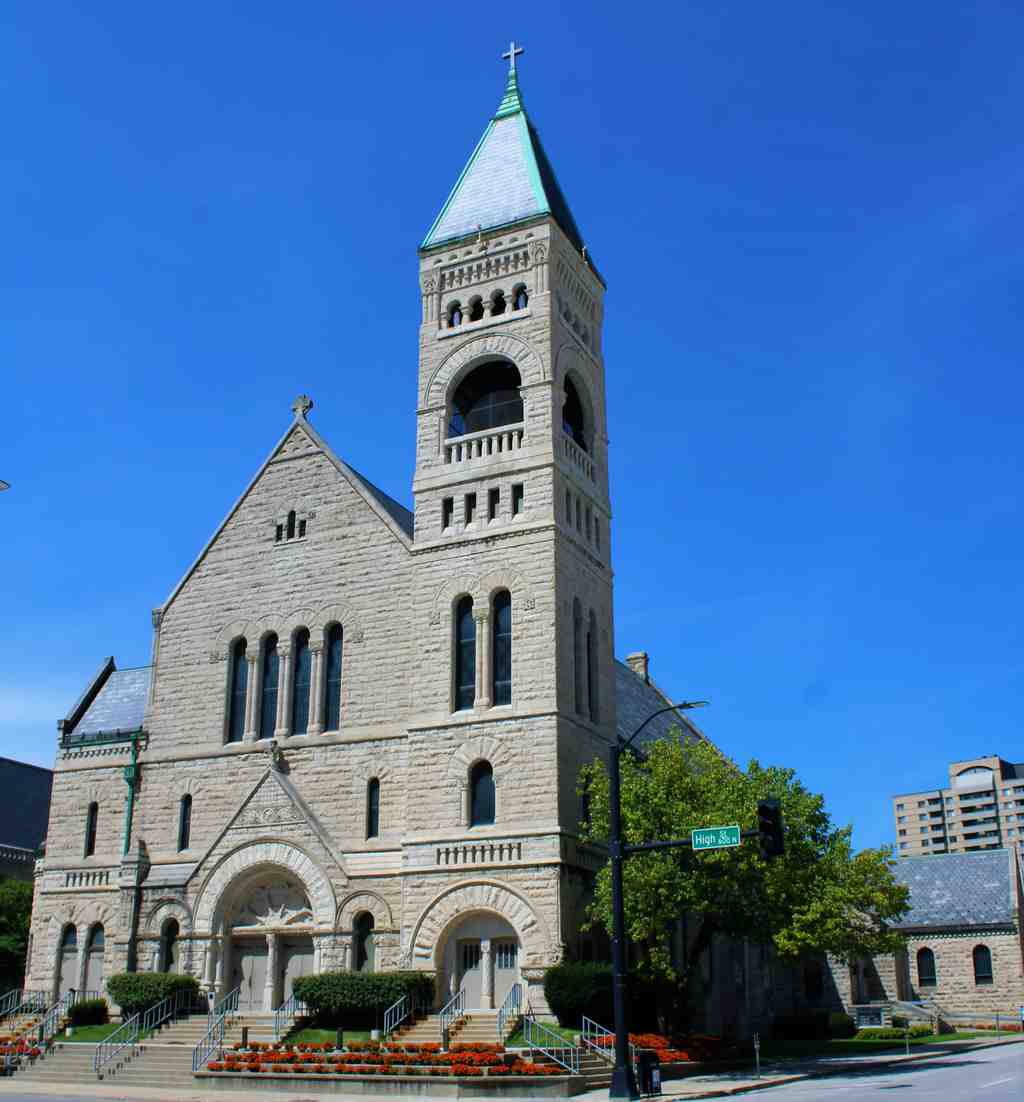
On your left stands Saint Ambrose Cathedral, a massive Bedford limestone building defined by its deeply recessed arched entrance and a towering square bell tower capped by a green pyramid shaped spire.
Before this grand stone structure existed, the Catholic footprint in Des Moines was a bit more rustic. Back in eighteen fifty one, the very first Mass in the area was celebrated inside a humble log hut at the original Fort Des Moines. It was a rough military outpost where a traveling priest from Ottumwa ministered to a handful of pioneers on the edge of the frontier. That small gathering laid the groundwork for a parish that would eventually anchor the entire city block.
Everything changed a decade later with the arrival of Reverend John F Brazill, a frontier priest with a highly unusual and aggressive appetite for real estate. He bought up massive tracts of land in the rapidly expanding state capital, a bold financial gamble that ultimately secured this prominent location at Sixth and High Streets for the future diocese.
Brazill cultivated serious political connections and operated more like a visionary developer than a traditional pastor. By the time of his death in eighteen eighty five, he had amassed real estate worth two hundred and fifty thousand dollars, which equals about eight million dollars today. His audacious land grabs provided the immense wealth needed to fund the parish's early expansion. With that war chest, the church hired Chicago architect James J Egan in eighteen ninety to design the cathedral before you.
Egan chose the Romanesque Revival style, an architectural movement that mimics the heavy stone walls and rounded arches of medieval churches in southern France. The construction cost one hundred and twenty thousand dollars, roughly four million dollars today. The engineering inside is genuinely impressive. Egan designed the interior as a massive, unobstructed expanse. The ceiling is a barrel vault, essentially a continuous curved arch, rising fifty feet into the air without a single pillar to hold it up or block the view of the altar.
Of course, maintaining a historic building rarely goes perfectly. In the nineteen seventies, the church underwent a renovation to modernize the interior. They installed a new cathedra, which is the official bishop's throne, but they set it against a stark, rectangular wooden backdrop. It clashed horribly with the graceful Romanesque arches, looking like a forced, awkward imposition of modern design. Thankfully, a restoration in two thousand twenty three removed the drab wood and integrated a new architectural design that actually matches the historical sanctuary.
Beyond architecture, the parish has continuously adapted to the world around it. Following the fall of Saigon in nineteen seventy five, Iowa unexpectedly became a national leader in resettlement. The cathedral became a vital hub, welcoming waves of Vietnamese, Lao, and Hmong refugees. By two thousand and eight, a massive influx of refugees from Myanmar arrived. The Burmese community grew so rapidly that they divided into three distinct groups, allowing hundreds of parishioners to pray and celebrate Mass in their native languages.
It is quite the trajectory for a congregation that started in a wooden shed. From aggressive pioneer land deals to an international sanctuary, this building represents a century and a half of quiet audacity. We are going to continue exploring the gambles of early religious history at our next stop. The Cathedral Church of Saint Paul is just a five minute walk away.




