
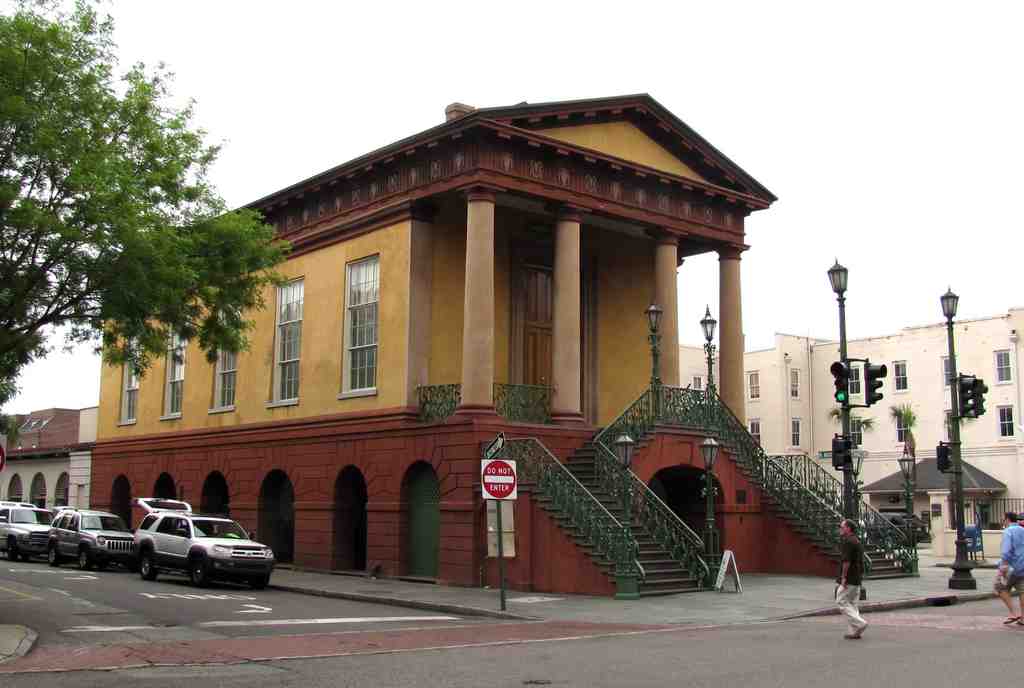
Right in front of you stands the City Market’s grand Market Hall-a bold ochre-yellow building perched on a high red brick base, with a dramatic staircase divided by swirling green ironwork and four enormous columns holding up a triangular Greek temple-like roof; just look for those columns and the double stairs at the corner of Meeting Street and you can’t miss it.
Take a deep breath and let yourself be whisked back to Charleston’s bustling days of old, when this market was alive with the clatter of wagon wheels and the cheerful shouts of vendors hawking everything from fresh beef to vegetables. The City Market was born out of necessity after the old Beef Market-yes, a building entirely dedicated to meat-went up in flames in 1796. Instead of just rolling over and ordering takeout, the city decided to set up shop along a marshy strip of land donated by Revolutionary War hero Charles Cotesworth Pinckney and his pals. But there was a catch: this land could only ever be used for a market, or else the city would have to give it back. Talk about pressure!
So, between the 1790s and the early 1800s, a patchwork of one-story wooden sheds began stretching from these very stairs down to East Bay Street, making up one of Charleston’s lengthiest landmarks at over 1,200 feet long-just try running that distance with your grocery cart! At its heart is Market Hall, the impressive building before you, added in the 1840s, designed by architect Edward B. White, who took inspiration from Greek and Roman temples. The four Roman Doric columns and the elevated portico-reached by that dramatic double staircase and spruced up with intricate iron railings-were meant to make every visitor feel like shopping was a truly noble pursuit. On top of that, if you squint, you might spot decorative skulls and rams’ heads up in the stone carvings-a nod to the building’s original job as a meat market. Don’t worry, there’s no surprise beef hiding up there today!
But the market was more than meat. It was a riot of smells, sights, and sounds, separated into sections for beef, fish, farm produce, and even flowers-and at times, vultures wandered in, gobbling up scraps for a free meal. In fact, vultures were so useful at cleaning things up, the city passed actual laws to protect them. Imagine a city meeting: “Let the record show, the vultures are now official city employees!”
The energy here was contagious-locals, whether wealthy planters or working-class families, all mingled as they shopped, swapped gossip, and swapped food. Friends met for drinks and games; the market buzzed with both commerce and camaraderie. Through the centuries, this space turned into Charleston’s social nerve center. But don’t mix it up with the Old Slave Mart nearby-a common mistake! No enslaved people were ever sold right here at the City Market, but it is easy to see why the story gets tangled.
Disaster, however, seemed to have a taste for the market: the original headhouse burnt down in 1838, leaving the city scrambling, and just a century later, tornadoes ripped across the sheds, sending market vendors and their goods tumbling into the chaos. There was a time in the early 1900s when the city nearly razed these sheds to the ground to plant gardens or even set up freight stations. Thankfully, local preservationists rallied to save the market-sometimes with creative suggestions like turning the market sheds into bathhouses! In the end, city leaders compromised: the eastern sheds became a bright, inviting covered walkway for all to enjoy, meat stalls congregated on the north, and fruit sellers on the south.
Market Hall itself kept reinventing. During the Civil War, the upper room became a military recruiting post, and later, even the mayor worked here when City Hall was out of commission. From 1899 on, the United Daughters of the Confederacy ran a museum upstairs filled with artifacts from Charleston’s Confederate years. In modern times, after a nasty run-in with Hurricane Hugo-who rudely tore off part of the roof-the Hall was restored and proudly sported its original, rather bold, ochre-and-green color scheme, much to the shock of locals who preferred things a little less…sunny.
Today, instead of cows and farm produce, you might spot Gullah basket weavers and artists selling sweetgrass baskets, jewelry, and regional crafts. Just imagine the ghosts of all those 19th-century characters, peeking out from the shadows to see what strange treasures today’s vendors have brought to these historic stalls. And if you listen closely, you might even hear faint echoes of wagon wheels on cobblestone and lively market calls floating on the breeze.
You’re at the living, beating heart of historic Charleston-where the echoes of centuries never really die down.


