
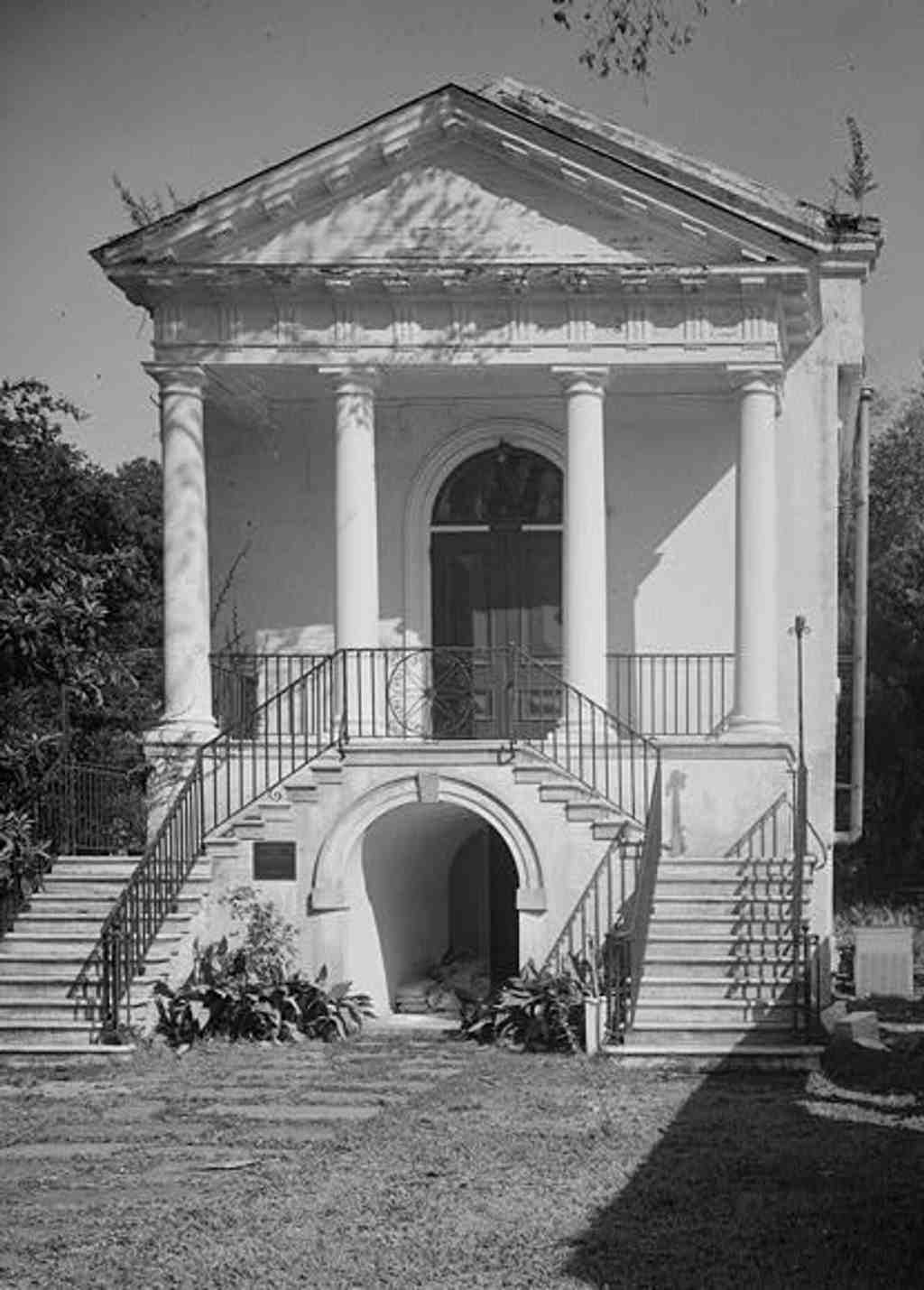
To spot the Circular Congregational Church’s historic parish house, look for a small, white, Greek Revival building with a grand entrance at the top of two elegant curved staircases and four tall columns supporting a triangular pediment-it stands just ahead of you, a stately and serene sight amidst the trees.
Now that we’re here, let’s step back in time and imagine Charleston as it was in the late 1600s-dusty roads, horse-drawn carriages, and a patchwork of settlers from England, Scotland, and France, all with very different ideas about faith. This site was chosen by those early “dissenters,” which is just a fancy way of saying folks who didn’t want to pray the way the English authorities did! They built their original Meeting House right here at the edge of the new colony. In fact, Meeting Street gets its name because it literally led to this meeting house, and the word “church” wasn’t quite their style back then-they tried out names like Presbyterian, Congregational, and Independent, sometimes all at once. It’s a bit like when you can’t decide what nickname you want to go by in middle school!
Through hurricanes, wars, and even lost paperwork (thanks to a 1713 hurricane that sent all the early records flying into the sea), the congregation stuck together. During colonial times, if you were a moderate dissenter looking for a community, this was the place. But their independence had a price: the church became a hotbed for revolutionary ideas, and Reverend William Tennent was known to stir up trouble-not with a sword, but with words about freedom. He risked his life crisscrossing the backcountry, rallying people for the American cause. Then came the Revolutionary War and, like a scene out of an action movie, a British cannonball struck the church! The British occupied Charleston and turned this sacred space into a hospital or warehouse, smashing the pews and sending 38 heads of families off to prison as punishment for their loyalty to liberty. Families left behind struggled, and the church had no minister-just memories and hope.
After the war, the congregation set to rebuilding, though not just in spirit but with bricks too! By the late 1700s, they were so numerous that they opened a second meeting house nearby, alternating services between their two sanctuaries depending on the day. But in 1804, a woman named Martha Laurens Ramsay suggested something bold-a circular sanctuary. Robert Mills, Charleston's most famous architect (you might know him best for that little project in Washington, D.C. called the Washington Monument), designed a revolutionary new round church here in 1818. Seven great doors, 26 windows, and enough room for 2,000 worshippers: it was the first major domed building in all of North America! Before the days of Yelp, locals couldn’t resist poking fun at its lack of a steeple, inventing songs to poke fun at the congregation’s “circle without a point,” until 1838 when the tallest steeple in town was added-take that, critics!
The golden age of the Circular Church was dazzling. Members included everyone from governors and newspaper editors to enslaved and poor worshippers, all united under this innovative roof. The city’s first Sunday School started here, and so did organizations like the Charleston Bible Society. But history is never a straight line, and in 1861, a fire swept across Charleston, leaving only charred walls where the church once stood. The Civil War followed, and afterward, Black members formed their own Plymouth Congregational Church, forever changing the community’s fabric. For years, only ruins stood as a testimony to the fiery night that changed everything.
The beautiful parish house you’re looking at now is a Greek Revival jewel, designed by Robert Mills, and declared a National Historic Landmark in 1973. But the main church you see today was built in 1890, in a style called Richardsonian Romanesque-that’s “fancy old stone with curves” if you’re not an architect. Despite the name, it’s not perfectly round anymore, but everyone still calls it the Circular Church, a nod to its legendary shape and all the wild, winding stories it holds.
Today, the church stands for radical, welcoming Christianity and keeps Charleston ahead of its time. They were the first in the city to open a marriage and family counseling center and still open their doors to everyone in need-no matter what name you go by or which way you circle 'round. So take a deep breath and soak up the echoes of revolution, resilience, and a bit of architectural mischief-this is one Charleston story that has come full circle, again and again. Ready to take the next steps on our adventure?
Fascinated by the beliefs and service, buildings or the gallery? Let's chat about it


