
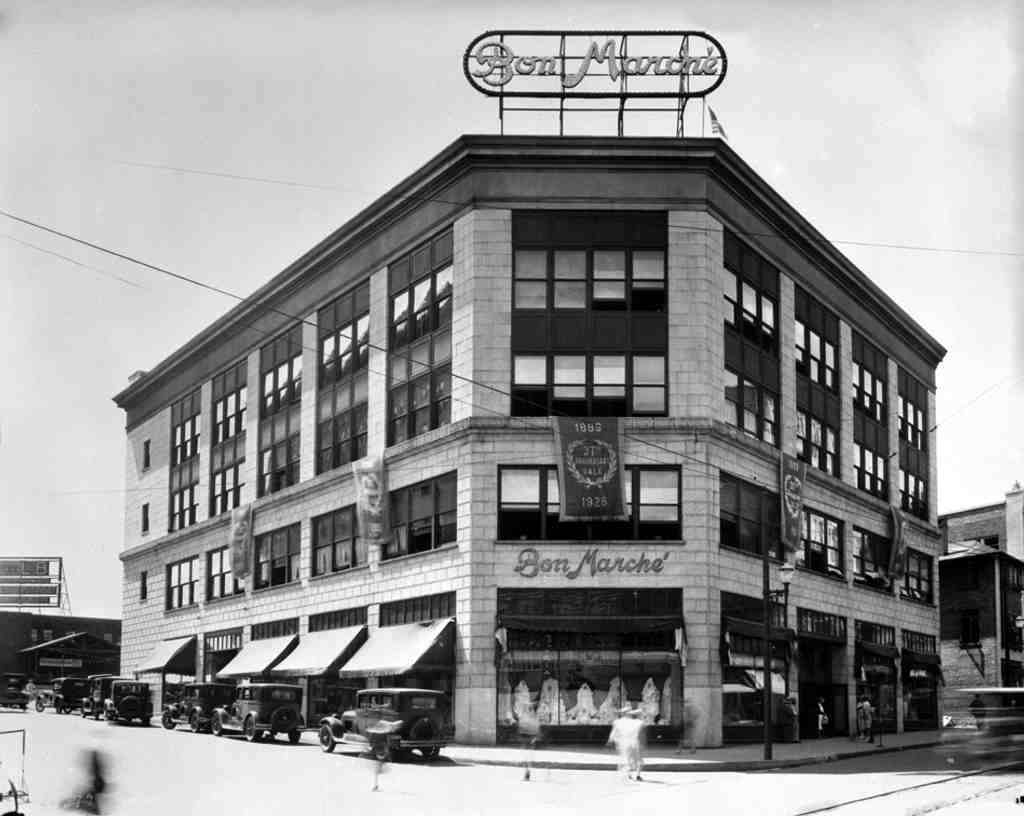
On your right, look for a pale stone and brick Beaux-Arts block with a broad rectangular face, tall rows of windows, and a strong cornice capping the roofline.
In nineteen twenty-three, E. W. Grove commissioned this building for Solomon Lipinsky, several years before Grove turned to the nearby Grove Arcade. Architect W. L. Stoddart drew it with the confidence of someone who also shaped Asheville’s Battery Park Hotel and Vanderbilt Hotel. Lipinsky, a prominent Jewish businessman and community leader, needed more room for his growing store, which had begun downtown in the eighteen nineties as Lipinsky and Ellick.
The name Bon Marché means “the good deal” in French, borrowed from the famous Paris department store. And for Asheville families, this place became exactly that kind of trusted landmark. For nearly ninety years, until nineteen seventy-eight, Bon Marché held on as the longest-running department store in the city’s history. Thomas Wolfe loved it so much he said losing it would feel almost like Beaucatcher Mountain being ripped from the landscape.
In nineteen thirty-seven, the store moved across the street, and Ivey’s took over here. Decades later, renovators carefully removed some later additions, including a semicircular awning from the nineteen fifties and sixties that clashed with the original design. If you want, take a quick look at the before-and-after image in the app... it shows the old store becoming the Haywood Park Hotel while the facade still keeps its dignity. The Haywood Street Redevelopment Corporation completed that conversion in nineteen eighty-eight, and today the building belongs to Historic Hotels of America.
If you want to step inside, the venue generally opens from ten in the morning to seven, with Friday and Saturday hours extended until nine.
This building feels like downtown Asheville remembering itself. When you’re ready, continue on and let the next stop add another layer to the story.




